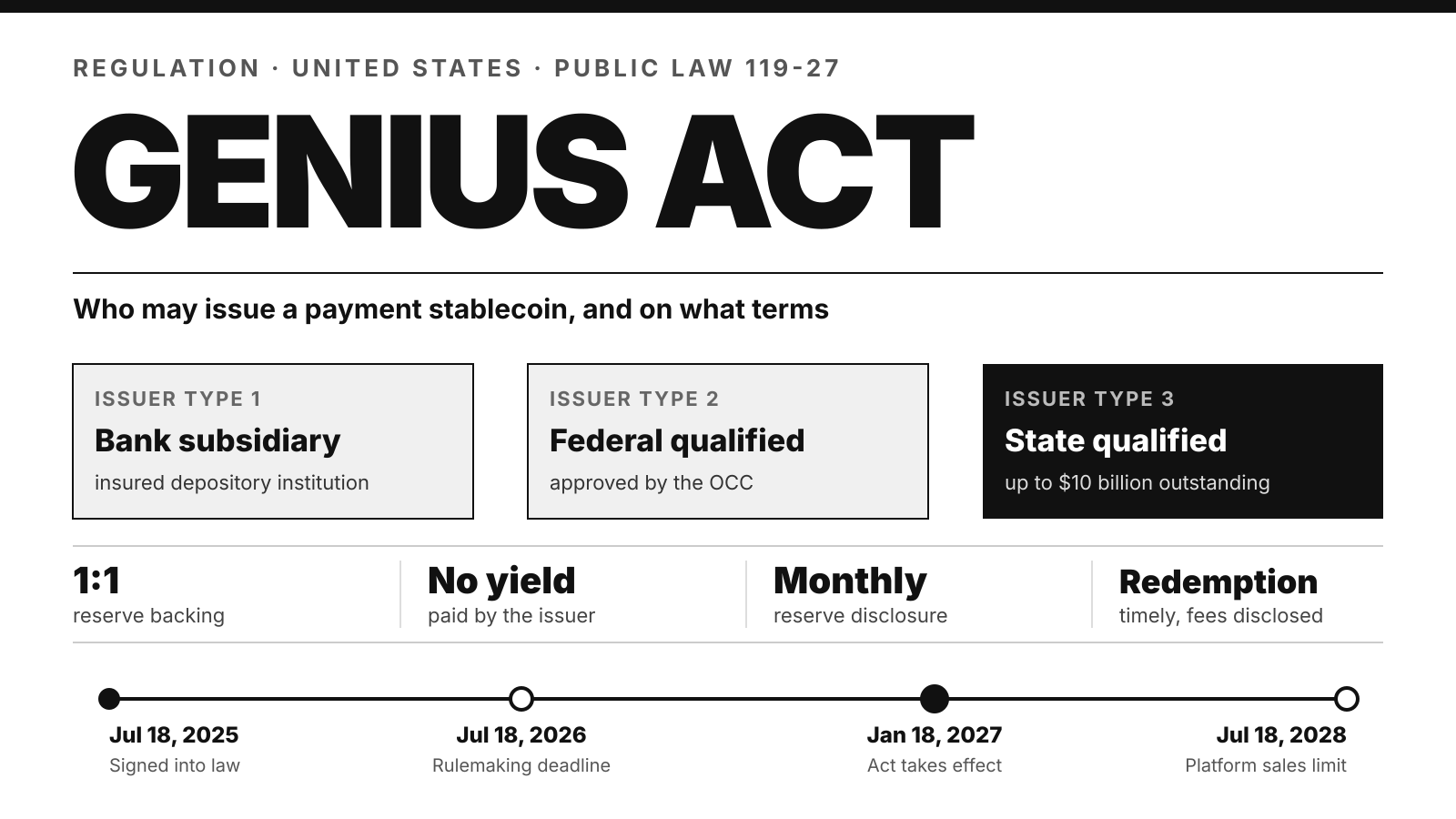
The GENIUS Act is the US federal law that decides who may issue a payment stablecoin in the United States and on what terms. It limits issuance to three kinds of approved US issuers, requires every token to be backed at least one to one by cash and short-dated Treasury assets, bans issuers from paying interest, and requires monthly public reports on reserves.
It became Public Law 119-27 on July 18, 2025, according to the bill record on Congress.gov, and the Office of the Comptroller of the Currency says it takes effect on January 18, 2027.
This explainer covers what counts as a payment stablecoin, who can issue one, the reserve and redemption rules, what issuers may not do, and the dates that matter for holders and platforms. For the agencies’ own rules, see our reports on the OCC’s final rule and the Federal Reserve’s proposals.
What the Act calls a payment stablecoin
Section 2 defines a payment stablecoin as a digital asset that is, or is designed to be, used as a means of payment or settlement, whose issuer is obliged to convert, redeem or repurchase it for a fixed amount of monetary value, and which the issuer says will keep a stable value relative to that amount.
Three things are excluded from the definition:
- a national currency;
- a deposit, “including a deposit recorded using distributed ledger technology”, so bank tokenized deposits fall outside it;
- a security under the federal securities laws.
Who may issue one
Section 3 makes it unlawful for anyone other than a permitted payment stablecoin issuer to issue a payment stablecoin in the United States. A permitted issuer must be formed in the United States and must be one of three types:
| Issuer type | What it is | Primary federal regulator |
|---|---|---|
| Bank subsidiary | A subsidiary of an insured depository institution, approved under section 5 | The parent bank’s federal banking agency (NCUA for credit unions) |
| Federal qualified issuer | A nonbank entity, uninsured national bank or federal branch approved by the OCC | OCC |
| State qualified issuer | An issuer approved by a state regulator | State regulator, with federal oversight above $10 billion |
A state qualified issuer with no more than $10 billion of its stablecoin outstanding may stay under a state regime, but only if that regime is certified as “substantially similar” to the federal framework. Above $10 billion, the issuer must move to joint federal supervision within 360 days or stop issuing new coins until it is back under the threshold, unless its federal regulator lets it remain solely state-supervised.
Regulators must decide on an application no later than 120 days after it is substantially complete (section 5). Knowingly issuing without approval can bring a fine of up to $1,000,000 per violation and up to five years in prison.
Reserves: one to one, short and liquid
Section 4 requires a permitted issuer to hold identifiable reserves of at least one dollar for every dollar of stablecoins outstanding. The reserves may consist only of:
- US coins and currency, or balances at a Federal Reserve Bank;
- demand deposits, or deposits withdrawable on request, at insured depository institutions;
- Treasury bills, notes or bonds with a remaining maturity of 93 days or less, or issued with a maturity of 93 days or less;
- overnight repurchase and reverse repurchase agreements backed by Treasuries, under conditions the Act sets out;
- shares of registered government money market funds that invest only in those assets;
- other similarly liquid federal government-issued assets approved by the regulator;
- any of these in tokenized form, if it complies with applicable law.
Reserves may not be pledged, rehypothecated or reused, except for narrow purposes such as margin on the permitted repos, standard custody, or raising cash for redemptions through cleared or pre-approved repo. For how issuers spread cash across banks, see stablecoin reserves in bank deposits.
Redemption and monthly disclosure
The issuer must publish a redemption policy with clear procedures for timely redemption. Only a state regulator, the FDIC, the OCC or the Federal Reserve can impose discretionary limits on timely redemptions. All fees for buying or redeeming the coin must be disclosed in plain language, and they can be changed only with at least seven days’ notice to consumers. The Act does not set a redemption deadline in days; our redemption explainer shows how issuers handle it today.
Every month the issuer must publish on its website the total number of coins outstanding and the amount and composition of its reserves, including the average tenor and the geographic location of custody for each category. A registered public accounting firm must examine each month-end report, and the chief executive and chief financial officers must certify its accuracy to the regulator. Knowingly certifying a false report is a criminal offence. An issuer with more than $50 billion outstanding that is not already an SEC reporting company must also publish audited annual financial statements.
What an issuer may not do
- Pay interest or yield. No permitted or foreign issuer may pay a holder “any form of interest or yield (whether in cash, tokens, or other consideration) solely in connection with the holding, use, or retention” of the stablecoin.
- Claim government backing. Payment stablecoins are not backed by the full faith and credit of the United States, not guaranteed by the government and not covered by FDIC or NCUA insurance, and it is unlawful to say they are.
- Use misleading names. Names may not combine terms such as “United States” or “USG”, and marketing may not suggest the coin is legal tender or government-approved. A currency abbreviation such as “USD” is allowed.
- Run unrelated businesses. Issuers are limited to issuing and redeeming coins, managing reserves, custody, and activities that directly support those, unless their regulator authorizes more.
Issuers must also have the technological capability to comply with lawful orders, which the Act defines to include orders to seize, freeze, burn or prevent the transfer of their coins. Our explainer on whether USDT can be frozen shows how issuers already use those controls.
What holders get in a failure
The Act gives holders first claim on the required reserves if a permitted issuer becomes insolvent. Their claims rank ahead of the issuer’s other creditors, shared ratably among holders. If the reserves fall short of what the Act required, the remaining holder claims get first priority against the rest of the estate, to the extent of that shortfall. A custodian holding stablecoins for customers must also give those customers priority over its other creditors.
Platforms and foreign issuers
From three years after enactment, which is July 18, 2028, it becomes unlawful for a digital asset service provider, such as an exchange or custodian serving US customers, to offer or sell a payment stablecoin in the United States unless a permitted issuer issued it. The Treasury may create limited safe harbors.
A foreign issuer’s coin can stay available only if the issuer has the technological capability to comply with US lawful orders, and does comply, and only within the reciprocal arrangements the Act lets the Treasury set up for comparable foreign regimes. Our comparison of USDT, USA₮ and USDT0 covers one issuer’s response. For the EU, Hong Kong and Canadian approaches, see MiCA, the Hong Kong stablecoin license and Canada’s Stablecoin Act.
The dates that matter
| Date | What happens |
|---|---|
| July 18, 2025 | The Act becomes Public Law 119-27 |
| July 18, 2026 | One-year deadline for regulators and the Treasury to issue implementing rules (section 13) |
| October 21, 2026 | The OCC announces its final rule |
| January 18, 2027 | The Act and the OCC rule take effect |
| Up to 12 months from the effective date | Regulators may waive requirements for bank subsidiaries and federal qualified issuers with applications pending (section 5) |
| July 18, 2028 | Platforms may no longer offer or sell payment stablecoins from unapproved issuers to US persons |