Yes. Both USDT and USDC can be frozen. Tether and Circle have written the power into their terms, and the token contracts they deployed include functions that stop a listed address from moving the token. What differs is who can trigger a freeze, what the issuer may do afterward and how the holder can contest it.
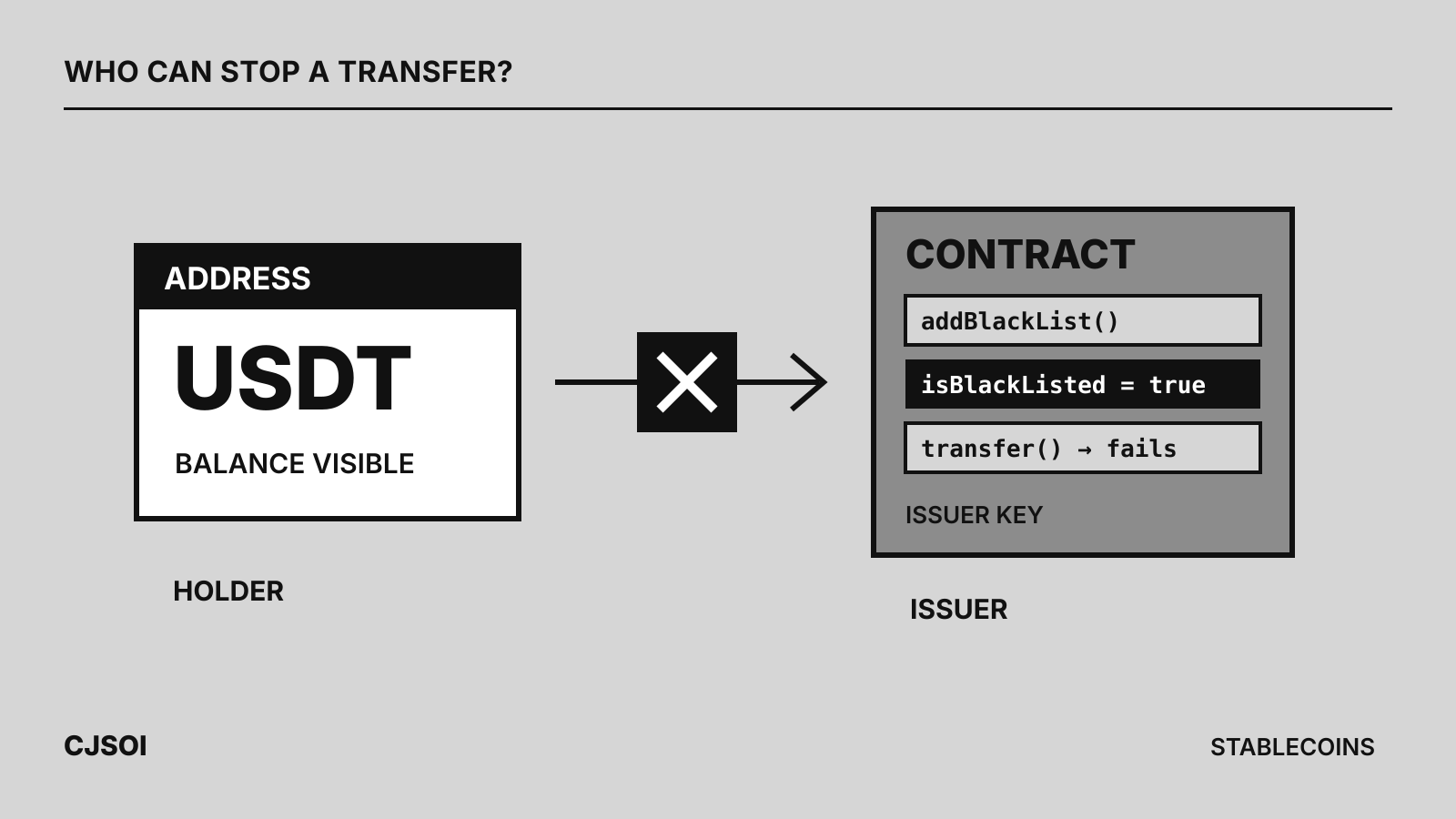
A freeze does not erase the balance. The tokens stay visible on the blockchain explorer, but transfers out of the blocked address fail. Whether the holder can later recover the value or redeem it for dollars depends on the issuer’s terms and any legal process.
What a freeze is, technically
A stablecoin is a smart contract that keeps a ledger of balances. For a centrally issued token, the issuer controls administrative keys in that contract.
Tether’s verified USDT contract on Ethereum, published on Etherscan, includes the functions addBlackList, removeBlackList, isBlackListed and destroyBlackFunds. Adding an address to the list blocks transfers from it. destroyBlackFunds removes the balance of an address already on the list, which reduces supply.
Circle’s open-source USDC contract has an equivalent Blacklistable module with blacklist, unBlacklist and isBlacklisted, controlled by a designated blacklister role.
By contrast, the DAI token contract in Maker’s core repository has no blocklist function. Its controls are limited to minting rights. That design does not make DAI free of issuer-adjacent risk: its collateral and the wider system have their own governance and dependencies. The point is narrower. The question “which stablecoin cannot be frozen” is answered by reading the token’s contract, not its marketing.
What Tether’s terms allow
Tether’s Token Terms of Sale and Service give it broad discretion. Tether may “freeze any Tether Tokens held by you” when applicable law requires it, when a user breaches the terms, or where Tether “in its sole discretion, determines it is prudent to do so.”
If Tether suspects prohibited use, the same terms list possible sanctions: a report to authorities without notice to the user, freezing or confiscation of tokens, and “blacklisting any Digital Tokens Address which holds Tether Tokens.” Tether also reserves the right to seize and deliver property to authorities.
The terms apply to every holder of USDT, not only verified Tether customers. A wallet user who never opened an account at Tether is still holding a token whose issuer reserves these powers.
Tether describes its freezes as cooperation with law enforcement. In an April 23, 2026 statement, the company said it had supported freezing $344 million of USDT across two addresses at the request of U.S. authorities. It said it works with more than 340 law enforcement agencies in 65 countries and that its cooperation had led to freezing more than $4.4 billion in assets. Those are the company’s own figures.
What Circle’s terms allow
Circle’s USDC Terms say Circle reserves the right to “block” certain USDC addresses that it determines, in its sole discretion, may be associated with illegal activity or activity that violates the terms. USDC sent to or received from a blocked address may be frozen, and the holder may forfeit the right to redeem it for dollars.
The terms also say USDC is issued and redeemed under Circle’s blocklisting policy, and that Circle may block on-chain transfers to and from an address as that policy permits. Separately, Circle may be required to freeze USDC if it receives a legal order from a valid government authority.
Read side by side, Tether’s wording includes a general “prudent” trigger. Circle’s wording ties blocking to suspected illegal activity, breaches of its terms, its published policy or a legal order. Both leave the issuer to decide in the first instance.
What U.S. law now requires
The GENIUS Act, signed on July 18, 2025, defines a “lawful order” as a final order from a court or authorized federal agency that requires a person to “seize, freeze, burn, or prevent the transfer of payment stablecoins.” It requires a permitted issuer to have the technological capability to comply with such orders and to maintain “technical capabilities, policies, and procedures to block, freeze, and reject” transactions that violate federal or state law.
Foreign issuers whose tokens trade in the United States face the same technological-capability test. In practice, the law makes freeze capability a condition of operating as a regulated dollar stablecoin in the U.S., not an optional feature.
For the wider map of supervisors, see who regulates a stablecoin.
Exchange holds are a different thing
Many “my USDT is frozen” complaints involve an exchange or custodial wallet, not the issuer. An exchange can restrict an account under its own terms while the tokens remain unrestricted on-chain.
The difference is visible on a block explorer. An issuer freeze appears as a blocklist status on the token contract for that address. An exchange hold leaves the on-chain address untouched, because the exchange controls the keys. On TRON, our TRONSCAN guide explains how to read a USDT transaction and the contract it called.
What a holder can actually check
- The token contract. On Etherscan or TRONSCAN, the USDT contract’s read functions include
isBlackListed; USDC’s includeisBlacklisted. Entering an address returns true or false. - The source of incoming funds. Issuer terms on both sides treat receiving tokens from a blocked address as a risk to the recipient.
- The issuer’s terms date. Terms change. Note the version you relied on.
- The redemption route. A frozen balance cannot be redeemed through ordinary channels. See what happens when you redeem a stablecoin and the issuer entries for USDT and USDC.