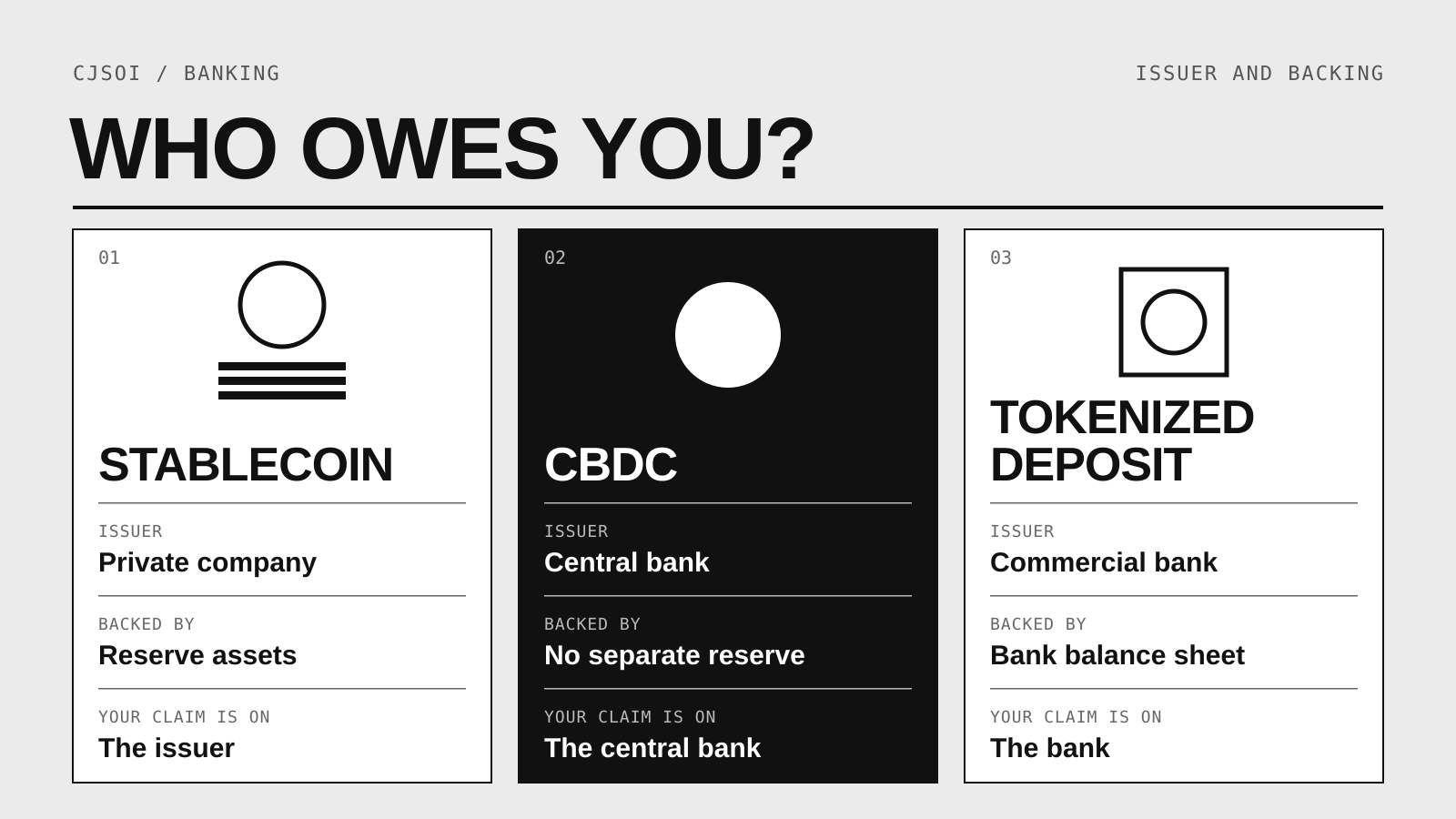
A stablecoin is issued by a private company and backed by reserve assets that company holds. A CBDC is issued by a central bank and is the central bank’s own liability, so no separate reserve stands behind it. A tokenized deposit is issued by a commercial bank and is an ordinary deposit claim on that bank, recorded in token form.
All three can show one dollar or one euro in a wallet. The difference is who owes you that balance and what supports the promise.
Stablecoin vs CBDC vs tokenized deposit at a glance
| Stablecoin | CBDC | Tokenized deposit | |
|---|---|---|---|
| Issuer | A private company, such as Circle (USDC) or Tether (USDT) | The central bank | A commercial bank |
| Whose liability | The issuer’s | The central bank’s | The bank’s |
| What backs it | Reserve assets the issuer holds: cash, bank deposits, short-term government debt | Nothing separate: it is central bank money | The bank’s balance sheet, like any deposit at that bank |
| New units | Created when a buyer pays the issuer in full | Issued by the central bank under its own rules | Created as bank deposits are |
| Interest to holders | Barred for U.S. payment stablecoins | None in the digital euro design | Set by the bank’s product terms |
| Where it stands | USDC and USDT circulate | Digital euro in preparation; Ghana’s eCedi piloted | JPMD and HSBC’s service, for institutional clients |
Stablecoin: a private issuer and a reserve
Under the GENIUS Act, enacted on July 18, 2025, a payment stablecoin is a digital asset used for payment or settlement whose issuer is obligated to redeem it for a fixed amount of monetary value and says it will keep a stable value.
The same definition leaves out a national currency and a deposit, “including a deposit recorded using distributed ledger technology.” In U.S. law, then, neither a CBDC nor a tokenized deposit is a payment stablecoin.
The backing is the issuer’s reserve. The Act requires a permitted issuer to hold identifiable reserves on an at least 1 to 1 basis, limited to cash, balances at a Federal Reserve Bank, deposits at insured banks, Treasury bills, notes or bonds with 93 days or less to maturity, overnight repo and reverse repo backed by Treasuries, and government money market funds holding those assets. The issuer must publish the reserve composition every month and may not pay holders interest or yield for holding the coin.
The Federal Reserve’s proposed rule for the issuers it supervises, published in the Federal Register on September 29, 2026, uses the same definition and states that the issuer must be obligated to redeem for a fixed amount of monetary value. Comments are open until November 30, 2026; it is a proposal, not a final rule. CJSOI reported the Board’s announcement.
Issuers describe their own reserves. Circle says USDC is backed 100% by cash and cash-equivalent assets, with most of the reserve in the Circle Reserve Fund, an SEC-registered government money market fund managed by BlackRock, and the rest in bank deposits. Tether says its tokens are backed 100% by its reserves and that the issuer’s assets exceed its liabilities; its June 30, 2026 report put the excess at about $4.11 billion.
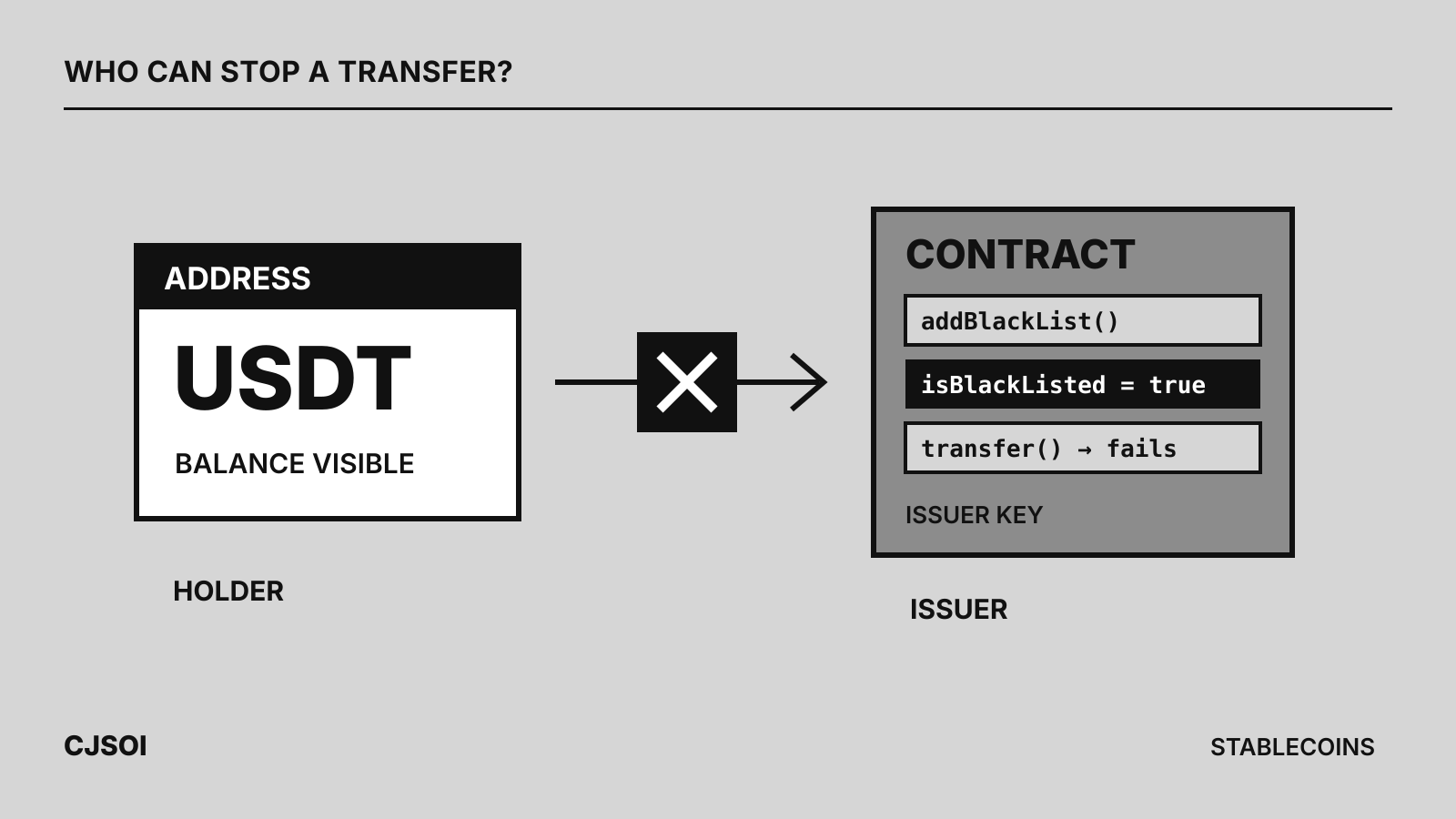
These are company statements and dated snapshots, not a public guarantee. Your claim runs to the issuer under its redemption terms; many holders sell on an exchange instead, as our redemption guide explains. The stablecoin list and the USDT vs USDC comparison set out reserves and redemption coin by coin.
CBDC: the central bank’s own money
A central bank digital currency is money issued by the central bank itself, in digital form. The ECB describes the planned digital euro as “a digital form of cash, issued by the central bank,” and its FAQ calls digital euro holdings “direct liabilities of the Eurosystem.”
That changes the backing question. No reserve portfolio sits behind each unit. The ECB says the digital euro would be central bank money, “issued and guaranteed by the Eurosystem,” with legal tender status, while stablecoins “are not guaranteed by a central bank or public authority” and depend on how the company manages its reserves.
In the ECB’s plan, banks and other payment service providers would distribute the digital euro, each person’s holdings would be capped, and no interest would be paid. The ECB analyzed hypothetical limits of up to €3,000 per person at legislators’ request; the limit itself is not set. Settlement would run on a centralized Eurosystem platform, not on distributed ledger technology.
The digital euro does not exist yet. The ECB’s Governing Council will decide on issuance only after the EU regulation is adopted. The ECB aims to be ready for a first issuance during 2029 if the law is adopted by the end of 2026, with a 12-month pilot planned from the second half of 2027. CJSOI covered the move into the current phase.
A retail CBDC that was piloted: Ghana’s eCedi
The Bank of Ghana’s eCedi Report, published in October 2024, describes a retail, token-based CBDC on a two-tier model: the central bank issued the eCedi and distributed it wholesale to financial service providers, which handled distribution to users. The technology was Giesecke+Devrient’s Filia platform.
Field tests ran for four months. 2,750 people used the eCedi online in Accra and Tarkwa through five providers, including Fidelity Bank and CAL Bank. 173 people tested an offline version with smart cards and point-of-sale devices in Sefwi Asafo, an area with poor network coverage. The bank reported transactions worth GHS 473 million and 96,000 in number, counting those of the providers as well as customers. The report describes a sandbox pilot; it does not announce a public launch.
Tokenized deposit: a bank deposit in token form
A tokenized deposit is a claim on a commercial bank recorded on a token-based ledger. Tokenization changes how the balance is recorded and moved, not who owes it. The backing is what supports any deposit at that bank: its assets, capital and supervision, plus deposit insurance where it applies to the product.
The BIS places tokenised commercial bank money inside today’s two-tier system. In its 2025 Annual Economic Report it proposes tokenised central bank reserves, commercial bank money and government bonds on a shared “unified ledger,” and argues that bank money keeps its value at par because payments between banks settle in central bank reserves. It concludes that stablecoins fall short on “singleness, elasticity and integrity.” That is the BIS’s policy view, and it made the case for deposit-based models again in an August 28, 2026 speech.
The BIS also notes that new stablecoin issuance “requires full upfront payment by holders,” while banks can create deposits through loans and overdrafts without full reserve backing.
J.P. Morgan made its JPMD deposit token available to institutional clients on Base on November 12, 2025. HSBC launched its Tokenised Deposit Service for corporate clients in Hong Kong on May 22, 2025. Our tokenized deposits explainer covers both and the deposit insurance question.
Three questions that tell them apart
Whose liability is it? A private issuer, a central bank or a commercial bank. The balance sheet tells you more than the word “digital” on the product.
What happens if the issuer fails? For a U.S. permitted stablecoin issuer, the GENIUS Act ranks holders’ claims ahead of other creditors’ claims on the reserve assets. A deposit falls under bank resolution rules and any deposit insurance limits. A CBDC is a claim on the central bank itself.
How do you get back to ordinary money? A stablecoin goes through the issuer’s redemption policy or a sale. The digital euro would be funded and defunded through a payment service provider, with a linked bank account covering amounts above the holding limit. A tokenized deposit is already a bank deposit, so moving it into an ordinary account follows the issuing bank’s terms.
Questions
Is a CBDC a stablecoin?
No. The GENIUS Act excludes national currency from the definition of a payment stablecoin, and the ECB contrasts the digital euro, which is central bank money, with privately issued stablecoins.
Is a tokenized deposit a stablecoin?
Not under U.S. law. The GENIUS Act excludes deposits from the definition, including deposits recorded with distributed ledger technology.
Which of the three can I use today?
Stablecoins such as USDC and USDT circulate now. The named tokenized-deposit services are for institutional and corporate clients. The digital euro is in preparation, and Ghana’s eCedi has been piloted, not launched.
Sources
GENIUS Act, Public Law 119-27; Federal Reserve proposed rule, Federal Register, September 29, 2026; ECB, digital euro; ECB, digital euro FAQ, updated August 17, 2026; BIS Annual Economic Report 2025, chapter III; BIS speech, August 28, 2026; Bank of Ghana, The eCedi Report, October 2024; Circle, transparency; Tether, transparency; J.P. Morgan, JPM Coin availability, November 12, 2025; HSBC Tokenised Deposit Service, May 22, 2025. Checked October 11, 2026.