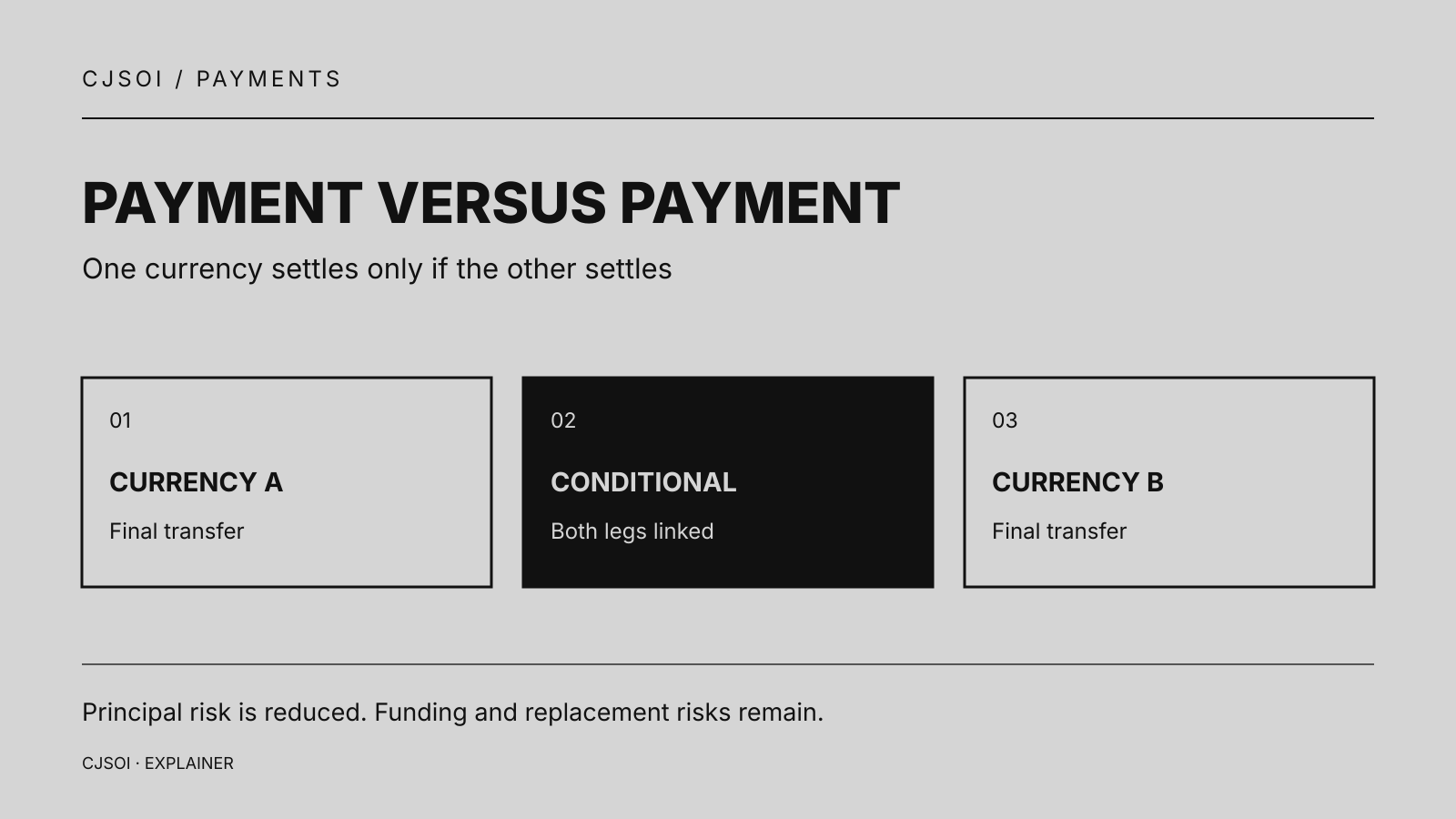
Payment versus payment (PvP) links the final transfer of one currency to the final transfer of another. One leg settles if, and only if, the other settles.
The purpose is to remove the principal risk of paying away the currency you sold and then failing to receive the currency you bought. PvP does not guarantee that a trade will settle, and it does not remove every risk around the trade.
This distinction appears in the Basel Committee’s FX settlement guidance. It is the right starting point when a payment or foreign-exchange service says it uses conditional settlement.
Why two currencies create principal risk
An FX trade involving an exchange of principal has two payment flows. Bank A delivers one currency to Bank B, and Bank B delivers the other to Bank A.
Without a conditional arrangement, the payments can become final at different times. If Bank A’s outgoing payment becomes irrevocable and the incoming payment fails, Bank A may lose the full principal it has paid away.
That is different from a change in the exchange rate. The risk is the full delivered amount, not just a smaller difference between the original price and a replacement trade.
The Basel guidance describes the exposure period as beginning when an outgoing payment can no longer be cancelled with certainty. It ends when the purchased currency is received with finality. The relevant cancellation deadline may occur before settlement day, depending on the arrangements.
For the accounts and service relationships behind a payment, see our correspondent banking guide. Here the narrower question is whether the two final transfers are conditional on each other.
What the condition changes
In a basic PvP arrangement, both counterparties must provide the correct amounts for the trade to settle. If one fails to pay in, the other receives back the currency it was selling rather than losing that principal through a one-sided final exchange.
This is a mechanism for controlling a specific exposure. It should not be translated into a promise that every customer payment arrives on time.
Consider an illustrative trade: one bank is selling dollars and buying euros. A genuine PvP condition prevents the dollar transfer from becoming final independently of the euro transfer. If the euro side does not fund the arrangement as required, the exchange does not complete as an ordinary successful trade.
The example uses no live exchange rate and makes no claim about a named provider. The necessary evidence in a real service is its settlement rules, including what is conditional, what constitutes finality and what happens when a participant cannot fund.
Three risks that readers should keep separate
| Risk | What can go wrong | Does PvP remove it? |
|---|---|---|
| Principal risk | Currency sold is paid away without receiving the currency bought | The conditional final exchange is designed to eliminate this exposure |
| Replacement cost risk | A failed trade must be replaced at a different market price | No |
| Liquidity risk | The needed currency is unavailable when other obligations fall due | No |
The Basel guidance explicitly says PvP does not eliminate replacement cost or liquidity risk. That limit belongs beside the benefit.
In the illustrative dollar-euro trade, a failed exchange can leave the bank still needing euros for another obligation. Getting the dollars back protects the sold principal, but it does not create the missing euros.
Replacing the trade can also cost more after prices move. Neither result contradicts the PvP condition. They are risks arising from a trade that failed to complete.
Funding requirements still matter
A participant needs the correct currency at the correct time under the arrangement. A bank’s total holdings are not necessarily the same as funds available in the required account and currency at a funding deadline.
The Basel guidance recommends identifying liquidity needs in each currency, prioritising time-critical obligations and maintaining appropriate resources. It also discusses how disruption at a settlement infrastructure or participant can change funding needs.
For a service review, ask who provides the funds, when they must be available and what happens if the funding deadline is missed. Ask how unsettled trades and returned funds are communicated.
These are evidence questions. There is no universal fee, minimum trade size or funding schedule implied by the term PvP. Those belong to the particular arrangement and should be verified in its official rules.
Indirect access adds another relationship
A bank may participate directly in a PvP arrangement or use a direct participant to obtain access. The Basel guidance cautions that the risks for an indirect participant depend on the services and terms provided.
In particular, an internal or on-us settlement process can create principal exposure if the debit or authorisation in the currency sold is not conditional on the corresponding entry in the currency bought.
That means “our provider uses PvP” is the beginning of a review. Establish which transactions reach the PvP arrangement and what happens between the customer, service provider and direct participant.
Keep the scope precise. Conditional settlement inside one infrastructure does not automatically establish identical protection at every account movement before or afterward.
Coverage is an important limit
The CPMI’s 27 March 2023 final-report overview says PvP arrangements are not available for every currency and may not be the preferred solution for some participants or trades.
It identifies technical and legal challenges, alongside incentives, as barriers to broader adoption. It also describes how new solutions could complement existing arrangements through features such as additional currency coverage, real-time settlement or expanded operating hours.
Those are findings and possibilities from a dated report. They are not evidence that every such feature is available from every provider in October 2026.
When reviewing a product, verify the actual supported currency pair, product, access model and operating window. A generic claim about cross-border settlement cannot answer each of those questions.
Finality and reconciliation are part of the evidence
The Basel guidance defines settlement finality as a legally determined, irrevocable and unconditional transfer or discharge of an obligation.
A confirmation that instructions were received differs from confirmation that the currency exchange has reached that final point. Reconciliation then matches actual incoming funds to the transactions they settle.
A useful review asks:
- Which two transfers are subject to the PvP condition?
- What event makes each transfer final?
- Who supplies and controls the required funding?
- What happens when a participant fails to fund?
- Which costs and liquidity exposures remain?
- What evidence shows successful settlement or a failed trade?
These questions also make it easier to compare conventional and digital settlement proposals without assuming that a blockchain transaction, a timestamp or the word “atomic” establishes the legal and operational result on its own.
Sources and document dates
Checked 9 October 2026. Basel RMA20 is labelled a draft under consultation, published 1 January 2026, and based on January 2013 supervisory guidance. This explainer uses its definitions and risk distinctions without treating the draft as new national law. CPMI’s PvP final-report overview, published 27 March 2023, supplies the dated coverage and adoption findings.