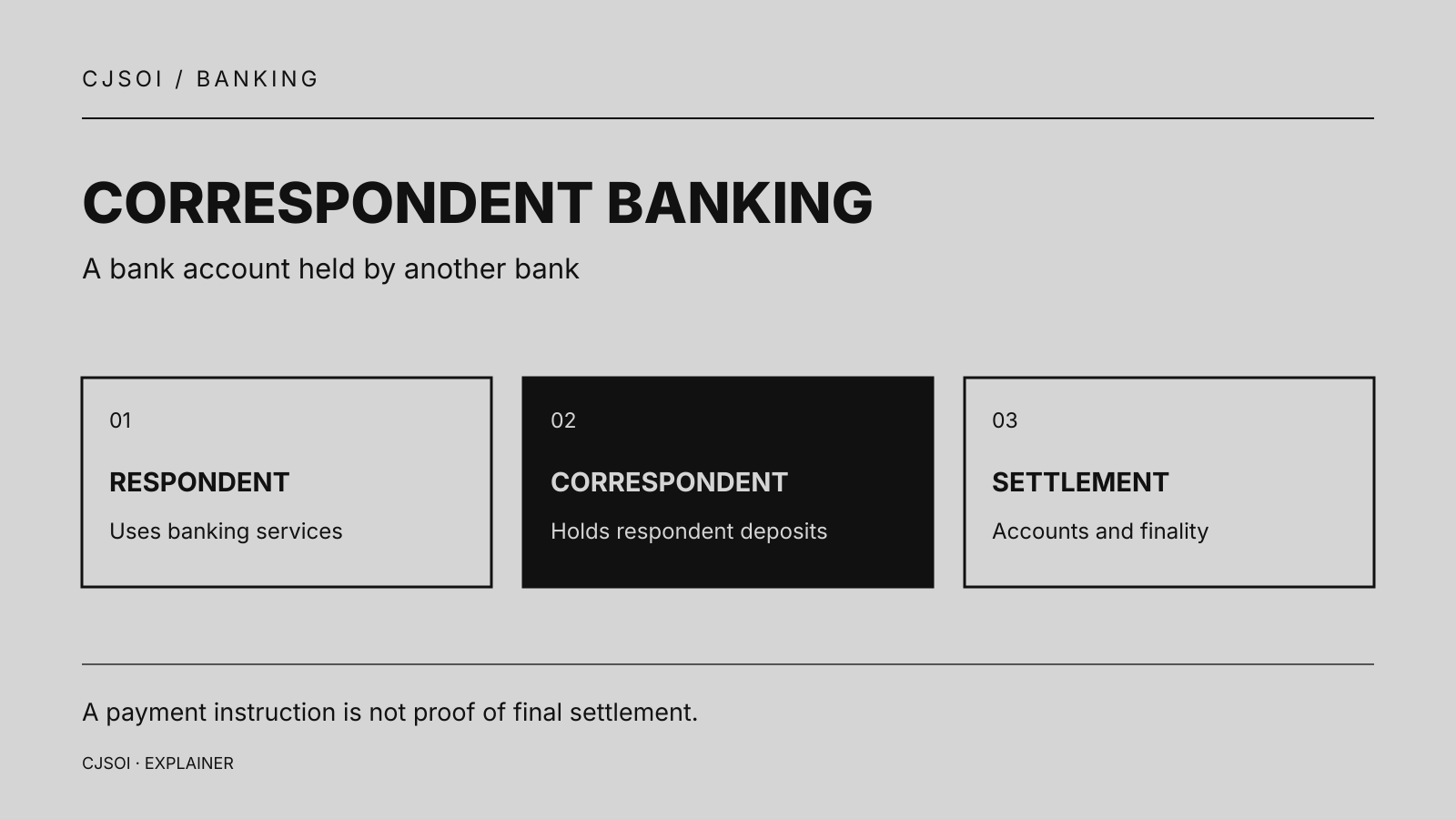
Correspondent banking is a relationship in which one bank holds deposits for another bank and provides payment or other banking services to it. The bank providing those services is the correspondent; the bank using them is the respondent.
That relationship gives a bank access to accounts and services beyond its own infrastructure. For an international payment, the relevant question is which banks and accounts carry out settlement, not simply which app initiated the instruction.
The Basel Committee’s foreign exchange risk guidance defines correspondent banking in those terms. This is an explanation of the account relationship, rather than a claim about a new product or a guaranteed payment route.
A bank can be another bank’s customer
A respondent’s deposit at a correspondent is a bank-to-bank claim. The respondent may use that account to make and receive payments in the relevant currency.
In international banking, the respondent’s foreign-currency account at another bank is commonly called a nostro account. The Basel guidance describes it as the account where a domestic bank keeps balances in a currency and makes or receives payments. Reciprocal relationships can involve nostro and vostro accounts.
The account should not be confused with the end customer’s own deposit account. A company may instruct its bank to pay a supplier, but the bank’s settlement arrangements sit behind that customer instruction.
This distinction also matters when reading claims about tokenized bank money. An onchain representation, a customer’s bank balance and an interbank settlement balance answer different questions. Our tokenized deposits guide explains the first distinction.
Trace the accounts, not just the message
Consider an illustrative currency payment. Bank A needs to make a payment in a currency for which it uses Bank B as a correspondent. Bank A holds a balance with Bank B and uses the agreed services to arrange the payment.
Bank B’s involvement is therefore more than forwarding a message. It provides account and payment services under its relationship with Bank A. The complete route depends on the receiving bank, the relevant payment arrangements and the terms under which the banks operate.
There is no universal number of intermediaries in this example. A particular payment may use different relationships or settlement arrangements. A provider’s displayed sending status does not disclose all of them.
For a real payment, ask the provider what the status represents. Has an instruction been accepted? Has the relevant account been debited? Has the recipient’s bank confirmed receipt? Has the customer been credited? Those are useful operational questions, rather than interchangeable definitions of “sent.”
A deposit relationship brings exposure
When a respondent holds deposits at a correspondent, it depends on that institution to perform the agreed services. The Basel guidance tells banks to evaluate their correspondent relationships, including the institution’s financial condition and relevant jurisdictional risks.
Its discussion of FX settlement includes credit, liquidity, operational and legal risks. That is a wider review than checking whether a bank can process a particular currency.
An account may be available while an operational disruption prevents a payment from completing on time. A bank may need funds in one currency at a particular deadline while its expected incoming payment is delayed. Legal uncertainty can affect when a transfer becomes final.
These risks should not be described as identical. Credit exposure concerns a counterparty’s ability to meet obligations. Liquidity concerns having the necessary currency available when it is needed. Operational risk includes failures in systems or processing. A working payment message does not remove the other questions.
Currency exchange adds a second payment
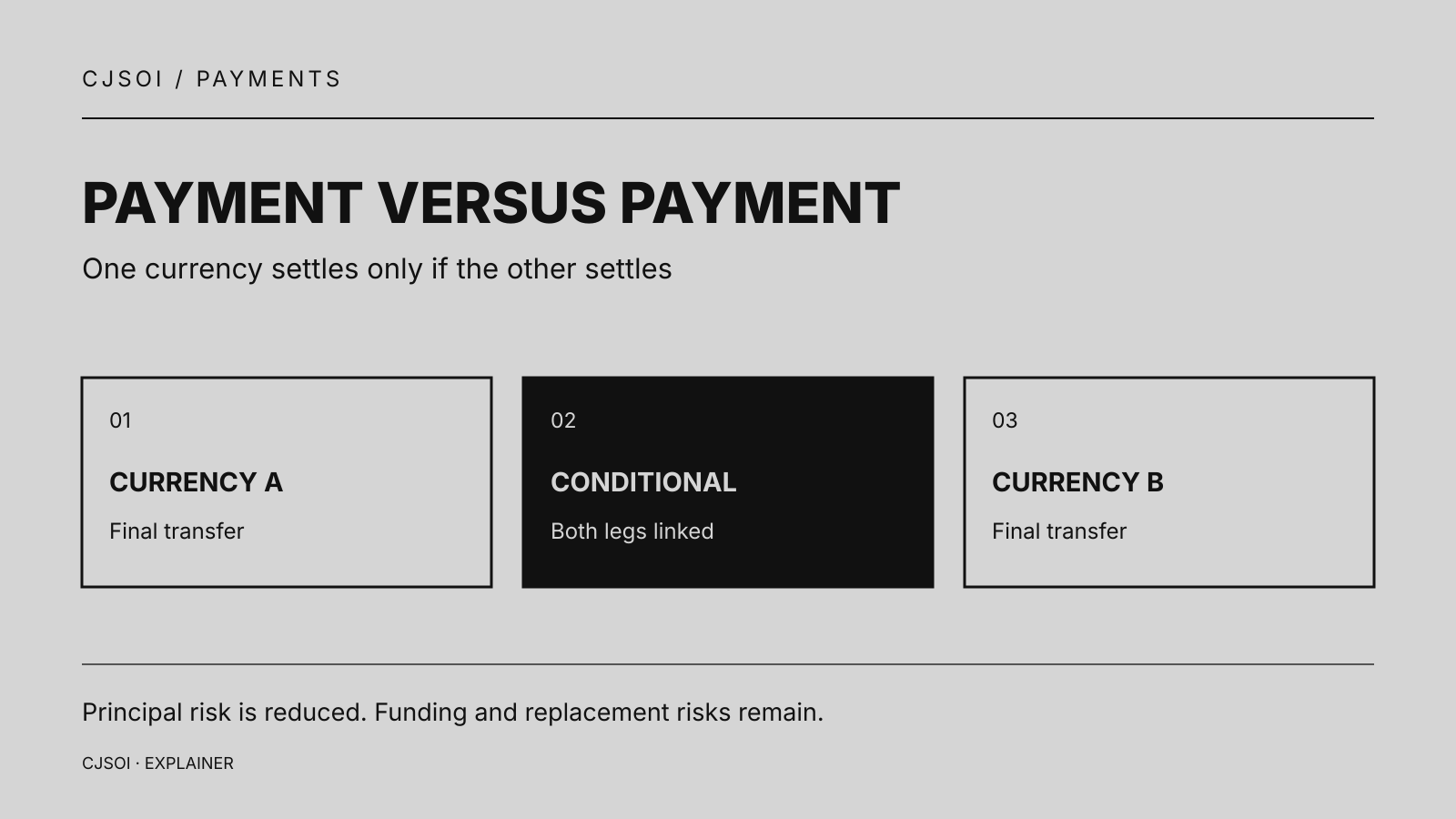
A cross-border payment and an FX trade are related activities, but they are not the same transaction. An FX trade that exchanges principal has two currency payment flows.
Under correspondent settlement, each trading counterparty typically transfers the currency it is selling through the relevant banking arrangements. If one leg becomes irrevocable before the other arrives, a bank can be exposed to losing the full amount it has paid away.
The Basel guidance calls that principal risk. It begins when a bank can no longer cancel its outgoing payment with certainty and ends when it receives the purchased currency with finality.
Our payment-versus-payment explainer covers the separate mechanism designed to link those currency transfers conditionally. Correspondent banking describes the service relationship; PvP describes a settlement condition. One term should not be used as shorthand for the other.
Finality is a specific point
The Basel guidance defines settlement finality as an irrevocable and unconditional transfer, or the discharge of an obligation, under the applicable arrangements. It is a legally defined moment.
For FX risk management, the guidance says a bank should confirm credit to its nostro account and reconcile which trades have settled or failed. Until that evidence is available, it should not assume that an expected incoming payment has arrived.
An operational status label can be useful without representing legal finality. Readers should ask what the label confirms and which account it refers to.
| What you are checking | What it helps establish |
|---|---|
| Customer instruction accepted | The sending provider has accepted the request |
| Bank-to-bank account movement | A particular settlement account has been debited or credited |
| Incoming receipt reconciled | The bank has matched the receipt to the relevant trade or payment |
| Settlement finality under the arrangement | The transfer has reached the legally defined final point |
| Customer account credit | The recipient can see the credit under their provider’s process |
The table is an editorial way to separate the questions. It does not prescribe every bank’s status terminology.
Backup relationships require preparation
The Basel guidance discusses dependence on other institutions and possible mitigants, including backup correspondents or settlement banks. It also identifies switching time, onboarding, testing, agreements and fees as matters to consider.
A second bank name on a contingency document is therefore different from a tested, usable alternative. The appropriate arrangement depends on the bank’s activity and the services required.
For a business customer, the practical question is what the payment provider’s contingency process means for the actual route. Avoid assuming that an alternative can instantly process every currency or payment.
Correspondent relationships also help explain why digital-asset businesses can still need ordinary banking access. Their onchain activity does not automatically supply payroll accounts or every offchain settlement service. See why crypto companies need bank accounts for that broader operational distinction.
Sources and document dates
Checked 9 October 2026. The Basel Consolidated Guidelines chapter RMA20 is labelled a draft under consultation and published 1 January 2026; its FX settlement material is based on January 2013 supervisory guidance. It is used here for definitions and mechanisms, not presented as newly binding national law. The CPMI’s Correspondent banking final-report overview, published 13 July 2016, provides historical context for the account relationships and the report’s recommendations.