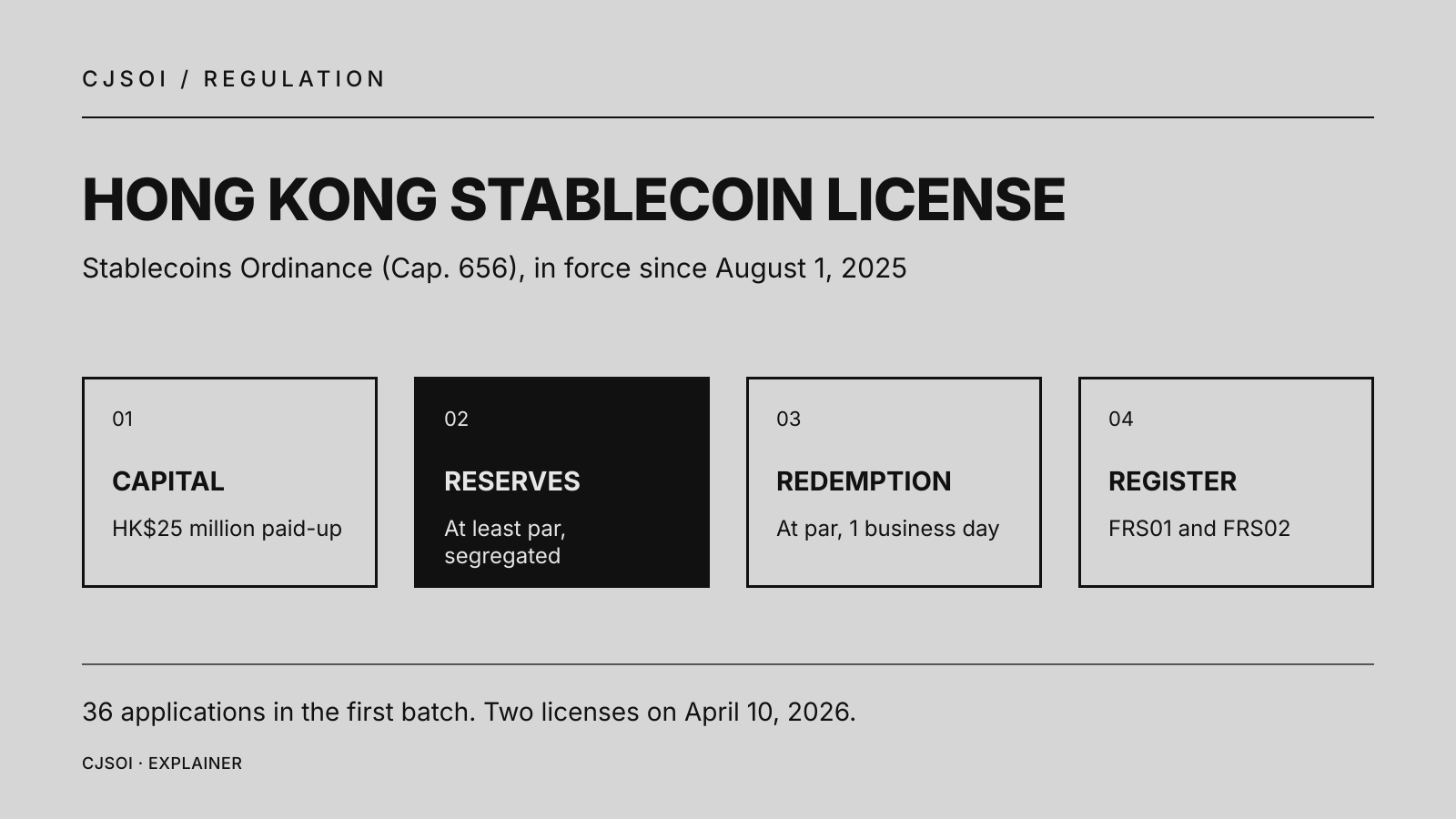
A Hong Kong stablecoin license is the permission the Hong Kong Monetary Authority (HKMA) grants under the Stablecoins Ordinance (Cap. 656) to issue fiat-referenced stablecoins. The regime took effect on August 1, 2025. On April 10, 2026 the HKMA granted the first two licenses, to Anchorpoint Financial Limited and The Hongkong and Shanghai Banking Corporation Limited (HSBC), out of 36 applications in the first batch.
This explainer covers who needs a license, what the HKMA requires, and how to check whether a token is regulated in Hong Kong. For how this differs from other regimes, see our guides on who regulates a stablecoin and MiCA.
Who needs a Hong Kong stablecoin license
Since August 1, 2025, issuing a fiat-referenced stablecoin in Hong Kong in the course of business is a regulated activity, according to the HKMA’s regime page. The HKMA’s Explanatory Note on Licensing (July 2025) sets out three triggers:
- issuing a specified stablecoin in Hong Kong;
- issuing, from outside Hong Kong, a stablecoin that references the Hong Kong dollar in whole or in part;
- an activity the Monetary Authority later specifies.
For now, “specified stablecoin” means a token that references one or more official currencies. A token pegged to gold or to a crypto-asset is outside the current scope, while a US dollar token issued from Hong Kong is inside it.
The HKMA looks at the whole picture to decide where a token is issued: where the issuer is managed and incorporated, where minting and burning happen, where reserves are managed and where the bank accounts for mint and redemption flows sit. Actively marketing such an activity to the Hong Kong public also counts as holding out, and doing either without a license is an offence under section 8 of the Ordinance.
Tokens issued by central banks or governments, bank deposits as defined in the Banking Ordinance, securities and stored-value float are excluded from the definition. Bank deposit tokens are a different instrument; we explain the difference in tokenized deposits and stablecoins.
The license requirements
The Explanatory Note lists minimum criteria that must be met at the time of the application and at all times afterwards. The main ones for a reader comparing stablecoins:
Local company. The applicant must be a company incorporated in Hong Kong, or a bank authorized in Hong Kong but incorporated elsewhere. Foreign groups apply through a Hong Kong subsidiary.
Capital. Paid-up share capital of at least HK$25 million, or other financial resources of that amount approved by the HKMA. This criterion does not apply to applicants that are authorized banks.
Reserves. Each stablecoin type has its own pool of reserve assets. Its market value must be at all times at least equal to the par value of the tokens in circulation, and the HKMA expects over-collateralization as a buffer. Assets must be high quality and highly liquid, held in the same currency as the peg unless the HKMA approves otherwise, kept with a qualified custodian, and protected from the issuer’s other creditors through a trust arrangement backed by an independent legal opinion.
Disclosure and audit. The issuer must publish its reserve management policy, the composition and market value of reserves, and the results of regular independent attestation and audit. It must also publish a white paper before offering the token to the public.
Redemption. Holders have the right to redeem at par. Unless the HKMA approves otherwise, a valid request should be processed within one business day after receipt, without an unreasonable fee or unduly burdensome conditions. If the issuer becomes insolvent, holders can direct the sale of the reserve pool and claim any shortfall from the issuer. Our explainer on stablecoin redemption shows how this works in practice.
No interest. A licensee must not pay interest on its stablecoins, and income from managing the reserves belongs to the issuer, not to holders.
People and controls. Chief executives, directors, stablecoin managers and controllers must be fit and proper, with senior staff generally expected to be based in Hong Kong. The issuer also needs risk management, anti-money-laundering controls, complaint handling and a recovery and orderly wind-down plan.
Who can sell a licensed stablecoin
Under section 9 of the Ordinance, a licensee may only use a “permitted offeror” to offer its tokens. The Explanatory Note lists five kinds: the licensee itself, a bank authorized by the HKMA, a licensed stored-value facility, a virtual asset trading platform licensed by the Securities and Futures Commission, and an SFC-licensed corporation for Type 1 regulated activity (dealing in securities).
So the issuer’s license and the seller’s license are separate checks. A holder who buys through an exchange relies on that exchange’s own SFC license as well as the issuer’s HKMA license.
The first licenses
The HKMA’s press release of April 10, 2026 announced the first two licenses, effective that day. The Register of Licensed Stablecoin Issuers lists them as follows:
| Licensee | License number | Effective date |
|---|---|---|
| Anchorpoint Financial Limited | FRS01 | April 10, 2026 |
| The Hongkong and Shanghai Banking Corporation Limited | FRS02 | April 10, 2026 |
In a statement the same day, HKMA Chief Executive Eddie Yue said the 36 applications were the first batch submitted by the September 30, 2025 deadline. He described Anchorpoint as a joint venture of Standard Chartered Bank (Hong Kong), HKT and Animoca Brands, and said both licensees plan to issue Hong Kong dollar stablecoins first, for cross-border payments, local payments, tokenized asset trading and programmable uses. On further licenses, the HKMA said its threshold “will remain high” and that any additional licenses would keep the overall number “very limited.”
The HKMA also said licensed issuers must verify the identity of stablecoin holders, directly or through reliable third parties, and use blockchain analytics to detect suspicious transactions.
Anchorpoint’s token is called HKDAP (“HKD At Par”). Standard Chartered said on April 10, 2026 that Anchorpoint would issue it in phases. Anchorpoint’s site describes the phases as Beta Access for corporates and professional investors, followed by a full launch open to retail users, and warns about fake tokens using the HKDAP name. HSBC’s register entry confirms its license; this article does not describe HSBC’s token, because we found no issuer document on it to cite.
How to check a Hong Kong stablecoin
- Find the legal issuer named in the token’s white paper and look it up on the HKMA register. The register shows the license number, address and the email address the HKMA records.
- Confirm the token contract on the issuer’s own site. Anchorpoint, for example, says genuine HKDAP exists only at its official contract on each supported blockchain.
- Check the seller’s own license: an HKMA-authorized bank, a licensed stored-value facility or an SFC-licensed platform or corporation.
- Read the published redemption terms: who may redeem directly, any fee, and the processing time.
The HKMA’s July 29, 2025 notice adds that falsely claiming to be a licensee or an applicant is an offence, and that people who hold unlicensed stablecoins do so at their own risk.
For issuers, reserves and redemption terms of other coins, see our stablecoin list. For US rules under the GENIUS Act, see our report on the Federal Reserve’s September 2026 proposals.
Questions
Does a Hong Kong stablecoin license cover US dollar stablecoins?
Yes, if the token is issued in Hong Kong in the course of business. The current scope covers tokens referenced to any official currency. A Hong Kong dollar token issued from abroad also needs a license.
How fast must a licensed issuer redeem?
The HKMA’s guidance says a valid request should be processed within one business day after receipt, unless the HKMA approves otherwise.
Can a licensed Hong Kong stablecoin pay interest?
No. The Ordinance prohibits licensees from paying interest on their stablecoins.
How many issuers are licensed?
Two as of the HKMA register checked on October 10, 2026: Anchorpoint Financial Limited (FRS01) and HSBC (FRS02), both effective April 10, 2026.
Sources
HKMA regime page; HKMA Explanatory Note on Licensing, July 2025; HKMA register; HKMA press release, April 10, 2026; HKMA inSight, April 10, 2026; HKMA press release, July 29, 2025; Standard Chartered, April 10, 2026; Anchorpoint. Checked October 10, 2026.