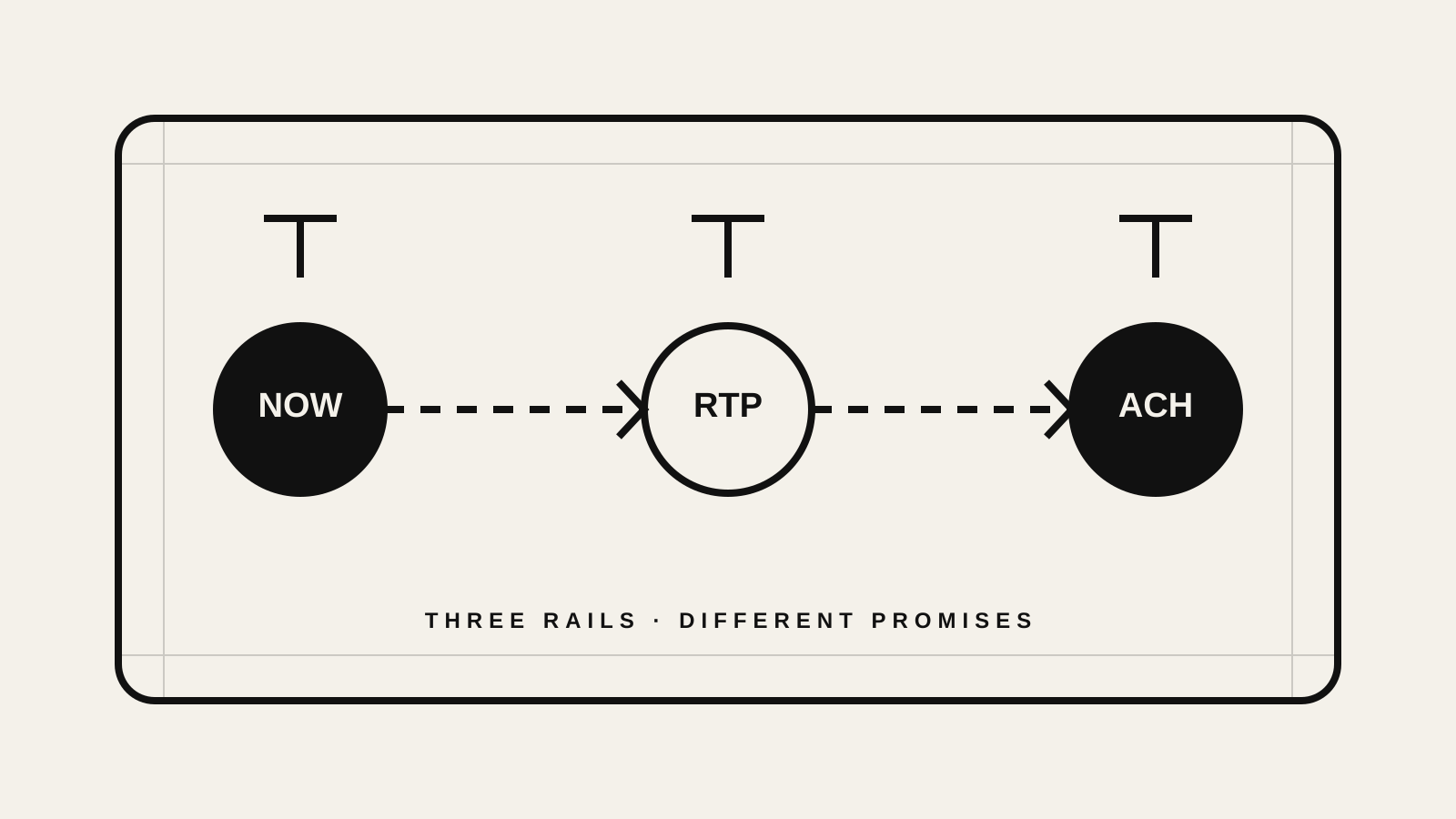
Three bank-payment rails can move dollars between US accounts, but they do not make the same promise. FedNow and the RTP network settle individual credit transfers within seconds, around the clock. ACH clears payments in batches and supports both credits and debits, with settlement ranging from the same banking day to a later banking day.
That distinction matters more than the logo shown in an app. It affects when funds become final, whether a payment can be pulled from an account, what happens on weekends, and which banks can receive it.
Documentation check: Network rules and service pages reviewed 24 October 2026. A bank may impose lower limits, shorter sending hours or narrower use cases than the underlying rail.
The short comparison
| Rail | Operator | Processing model | Availability | Direction | What settlement means |
|---|---|---|---|---|---|
| FedNow | Federal Reserve Banks | Individual, real-time gross settlement | 24/7/365 | Credit push | Interbank settlement occurs immediately in Federal Reserve master accounts |
| RTP | The Clearing House | Individual, real-time clearing and settlement | 24/7/365 | Credit push | The payment is final and the receiving institution gets immediate confirmation |
| ACH | ACH Operators under Nacha rules | Batch clearing with scheduled settlement windows | Banking-day schedule | Credits and debits | Entries settle in batches; Same Day ACH can settle eligible entries within hours |
For a customer, “instant” still depends on both institutions. The sending bank must offer the feature, the receiving bank must be reachable on that rail, and the bank’s own controls must approve the transfer.
FedNow: instant settlement through the Federal Reserve
FedNow is the Federal Reserve Banks’ instant-payment infrastructure. Its operating procedures describe it as a 24x7x365 real-time gross settlement service with integrated clearing. When a participating institution sends a customer credit transfer, the service settles the obligation through entries to Federal Reserve Bank master accounts.
The service has no weekend pause. Its official operating-hours page says processing continues while the service rolls from one funds-transfer business day to the next at about 7:01 p.m. Eastern time.
FedNow raised its network limit for customer credit transfers to $10 million in November 2025. That is a ceiling for the rail, not a promise that every bank will let every customer send that amount. Financial institutions can set tighter transaction and activity thresholds. The Federal Reserve also introduced account-level risk controls because instant settlement leaves little time to stop a mistaken or fraudulent instruction after it is accepted.
FedNow uses ISO 20022 messages. Alongside payment messages, its design supports non-value messages such as requests for payment, requests for information and requests for return. A request for return is not an automatic reversal: the recipient institution still has to act on it.
RTP: a private instant-payment network
RTP is operated by The Clearing House, a bank-owned payments company. It also runs continuously and settles credit-push payments one by one. The network’s current service overview lists a $10 million transaction limit, ISO 20022 messaging and immediate final settlement.
RTP is open to insured US depository institutions, not only owners of The Clearing House. A bank can connect directly or through an approved service provider. The participant information page says the network supports consumer, business and government use cases, including account-to-account transfers, payroll, merchant disbursements and loan funding.
RTP payments are credit push only. The payer instructs its institution to send; a merchant cannot originate an RTP debit that pulls money from the payer’s account. The network treats an accepted payment as irrevocable. Any recovery therefore relies on cooperation between the parties and their institutions rather than a built-in consumer “undo” button.
ACH: batch processing with broader payment types
ACH is the established batch network behind payroll deposits, bill payments and many bank-to-bank transfers. It handles both credits and debits. That makes it suitable for recurring collections and authorised pulls as well as payments initiated by a sender.
Nacha says the ACH Network processes files for 23¼ hours each business day and settles four times per banking day. It is not a continuous weekend settlement rail. Standard ACH credits may settle on the next banking day or later, while Same Day ACH gives eligible entries scheduled settlement windows during the same banking day.
This batch model does not mean ACH is always slow. Nacha estimates that most network volume settles in one banking day or less. It does mean the experience is different from an individual instant payment: a bank submits entries into a window, the operator clears the batch, and settlement occurs at a defined time.
ACH also has a formal return framework. Returns are not the same as card chargebacks, but the rules provide specified reasons and deadlines for returning entries. That makes ACH useful for debit-based billing, while also creating timing and risk considerations that do not exist in the same form on an irrevocable credit-push rail.
Why two instant rails coexist
FedNow and RTP solve a similar customer problem through different operators. Neither is simply a faster version of ACH. Banks decide which instant rail or rails to join, whether to receive only or also send, which customer segments get access, and what transaction limits to apply.
The practical result is that reach is institution-specific. A payment app may choose a rail after checking the recipient bank’s routing number and current availability. Customers often see only a label such as “instant transfer,” not the underlying network.
The two instant rails can support richer status and remittance data than a basic account transfer. That is valuable for invoice reconciliation, payroll corrections and time-sensitive disbursements. ACH remains attractive when a payment must be pulled under an authorisation, scheduled in bulk or sent through a broadly embedded bank workflow.
Which rail fits which job?
- Urgent account-to-account payment: FedNow or RTP, when both institutions support the chosen rail and the bank permits the amount.
- Payroll file or recurring vendor run: ACH often fits because it is built for batches and established business workflows.
- Authorised bill debit: ACH, because FedNow and RTP are credit-push systems.
- Weekend or holiday disbursement: FedNow or RTP can settle continuously; ordinary ACH settlement follows banking-day windows.
- High-value instant transfer: Both instant rails support network limits up to $10 million, but a bank’s customer limit may be far lower.
- Payment that may need routine returns: ACH has a structured return process; instant payments should be treated as final once accepted.
The best question is therefore not “Which network is fastest?” Both instant rails are designed for seconds. Ask whether the receiving institution is reachable, whether the payment is a push or a debit, what finality is required, and what controls the customer’s bank applies.
For the wholesale side of US bank payments, see CJSOI’s explainer on Fedwire vs CHIPS. Those systems serve a different role from retail instant payments and ACH.