USDT on TON is Tether’s dollar token issued as a TON jetton. Sending it safely means checking the official jetton master, using a wallet or platform that supports TON, and following the destination’s deposit instructions before the transfer leaves your wallet.
The network name matters as much as the token name. USDT on Ethereum, TRON and TON are separate deployments. A deposit address that accepts one does not automatically accept the others.
USDT on TON is a jetton
TON calls fungible tokens jettons. Its documentation describes a master contract that identifies the token and separate jetton-wallet contracts that hold balances for individual owners. That architecture is different from Ethereum’s single-contract balance model, even though both systems let wallets display and transfer fungible tokens.
Tether’s supported-protocols page lists USD₮ as a TON jetton and gives the official master address:
EQCxE6mUtQJKFnGfaROTKOt1lZbDiiX1kCixRv7Nw2Id_sDs
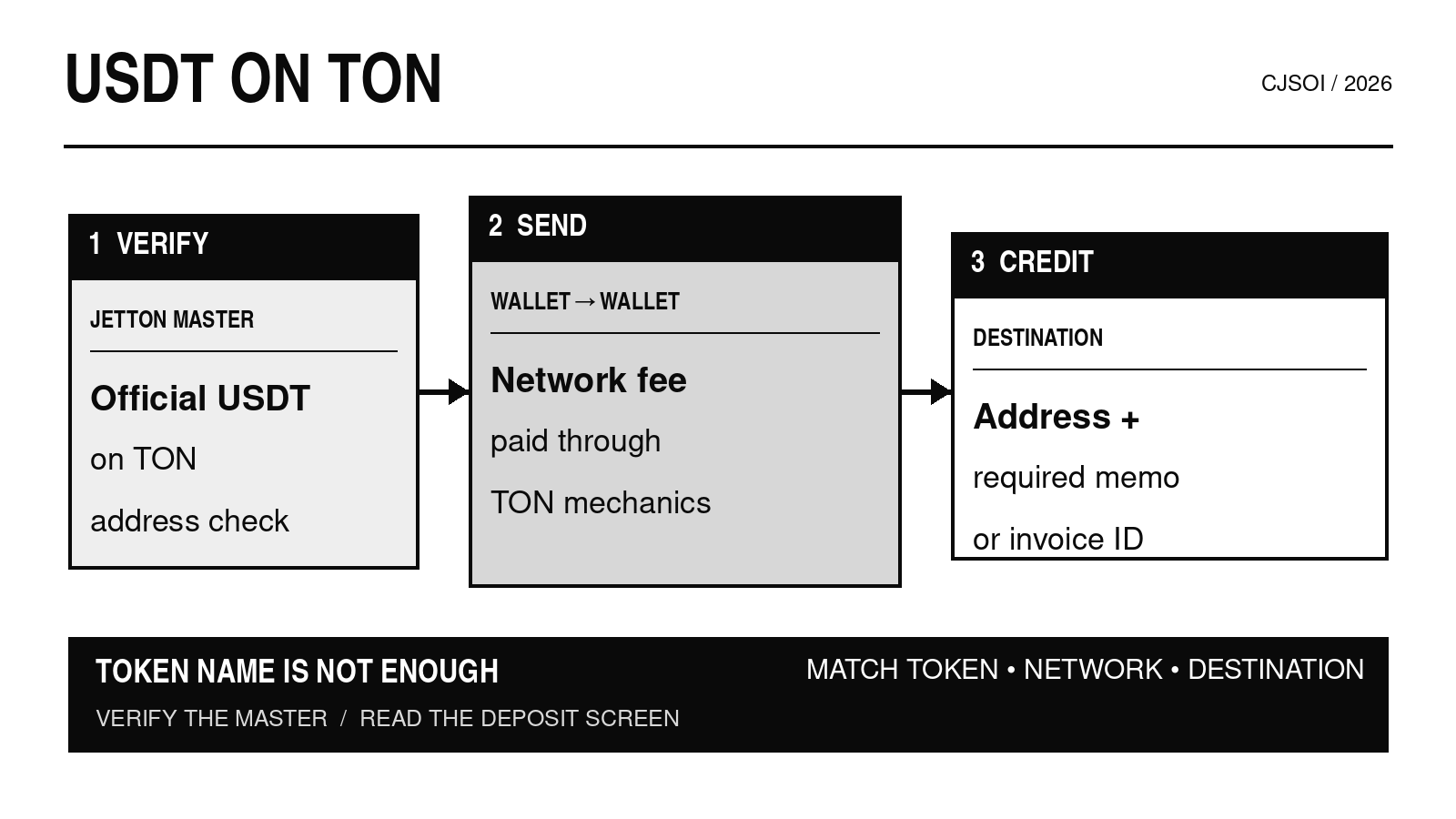
TON’s own payment-processing guide uses the same address. Verify that master address before accepting a wallet search result or a token with the name “USDT.” TON warns that anyone can deploy a jetton with copied metadata, including a familiar name, symbol or image.
The master address is an identity check, not the recipient address. Your wallet derives or uses the recipient’s jetton wallet behind the scenes. For an ordinary user transfer, enter the account address supplied by the recipient or service, then let the wallet construct the jetton transfer.
A transfer uses several TON messages
A jetton transfer is not one balance update. TON documents a message chain: the sender asks the sender’s jetton wallet to transfer; that contract sends an internal transfer to the recipient’s jetton wallet; the recipient can then receive a transfer notification.
That detail matters most when the destination is an exchange, merchant or payment processor. TON says compliant transfers should trigger a transfer_notification; without it, some services may not process the payment. A mainstream wallet should handle the message format, but the destination still decides which deposits it credits.
Do not copy a jetton-wallet contract from a block explorer and treat it as a normal deposit address. Use the account address and network shown by the receiving service. If the service does not list USDT on TON, choose another route rather than guessing.
Fees are paid on TON
TON transaction fees have several components. The official fee guide lists storage, compute, forward, action and import fees. A USDT transfer can touch more than one contract and send more than one message, so the final fee depends on the actual transaction path.
Most wallets quote the fee before confirmation. Keep enough TON’s native gas asset in the wallet unless the wallet explicitly offers a supported gasless or sponsored-fee route. A wallet’s marketing claim about paying fees in another token does not change the base network mechanics; it means the wallet or another service is handling the native fee for you under its own rules.
There is no fixed universal USDT-on-TON transfer fee that stays correct for every wallet and destination. Use the live wallet estimate. TON says validator-approved network parameters determine fee levels, and the message size and contract execution path also affect the total.
Exchange deposits may need a comment or invoice reference
Self-custody wallets can usually receive a direct transfer to an address. Custodial services often need more information because one deposit wallet may represent many customers.
TON’s payment guide describes invoice-based deposits that carry an invoice ID inside the transfer’s forward payload. In a consumer interface, that extra identifier may be presented as a memo, comment, tag or payment reference. The label is a product choice; the operational point is the same: the service needs the identifier it issued to credit the correct account.
Follow the deposit screen exactly:
- Select USDT and TON at the destination.
- Copy the displayed address.
- Copy any required memo, comment or tag.
- Paste both into the sending wallet in the matching fields.
- Check the amount, network and destination again before confirming.
If the platform shows no extra identifier, do not invent one. If it shows one as required, do not omit it. A blockchain transaction can succeed while the exchange leaves the deposit uncredited because its internal account reference was missing.
The practical sending sequence
Start at the destination rather than the wallet. Confirm that the recipient supports USDT on TON and copy its current instructions. Then open the sending wallet, choose the official USDT jetton, paste the destination address and add the required reference if one exists.
Review the wallet’s transaction preview. It should show USDT as the asset and TON as the network. Check the first and last characters of the destination after pasting. Keep enough native gas balance for the quoted fee, or confirm the terms of any wallet-sponsored fee option.
For a new exchange or an unfamiliar address, send a small test amount first when the destination’s minimum deposit permits it. Wait until the service credits the test before sending the remainder. Save the transaction hash so the receiving service can trace the transfer if it does not appear.
The network selection guide explains why a correct address on the wrong chain can still fail. The cheapest-way-to-send-USDT comparison separates network fees from exchange withdrawal charges, while the stablecoin list records issuer and network information.
What to check when a transfer does not arrive
First confirm the transaction status in a TON explorer. A successful onchain transfer proves that the network processed the messages; it does not prove that a custodian credited the right customer account.
Then compare four items with the destination’s deposit page:
- the network was TON;
- the asset was the official USDT jetton;
- the recipient address matches;
- the required memo, comment or tag was included exactly.
If those match, give the destination the transaction hash and amount. Do not pay an unsolicited “recovery fee” or share a seed phrase with anyone claiming to fix the deposit. A legitimate support team can investigate with the transaction hash and account details; it does not need your wallet’s recovery words.