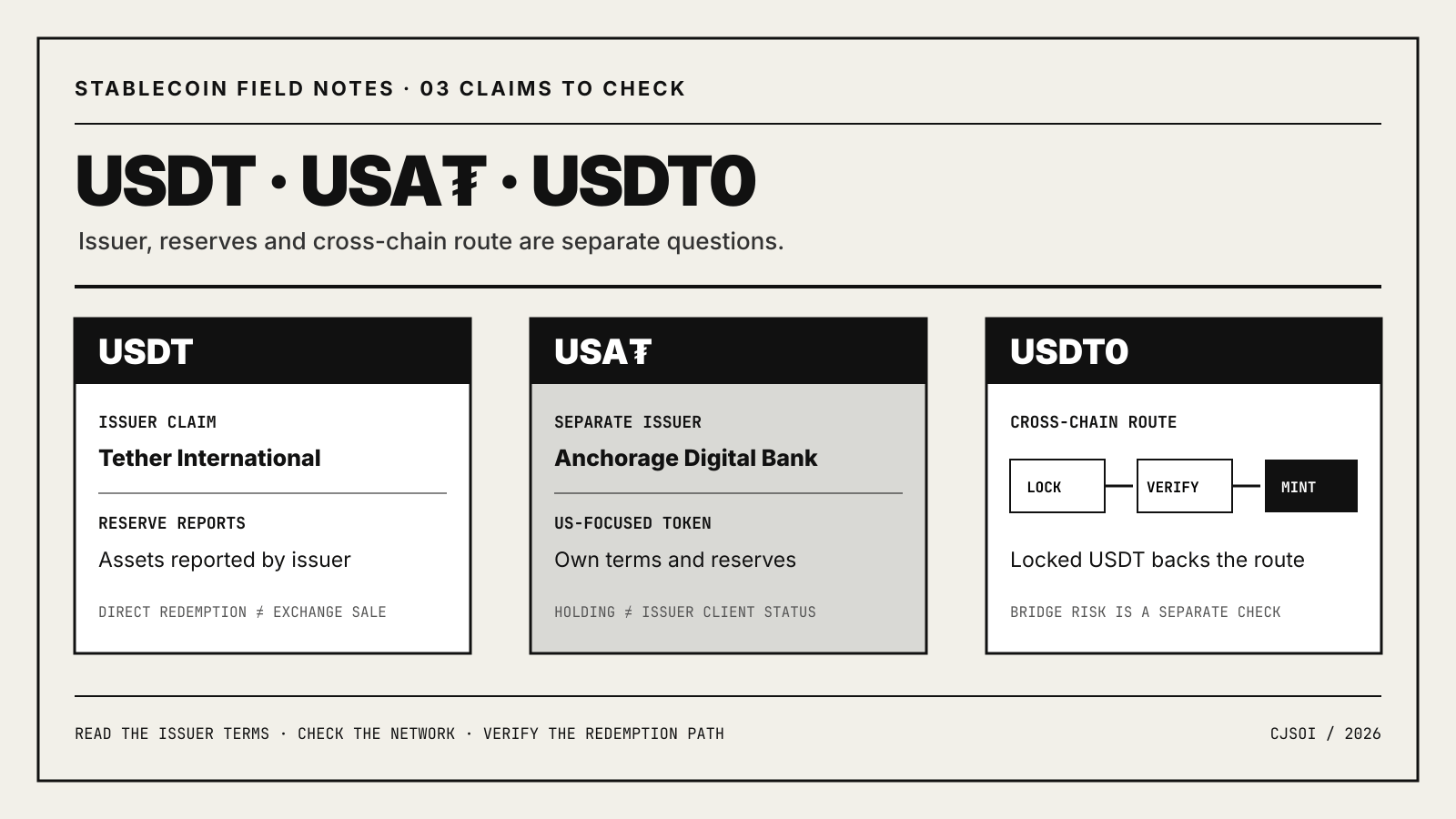
USDT vs USA₮ vs USDT0 is a comparison of three different claims and routes, even though all three use a dollar target. The useful comparison starts with three questions: who issues the token, what backs it, and what happens when it moves between chains.
USDT is the issuer-backed token
USDT is issued by Tether International, which says each token is backed one-to-one by its reserves. Those reserves are not described as cash alone. Tether’s public FAQ says they can include cash, cash equivalents and other assets, including receivables. The company publishes circulation data and quarterly reserve reports prepared by BDO Italia.
That reserve statement is about the issuer’s overall backing. It does not mean every holder has direct access to Tether’s fiat redemption service. Tether’s current fee page lists a USD 100,000 minimum for direct acquisition or redemption. It also lists a redemption fee equal to the greater of USD 1,000 or 0.1%. An exchange sale is a different transaction, with the exchange providing liquidity and setting its own price and fees.
Read Tether’s FAQ and current fee schedule.
USA₮ has a different issuer and rulebook
USA₮ is a separate stablecoin issued by Anchorage Digital Bank, N.A. Tether International does not issue it and, according to Anchorage’s disclosures, has no obligation to redeem it. Anchorage describes the product as intended for the US market and says its reserves consist of cash and low-risk liquid assets held through Reserve Trust Company.
The practical distinction is at the redemption desk. Anchorage says it issues and redeems USA₮ only for bank clients who have an eligible account and a written agreement. A person can acquire the token on a secondary market without becoming an Anchorage client. The disclosures also warn that the secondary-market price may differ from one dollar and that holdings are not FDIC, NCUA or SIPC insured.
Anchorage says USA₮ is designed with the US GENIUS Act framework in mind. That is the issuer’s description of its compliance position, not a conclusion that every transaction or holder is covered in the same way. Availability also depends on platform, network and jurisdiction.
Read the USA₮ FAQ and Anchorage’s policies and disclosures.
USDT0 is a route for moving USDT across chains
USDT0 is not a third fiat-backed reserve pool competing with USDT. It is a cross-chain representation built around locked USDT. The project documentation describes a lock-and-mint design: USDT remains locked in an Ethereum adapter, while a corresponding token is minted on a supported destination chain. Returning to Ethereum reverses that process through burn and unlock.
The wording matters. An ordinary USDT0 transfer between supported chains uses burn and mint messages; it does not lock a fresh batch of USDT every time. The project also documents exceptions. IOTA, for example, uses a dedicated lockbox path and routes through Ethereum rather than connecting directly to every other deployment.
USDT0 uses LayerZero’s Omnichain Fungible Token standard. Its security documentation says messages require confirmation from three designated verification networks. The contracts are upgradeable and the project links audit reports. Those controls do not make bridge execution identical to holding native USDT on its issued network. They add contracts, message verification and operational dependencies that should be checked separately from the dollar peg.
Read the USDT0 overview and security documentation.
A direct comparison
| Question | USDT | USA₮ | USDT0 |
|---|---|---|---|
| What is it? | A stablecoin issued by Tether International | A separate US-focused stablecoin issued by Anchorage Digital Bank | A cross-chain representation backed by locked USDT |
| Who handles issuer redemption? | Tether, subject to eligibility, minimums and fees | Anchorage, for eligible bank clients under its terms | The bridge unlocks underlying USDT; it does not create a new fiat redemption right |
| What should a holder verify? | Issued network, exchange or issuer route, and current fees | Designated network, platform availability, and whether issuer redemption is available | Supported deployment, contract address, route and bridge dependencies |
| Is it government money or insured deposits? | No | No | No; its backing route leads to USDT rather than a bank deposit claim |
The shared one-dollar reference should not erase these operational differences. Reserve reporting answers what the issuer says backs a token. Redemption terms answer who can present it to the issuer for cash. Network documentation answers where a particular contract can move. A transfer can fail even when the issuer remains solvent, and a token can trade near one dollar even when the holder cannot use the issuer’s direct redemption channel.
Which token name answers which problem?
Use the issuer distinction first. If the transaction calls for widely traded USDT, confirm the exact network and whether the exit will be through an exchange or Tether. If the counterparty specifically requires USA₮, treat it as a separate asset with Anchorage’s terms and designated networks. If the goal is to move USDT liquidity across supported chains, USDT0 describes the bridge route, not a new dollar reserve.
A wallet label is not enough evidence. Before sending, compare the contract address with the issuer or project’s current deployment page, make a small test transfer where appropriate, and confirm that the receiving service supports that exact token and network. Sending an unsupported representation to a deposit address can leave the funds outside the service’s recovery process.
For the broader mechanics, see USDT vs USDC, how stablecoin redemption works, and the network selection guide. The stablecoin list also separates issuer information from network availability.