Stablecoin FX is the exchange of one currency’s stablecoin for another’s, such as USDC (US dollars) for EURC (euros), with both legs delivered on a blockchain. The exchange rate is still a market price. What changes is how the trade settles: the two tokens can move in the same onchain transaction, at any hour, instead of through two bank payments that finalize at different times.
Circle’s StableFX is a working example with public documentation. This explainer uses it to show the parts of a stablecoin FX trade: who quotes the price, where the trade is executed, how settlement is made conditional, and which risks remain. It describes Circle’s documentation as checked on October 20, 2026; it is not a recommendation of the service.
The two legs of a currency trade
Any FX trade has two payment flows. One party delivers dollars and the other delivers euros. In conventional settlement the two payments can become final at different moments, which creates principal risk: one side can pay away the currency it sold and not receive the currency it bought. Our payment versus payment explainer covers that risk and the arrangements built to remove it.
When both currencies exist as tokens on the same blockchain, a smart contract can hold both legs and release them together. That is the core of onchain FX. It does not create a new kind of exchange rate, and it does not remove the need for someone to quote one.
How StableFX prices a trade
Circle describes StableFX as an “institutional-grade stablecoin FX engine built on Arc”, Circle’s own blockchain. It is permissioned: Circle lists payment service providers, fintechs, crypto OTC desks and prime brokers as the intended users, and access starts with an API key from a Circle representative.
Pricing uses a request-for-quote (RFQ) model. According to the StableFX technical guide:
- A taker (for example a fintech, exchange or corporate treasury) requests a quote for a currency pair, stating either the amount to sell or the amount to buy.
- Approved makers, the liquidity providers, return executable quotes. Circle says makers are reached through the Talos platform and that the engine takes the best-priced quote.
- The quote response, which Circle says arrives in under 500 milliseconds, includes the StableFX fee and the quote’s expiry.
- The taker accepts the quote, which locks the rate.
Execution happens offchain, in Circle’s execution engine. Settlement happens onchain. The technical guide lists a minimum trade of 10 USDC.
How settlement works
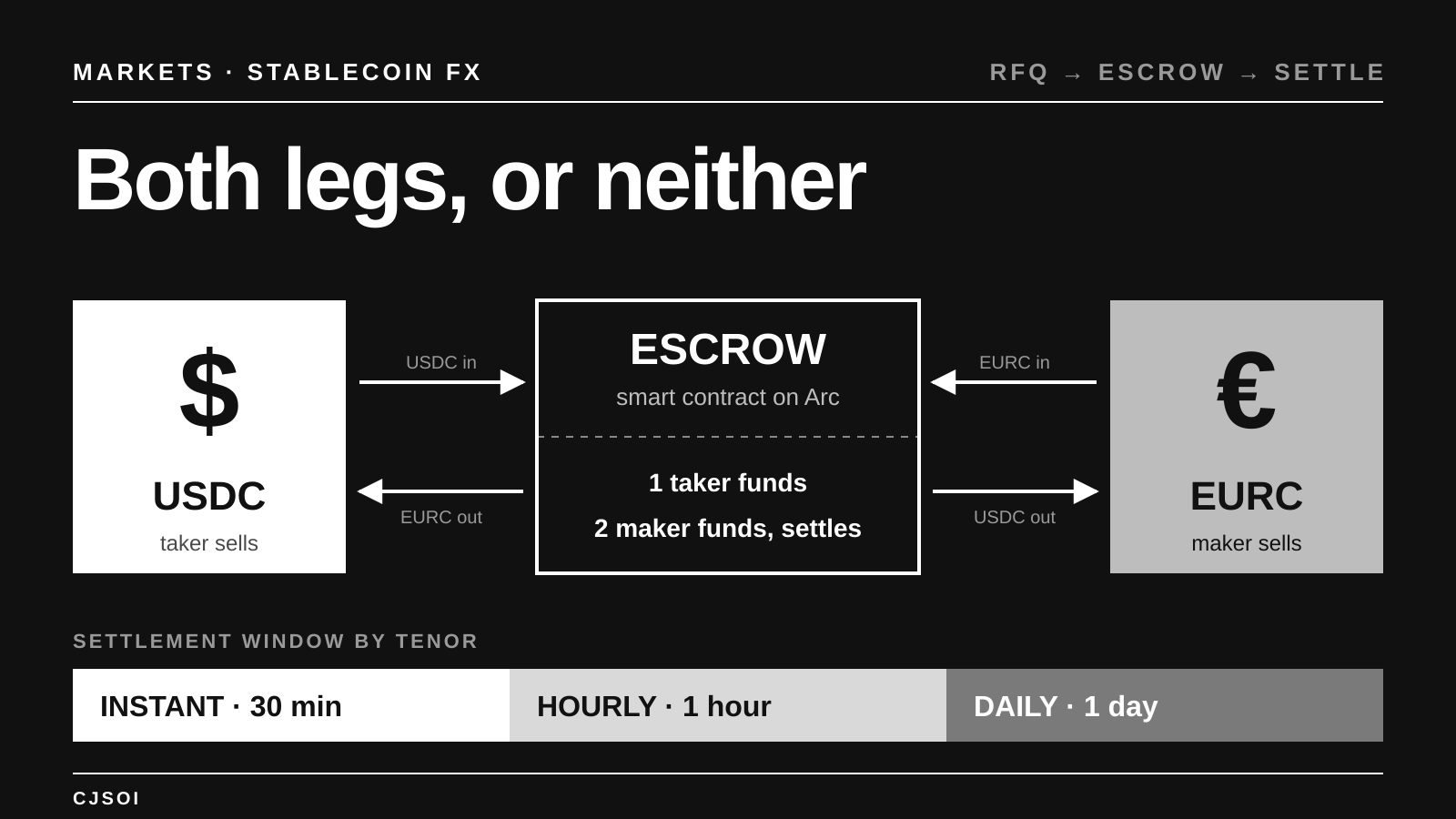
After the taker accepts, both parties sign the trade, and StableFX submits it to a smart contract on Arc called FxEscrow. The guide gives both sides a 10-minute window to submit signatures before the trade expires.
The taker chooses a settlement schedule, called a tenor:
| Tenor | Settlement window from trade creation |
|---|---|
| Instant | 30 minutes |
| Hourly | 1 hour |
| Daily | 1 day |
Settlement then runs in two steps. The taker funds first, through a signed Permit2 authorization that lets the contract pull the taker’s tokens into escrow. The maker then funds its leg, which triggers settlement. The contract sends the taker the bought currency minus the taker fee, sends the maker the sold currency minus the maker fee, and sends both fees to a StableFX fee wallet.
Circle’s product page calls this payment-versus-payment: “both sides of a trade settle or neither does.” Makers can also fund only their net position with a taker. Circle’s example: a maker selling 100 USDC for 90 EURC in one trade, and selling 90 EURC for 100 USDC in another with the same taker, has a net position of zero and sends nothing to the contract. The numbers in that example are Circle’s illustration, not market rates.
What happens if one side does not pay
Escrow removes principal risk only if the trade completes or unwinds cleanly. For trades that settle later, StableFX can hold a risk buffer: a share of the notional amount, from the taker, the maker or both, locked in escrow when the trade is recorded. Circle sets the buffer per maker and currency pair, and it can be zero.
If a trade reaches maturity unsettled, the contract’s breach function expires it:
- If neither party funded, both buffers are returned.
- If only one party funded, the other party is treated as in breach. Its buffer goes to the funding party as compensation, and the funding party gets its own buffer and funds back.
That protects the principal of the side that paid. It does not remove replacement risk: the party left without its currency may have to trade again at a different rate.
Which currencies trade
Circle’s StableFX page lists USDC and EURC alongside local stablecoins from other issuers in its Partner Stablecoins program, including tokens in Australian dollars, Brazilian reais, Canadian dollars, Swiss francs, sterling, Korean won, Mexican pesos, Swedish kronor and South African rand. Circle’s Arc mainnet announcement of September 16, 2026 gives a longer list of local stablecoins “active or onboarding”. A listed token is only as good as its issuer’s reserve and redemption terms, which differ by issuer and country. Euro tokens are compared on our euro stablecoin list, and EURC and USDC have their own entries.
What stablecoin FX does and does not change
| Question | Bank FX settlement | Onchain stablecoin FX (as documented by Circle) |
|---|---|---|
| Who sets the price | Dealers and banks | Makers answering an RFQ |
| When it can settle | Operating hours of each currency’s payment systems | 24/7 on Arc |
| Principal risk | Depends on the settlement arrangement | Escrow releases both legs together |
| Replacement risk on failure | Remains | Remains |
| What the holder ends with | A bank deposit | A stablecoin, a claim on its issuer |
The last row matters most. Settling in tokens moves the credit question from the bank to the stablecoin issuer. A taker that receives EURC holds a claim on Circle’s euro reserve; one that receives a local partner token holds a claim on that issuer. Converting back to bank money is a separate step, covered in our guide to stablecoin redemption.
Questions
Is stablecoin FX cheaper than bank FX?
Circle’s documentation describes its fees and RFQ pricing but does not publish a fee schedule or a comparison with bank FX, so no general answer can be given from its sources.
Can a retail user trade on StableFX?
Circle describes it as a permissioned platform for vetted institutions, accessed through an API key from Circle.
Does onchain settlement mean the trade cannot fail?
No. A trade can expire unsettled if a party does not fund it. The escrow and risk buffer decide who gets what back.
Does StableFX run only on Arc?
Circle’s documentation describes it as built on Arc, with test keys executing against Arc testnet and live keys against Arc mainnet.
Sources
- Circle Docs, “StableFX” overview (checked October 20, 2026)
- Circle Docs, “StableFX technical guide” (checked October 20, 2026)
- Circle Docs, “StableFX risk buffers” (checked October 20, 2026)
- Circle, “Circle StableFX” product page (checked October 20, 2026)
- Circle, “Circle Launches Arc Mainnet, an Economic Operating System for the Internet,” September 16, 2026
More from the Markets desk.