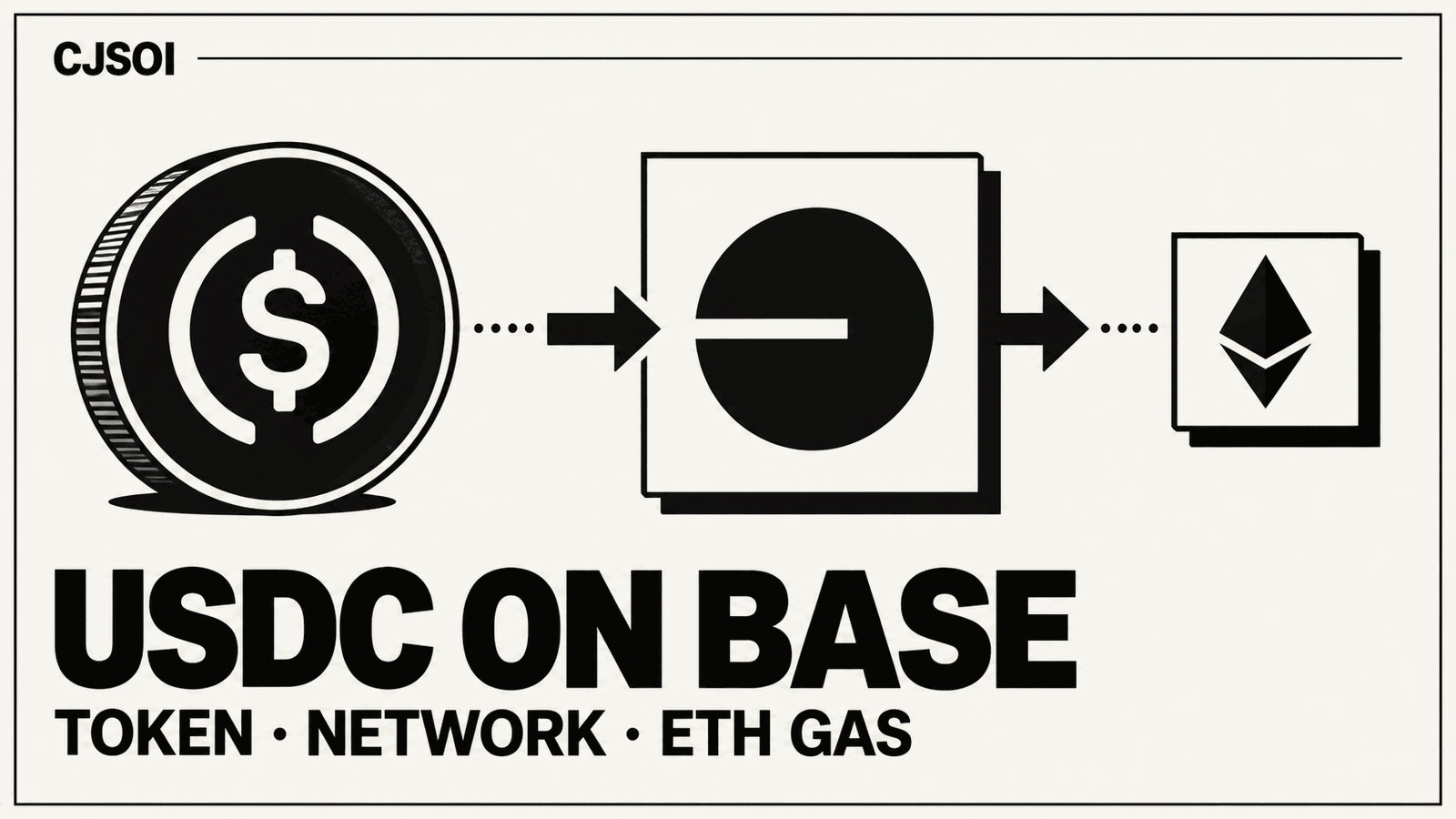
USDC on Base is Circle-issued USDC on the Base network. It uses Base’s own token contract, and a normal transfer needs a small amount of ETH on Base for network fees. The practical rule is simple: confirm the destination supports USDC on Base, verify the token contract, and keep Base ETH in the sending wallet before you press send.
Sources checked: 18 October 2026.
The short version
A safe USDC Base transfer has four checks:
- Select Base, not Ethereum, Polygon, Arbitrum or another network.
- Use Circle’s Base USDC contract:
0x833589fCD6eDb6E08f4c7C32D4f71b54bdA02913. - Hold enough ETH on Base to pay the transaction fee.
- Confirm that the receiving wallet, exchange or payment service accepts deposits on Base.
The asset may be called USDC in every interface, but the network is part of the transfer instruction. A matching ticker does not make two chain-specific balances interchangeable. If the destination only credits Ethereum USDC, sending Base USDC to the same-looking address may require recovery or may not be credited at all.
Circle lists Base among the networks where USDC is supported and publishes the official Base mainnet contract address. Base mainnet has chain ID 8453, according to Base’s own JSON-RPC documentation.
Native USDC on Base
USDC on Base is an ERC-20 token issued through Circle’s official contract for that network. It is not the Ethereum USDC contract copied onto another chain, even though Base is compatible with Ethereum tooling and wallet addresses often look the same.
That distinction matters because a wallet can display several assets named USDC or show an imported token that is not Circle-issued USDC. Before receiving a large payment, compare the contract shown by the wallet or explorer with Circle’s published address.
Circle describes USDC as a dollar-backed digital currency available on multiple blockchains and says its reserve holdings are covered by monthly attestation reports. Those issuer and reserve claims apply to Circle-issued USDC. They do not automatically apply to every token that uses “USDC” in its name.
For a broader comparison of token standards, read ERC-20: USDT and USDC on Ethereum explained. The transferable unit can use the same token standard on two EVM chains while still being a different contract in a different ledger.
How to send USDC on Base
Start at the destination, not the sending wallet. Open the receiving exchange, custodian, payment processor or wallet and choose USDC deposits. Check that Base appears as a supported network. Copy the deposit address only after making that selection.
In the sending wallet:
- Choose the Base network.
- Select the Circle-issued USDC token.
- Paste the destination address and compare the first and last characters.
- Enter the amount.
- Review the network label, token, address and estimated fee.
- Send a small test transfer when the destination or route is new to you.
- Wait for the destination service’s required confirmations before sending the remainder.
A test transfer reduces address and network-selection risk, but it does not guarantee that a later service outage, compliance review or deposit rule will produce the same timing. Save the transaction hash so the transfer can be traced on a Base block explorer.
If you are still choosing among networks, use Choosing a network for stablecoin transfers. The cheapest visible fee is only one part of the decision; destination support and the cost of moving funds onto the chosen network matter as well.
Why Base fees are paid in ETH
Base uses ETH as its native gas asset. A wallet needs ETH on Base even when the value being sent is USDC. The fee is separate from the USDC amount.
The wallet normally estimates the fee before signature. That estimate can change with network conditions and with the transaction’s execution requirements. Do not rely on a fixed dollar figure copied from an old guide. Check the live estimate in the wallet and leave a buffer rather than funding the address with the exact displayed minimum.
Running out of Base ETH creates a familiar trap: the wallet has enough USDC but cannot submit the transfer. Sending more USDC to the address does not solve the gas problem. The address needs ETH on Base.
Base documentation identifies chain ID 8453 for mainnet. That is a useful wallet and RPC check, but it is not a substitute for reading the destination’s deposit instructions. A service can support Base generally while disabling a particular asset or pausing deposits.
Moving USDC from Ethereum to Base
A cross-chain move is not a normal token transfer. Sending Ethereum USDC to an address while the receiving app expects Base USDC does not itself move the balance between networks.
Circle’s Cross-Chain Transfer Protocol moves USDC across supported blockchains through a burn-and-mint design rather than a traditional liquidity pool. On a CCTP route, USDC is burned on the source chain and minted on the destination chain after the required message is attested. The interface providing the route may add its own steps, limits and fees.
Users can also encounter third-party bridges or exchange withdrawal routes. These are not all equivalent. Before using one, check:
- which token is received on Base;
- whether it is Circle-issued native USDC or a bridged representation;
- which party operates the interface;
- the quoted fee and minimum;
- the expected completion stage; and
- the recovery process for a wrong destination or unsupported deposit.
Circle’s documentation says CCTP natively transfers USDC and offers standard and fast transfer modes. The provider’s live interface is the place to confirm which routes and options are actually available for a specific transfer.
Base USDC versus bridged tokens
“Bridged USDC” describes a token created by a bridge route rather than minted through Circle’s native USDC contract on the destination chain. A bridged token may track USDC economically, but it can have a different contract, issuer relationship and redemption route.
Circle explicitly warns Circle Mint users not to send unsupported tokens or bridged USDC to a Circle Mint address. That warning is a useful general lesson: check the exact asset and contract, not only the ticker.
For readers comparing issuer facts across networks, the CJSOI stablecoin list separates the stablecoin from the route used to move it. The official Base USDC contract is also the most reliable identity check when a wallet lists similarly named tokens.
Common failure cases
The wallet has USDC but no ETH
The transaction cannot be submitted until the address has ETH on Base. Buy, withdraw or bridge a small amount of ETH specifically to Base, using a route you have verified.
The destination supports USDC but not Base
Do not assume the deposit will be credited. Use a network explicitly offered by the destination or convert through a supported cross-chain route first.
The token contract does not match Circle’s address
Treat it as a different asset until you can identify the issuer and bridge. Do not send it as though it were native USDC.
The transfer is pending
Use the transaction hash to check whether the transaction was submitted, included or failed. A wallet’s activity label is less precise than the on-chain record. If the transaction is confirmed but the platform balance is missing, contact that platform with the hash and its deposit details.
The transaction failed
A failed on-chain transaction does not move the USDC, but it can still consume gas for the work the network performed. Read the receipt, correct the cause and make sure the address still has enough ETH before retrying.
A final pre-send checklist
Before a meaningful transfer, confirm all five items:
- Asset: Circle-issued USDC.
- Network: Base mainnet.
- Contract:
0x833589fCD6eDb6E08f4c7C32D4f71b54bdA02913. - Gas: ETH available on Base.
- Destination: Base USDC deposits are currently enabled.
That checklist takes less time than a recovery request and catches the most expensive category of stablecoin mistake: a correct address paired with the wrong network or token contract.