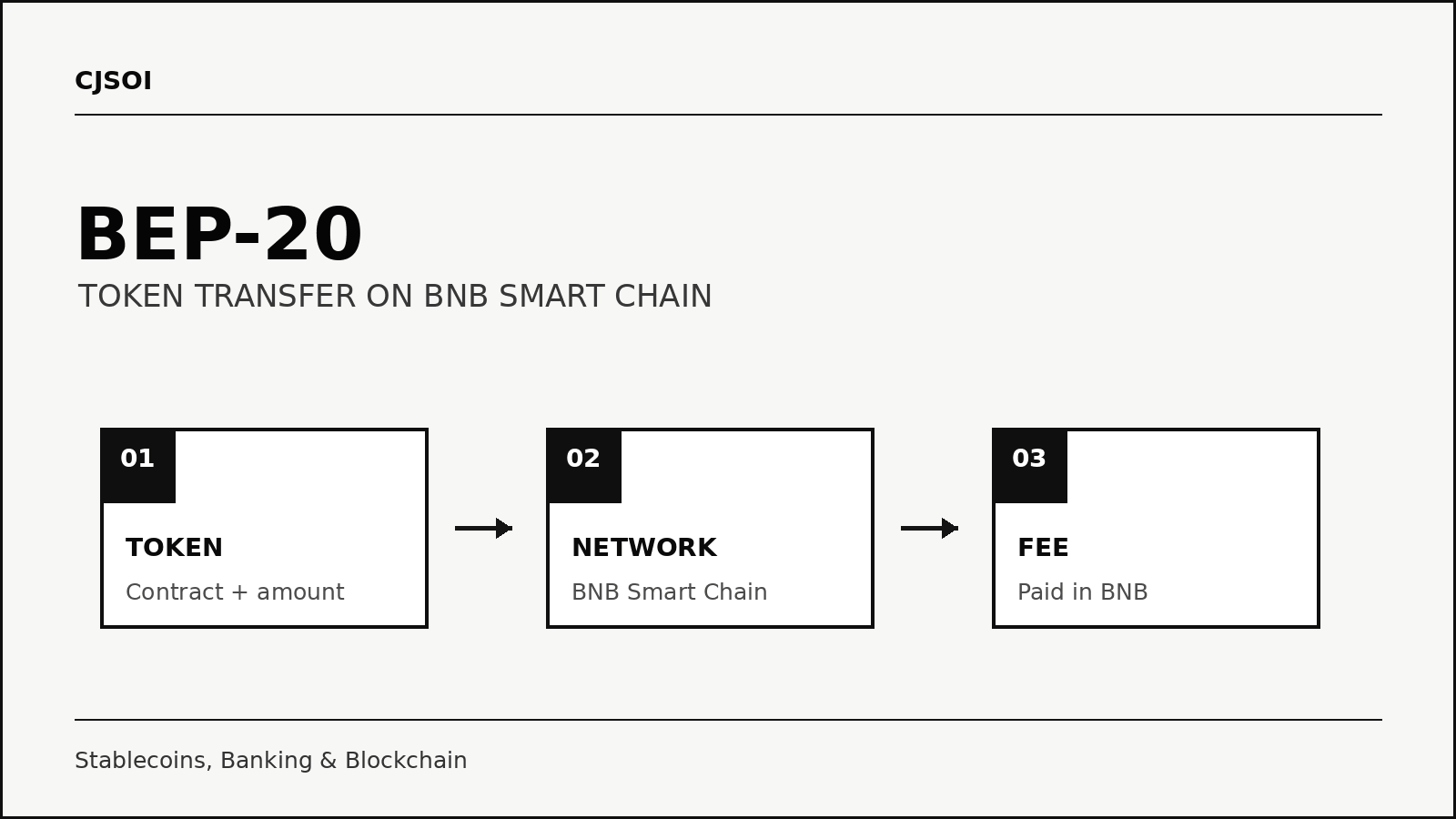
BEP-20 is the fungible-token interface used on BNB Smart Chain. It is similar to Ethereum’s ERC-20 model, but the token lives on BNB Smart Chain and a normal wallet transfer pays its network fee in BNB. The label tells you the token standard; it does not prove that a particular exchange, wallet or issuer supports the asset you are about to send.
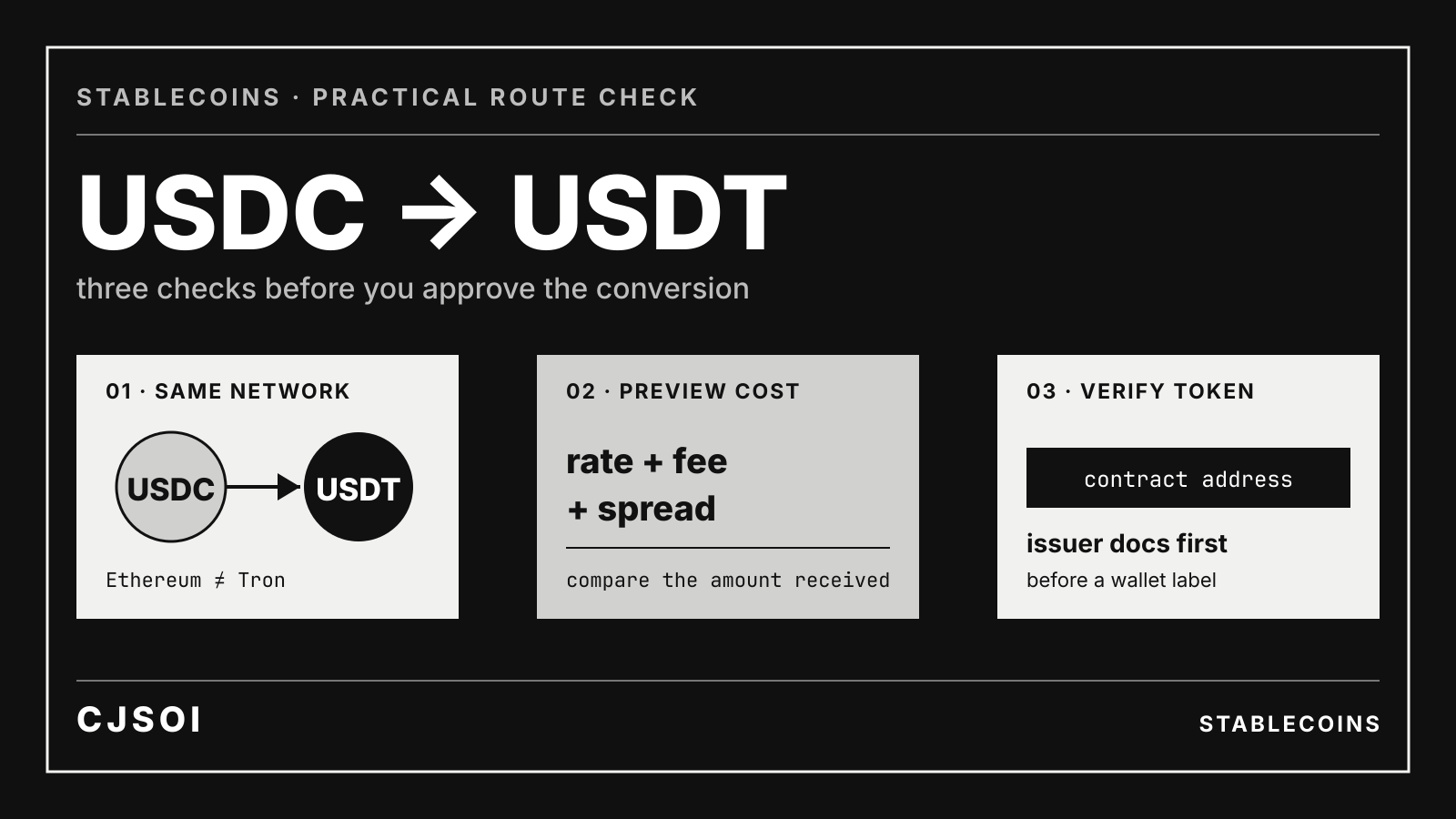
That distinction matters most with stablecoins. A token symbol can look familiar on several chains while the contracts and deposit routes are different. Before moving USDT, USDC or another token, match the network, full contract and destination support.
BEP-20 describes a token contract
BNB Chain’s current documentation says tokens can be created on BNB Smart Chain in a format similar to Ethereum’s ERC-20 standard. BNB Smart Chain is EVM-compatible, so familiar Ethereum tools and contract patterns can work there with limited changes.
A BEP-20 token contract normally keeps a ledger of balances and exposes standard actions such as:
- checking an account’s token balance;
- transferring tokens to another address;
- approving another contract to spend a defined allowance;
- moving tokens through that allowance;
- reporting supply and token metadata.
These functions make wallets, explorers and applications able to interact with many tokens through one common interface. They do not make all tokens equivalent. The issuer, contract address, reserves, redemption terms and supported networks remain specific to each asset.
BEP-20, BEP-2 and ERC-20 are not the same route
The names refer to different environments.
| Label | Where it is used | Network fee asset | Practical check |
|---|---|---|---|
| BEP-20 | BNB Smart Chain | BNB | Confirm the BNB Smart Chain token contract |
| ERC-20 | Ethereum and compatible token interfaces | The chain’s native fee asset | Confirm the selected network and contract |
| BEP-2 | The former BNB Beacon Chain token format | Legacy route | Do not treat it as a current BNB Smart Chain transfer |
BNB Chain’s token-economy documentation describes BSC tokens as similar in format to ERC-20 and separately describes the older BEP-2 system. A hexadecimal address can look valid on more than one EVM-compatible chain. That does not mean the receiving service watches every chain at that address.
This is why “the address looks right” is incomplete. The sender and receiver must agree on the network and token.
BNB pays the gas fee
BNB is the native utility token of BNB Smart Chain. BNB Chain’s documentation identifies it as the asset used for smart-contract execution and transaction fees.
A self-custody wallet therefore needs two balances for a normal BEP-20 transfer:
- the BEP-20 token being sent;
- enough BNB to pay the network fee.
Holding only the stablecoin is not normally enough to submit the transaction. A wallet or service may sponsor the fee or charge it through another arrangement, but that is a product feature. It does not change the network’s fee asset.
The fee is based on the work performed and the gas price, not directly on the face value of the stablecoin. A token transfer calls a contract. The wallet estimates the required gas before signing, and the transaction receipt records what was used after inclusion.
BNB Chain’s overview, dated March 16, 2026, says BSC adopted a 0.05 gwei standard gas price and describes typical fees as roughly $0.005 or less. Treat that figure as documentation context, not a guaranteed quote. Gas settings, token contracts and service charges can change. The wallet’s live confirmation screen is the source for the transaction you are about to sign.
A token symbol is not enough
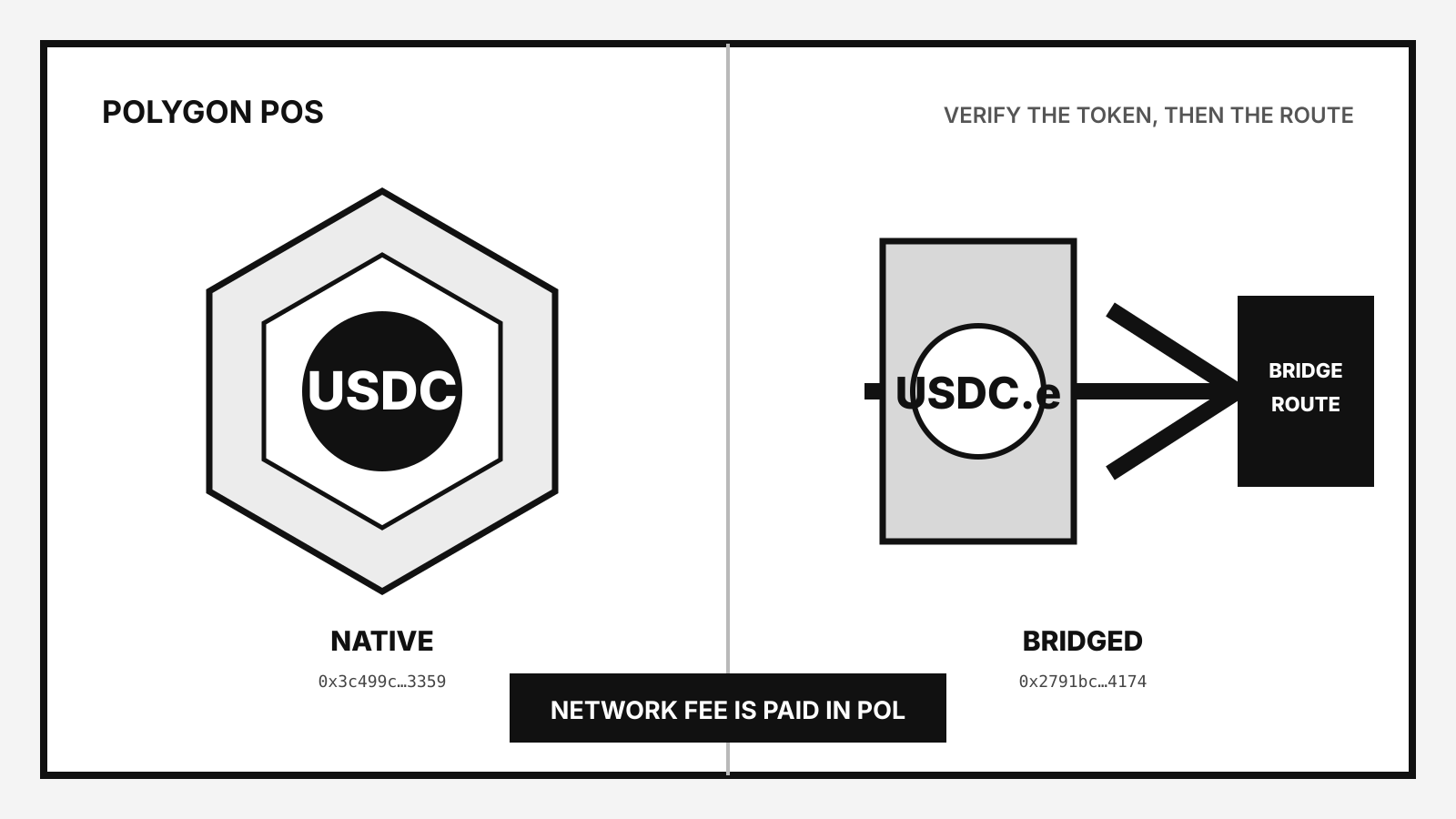
Anyone can deploy a token contract and choose a familiar name or symbol. A wallet showing “USDT” or “USDC” does not by itself prove that the token is the issuer-supported asset.
Verify:
- the network is BNB Smart Chain;
- the full token contract matches an official issuer or destination listing;
- the receiving exchange or wallet explicitly supports that asset on BNB Smart Chain;
- the recipient address was copied from the intended account;
- there is enough BNB for the fee.
Check the entire contract address. Short labels and logos are interface conveniences. They are not identity proofs.
CJSOI’s network-selection guide explains the same rule across chains. The stablecoin list keeps issuer and network information separate from transfer routing.
How a BEP-20 transfer works
A normal wallet transfer has four stages.
1. The wallet builds a contract call
The wallet selects the token contract, recipient and amount. The token amount uses the contract’s own decimal setting, while the network fee is calculated separately.
2. The wallet signs the transaction
The private key authorizes the call from the sending account. Review the network, contract, recipient, amount and estimated BNB fee before signing.
3. A validator includes the transaction
BNB Smart Chain uses Proof of Staked Authority. BNB Chain’s current introduction says the chain has 45 active validators and uses fast finality. The March 16, 2026 documentation describes a 0.45-second block time and finality in roughly 1.125 seconds when normal fast-finality votes are available.
Fast network inclusion is not the same as exchange crediting. A custodial platform can wait for its own confirmation threshold and internal screening before updating the user’s balance.
4. The receipt records the result
The receipt shows whether execution succeeded, how much gas was used and which token event was emitted. Save the transaction hash. It is the best reference when a recipient or exchange investigates a missing credit.
What happens after a wrong-network transfer
Recovery depends on who controls the destination address and which contract received the token.
If the destination is a self-custody wallet and the same private key controls the BNB Smart Chain address, the token may be present even when the wallet interface does not display it. Adding the verified token contract can reveal it.
If the destination belongs to an exchange or custodian, only that operator can decide whether an unsupported deposit is recoverable. Contact the platform through its official support channel and provide the transaction hash, network, token contract and destination address. Do not send another payment as a test until the first transaction is understood.
A successful receipt proves that the contract call executed on BNB Smart Chain. It does not prove that a platform supports or credited the deposit.
A final BEP-20 checklist
Before signing, confirm all seven:
- BNB Smart Chain is selected at both ends;
- the token contract matches an official source;
- the destination supports that token on BNB Smart Chain;
- the recipient address is complete and correct;
- the wallet has enough BNB for gas;
- the amount and fee preview are expected;
- the transaction hash will be saved after broadcast.