A fiat-backed stablecoin is only as liquid as the bank accounts behind it. Issuers keep part of their reserves as cash deposits at commercial banks because redemptions are paid out as bank transfers. That makes the issuer a large depositor, and it means a bank failure can reach a stablecoin even when the token’s own blockchain works normally.
This explainer looks at that link through the most fully documented case, USDC, and at the rules that now set how much of a reserve must, or may, sit in bank deposits.
Why a reserve needs bank cash
When a customer redeems stablecoins, the issuer burns the tokens and sends dollars or euros to the customer’s bank account. Treasury bills and money market fund shares cannot be wired to a customer directly; they have to be sold or redeemed first. Cash at a bank can be paid out the same day.
Circle explained this split in a March 28, 2023 post. At the time, it said the USDC reserve was held about 80% in short-dated US Treasuries and about 20% in cash deposits in the US banking system, and that it held the cash “to satisfy the immediate liquidity needs of our customers”. It added that Circle, “like every institution, relies on a safe, well-regulated commercial banking system to house those cash reserves”.
The step from token to bank money is covered in our guide to stablecoin redemption.
What the USDC reserve discloses today
Circle’s transparency page splits the USDC reserve into categories that show where the bank exposure sits:
- Other bank deposits: deposits held as reserves that are not with systemically important institutions.
- Deposits at systemically important institutions: Circle defines these as globally or domestically significant financial institutions and national central banks.
- Treasuries and overnight reverse repurchase agreements, which Circle says may be held in custodial accounts, in a separately managed account, or in the Circle Reserve Fund (USDXX), a 2a-7 money market fund managed by BlackRock.
Circle says the reserves are held separately from its operating funds, for the benefit of USDC holders. The page shows current balances by category; check it for the latest figures rather than relying on a snapshot.
March 2023: when a reserve bank failed
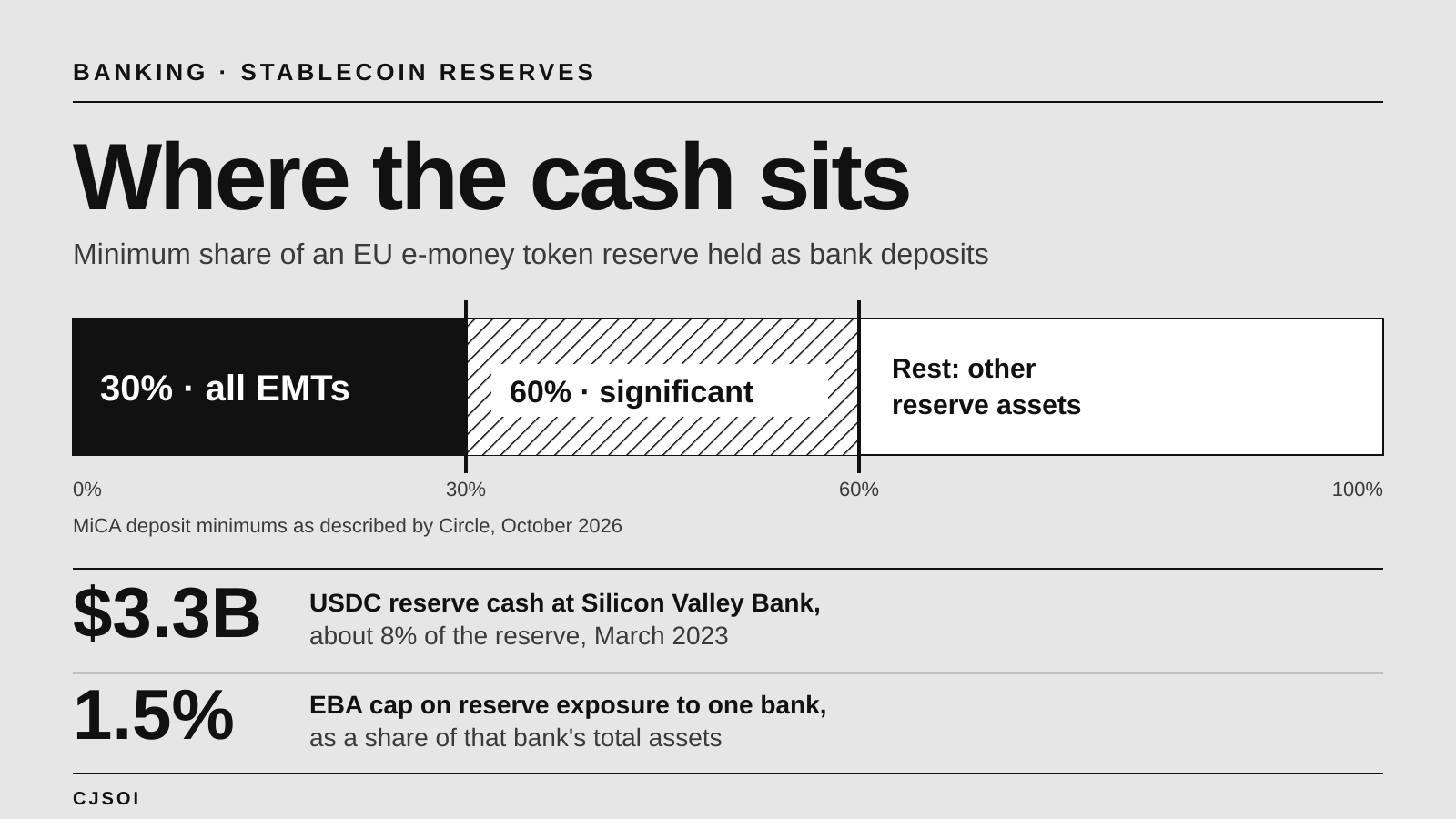
The risk became concrete in March 2023. In a press release dated March 12, 2023, Circle said $3.3 billion of the USDC reserve, about 8% of the total, was deposited at Silicon Valley Bank. It said the deposit would be fully available when US banks reopened, after the joint announcement by the US Treasury and prudential regulators that all depositors of Silicon Valley Bank and Signature Bank would be made whole. Circle said no USDC cash reserves were held at Signature Bank.
The same release said the reserve was then 77% ($32.4 billion) short-dated Treasury bills, held in custody by BNY Mellon and managed by BlackRock, and 23% ($9.7 billion) cash, “now held primarily at BNY Mellon”.
In its March 28 post, Circle said it had since moved “substantially all of the cash portion of the reserve” to one of the world’s 30 global systemically important banks, while keeping “modest funds” at transaction banking partners. The price effect of that weekend is covered in our explainer on how a stablecoin peg holds and breaks.
The trade-off: concentration or spread
The 2023 response shows the choice every issuer faces. Concentrating cash at a few very large banks reduces the chance that one of them fails. Spreading it across many banks reduces the share lost if one does, but adds operational work: more accounts to open, monitor and reconcile, and more payment relationships to keep running for redemptions.
Rules now push issuers in both directions.
What MiCA requires in the EU
In the EU, stablecoins referencing one official currency are e-money tokens (EMTs) under MiCA. In its October 1, 2026 response to the European Commission’s MiCA review, Circle summarized the deposit rules as follows:
| Rule | As described by Circle |
|---|---|
| Minimum bank deposits, EMT issuers | 30% of reserve assets |
| Minimum bank deposits, issuers of significant EMTs | 60% of reserve assets |
| Single-sovereign exposure (EBA technical standards) | Capped at 35% |
| Exposure to one bank (EBA technical standards) | Capped at 1.5% of that bank’s total assets |
Circle argued that the minimum deposit rule increases exposure to bank credit and counterparty risk, and that the per-bank cap “will require larger issuers to maintain reserve relationships with dozens of separate banks”. It asked for the deposit minimum to be replaced with a liquidity requirement and for both caps to be removed. These are Circle’s descriptions and arguments in a consultation; the rules have not changed.
The higher 60% figure became relevant to USDC on October 14, 2026, when the European Banking Authority classified USDC as the EU’s first significant EMT, with EBA supervision of its reserve and liquidity from November 12, 2026. Our MiCA and stablecoins guide covers the wider framework.
What the US proposals say
In the United States, the GENIUS Act framework is still being written into rules. On September 24, 2026, the Federal Reserve Board asked for comment on a proposal that would require Board-supervised payment stablecoin issuers to fully back their tokens with permissible reserve assets, “such as short-term Treasury bills and certain other high-quality, liquid assets”. The proposal would also set capital requirements and introduce rules for Board-supervised firms that safekeep the assets backing payment stablecoins. It is a proposal, not a final rule. Which agency supervises which issuer is explained in Who regulates a stablecoin?
How to read a reserve report for bank risk
When you compare stablecoins on our stablecoin list, four questions show how much the token depends on banks:
- What share of the reserve is cash at banks? That is the part exposed to a bank failure, and also the part available for same-day redemptions.
- Are the banks named, or at least classified? Circle’s split between systemically important institutions and other banks is one example of useful disclosure.
- Is the reserve segregated? Look for a statement that reserves are held for holders and separately from the issuer’s operating funds.
- Who holds the securities? Custody at a named bank or a regulated money market fund is different from securities held at an unnamed counterparty.
The questions apply to any issuer. The answers come only from that issuer’s own reports and its regulator.
Questions
Are stablecoin reserves held at the central bank?
Not in USDC’s case as of Circle’s 2023 post, which said holding the cash portion with the Federal Reserve was an aspiration that would require legislation. Circle’s current transparency page counts national central banks within its systemically important institutions category.
Did USDC holders lose money when Silicon Valley Bank failed?
Circle said the $3.3 billion deposit would be fully available after the US authorities announced that all depositors would be made whole, and that USDC remained redeemable 1:1.
Why not hold the whole reserve in Treasury bills?
Redemptions are paid in bank money. Circle has said it keeps cash for customers’ immediate liquidity needs, and MiCA sets a minimum share of bank deposits for EMT issuers.
Sources
- Circle, USDC transparency page (checked October 20, 2026)
- Circle, “$3.3 Billion of USDC Reserve Risk Removed, Dollar De-peg Closes,” March 12, 2023
- Circle, “How the USDC Reserve is Structured and Managed,” March 28, 2023
- Circle, “Circle’s Response to the European Commission’s MiCA Review Consultation,” October 1, 2026
- EBA, “The EBA classifies USDC as the first significant e-money token in the European Union,” October 14, 2026
- Federal Reserve Board, press release on GENIUS Act proposals, September 24, 2026
More from the Banking desk.