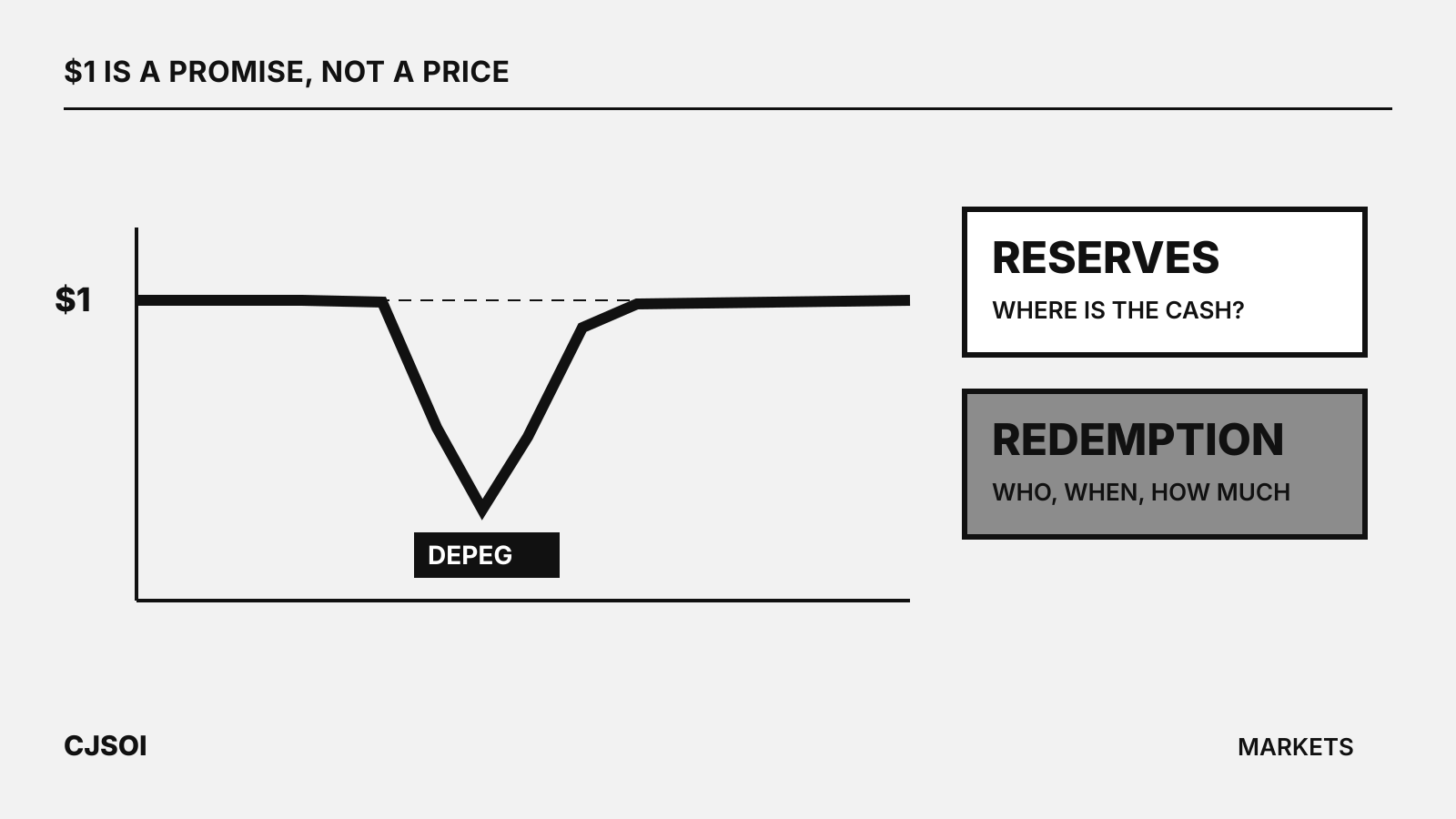
A stablecoin can lose value. The $1 target is a promise backed by an issuer’s reserves and redemption terms, or by an algorithm, and the market price holds near $1 only while traders believe that promise can be used. When access to redemption is interrupted or the backing is in doubt, the price can fall below $1. That is a depeg.
Two documented cases show the range. USDC traded below $1 in March 2023 after part of its cash reserve was caught in a bank failure, then recovered once the cash was available. TerraUSD (UST), which had no reserve assets, depegged in May 2022 and fell close to zero.
How the peg is supposed to hold
For a reserve-backed stablecoin, the mechanism is redemption plus arbitrage.
Circle’s Circle Mint documentation says every token “mints and redeems at a 1:1 ratio with the underlying fiat currency.” An eligible institution that buys USDC for $0.99 on an exchange can redeem it with Circle for $1.00. An institution that sees USDC trading at $1.01 can deposit dollars, mint new USDC and sell it. Both trades push the market price back toward $1. These are illustrative prices, not quotes.
Who can make those trades matters. Circle Mint is for institutional customers and “is not available to individuals,” according to Circle’s product page. Tether’s fees page sets a minimum redemption of $100,000, with a fee of the greater of $1,000 or 0.1%, and a one-time verification fee of 150 USDT. Retail holders rely on exchanges and the institutions that arbitrage on their behalf.
Our redemption guide follows the steps between handing back a token and receiving dollars.
What can break it
| Pressure | What happens | Example |
|---|---|---|
| Reserve access | Part of the backing is temporarily unavailable | USDC, March 2023 |
| Redemption hours | Issuers redeem through banks that close at weekends | USDC, March 2023 |
| No reserve assets | Confidence in the mechanism collapses | UST, May 2022 |
| Market structure | Thin liquidity on one venue or network | Local price gaps |
The first two pressures are about timing. The third is about design. The fourth can produce brief price differences between exchanges without saying anything about the issuer.
USDC in March 2023: a reserve-access depeg
Silicon Valley Bank was closed by U.S. authorities on Friday, March 10, 2023. Circle’s March 12 statement recounts that on March 11 it had shared details of the reserve: 77% ($32.4 billion) in short-dated Treasury bills and 23% ($9.7 billion) in cash, with $3.3 billion of that cash held at SVB. Redemption runs through bank wires, and banks were closed for the weekend, so holders could not test the 1:1 promise until Monday.
USDC traded below $1 over that weekend. On March 12, after the U.S. government announced that all SVB depositors would be made whole, Circle said the $3.3 billion, about 8% of the total reserve, would be fully available when banks opened, and that “USDC remains redeemable 1:1 with the U.S. Dollar.”
By the close of business on March 15, Circle reported that it had cleared “substantially all” minting and redemption backlogs, having redeemed $3.8 billion and minted $0.8 billion since Monday morning.
The lesson for a reader is narrow and practical. The token’s reserves were largely intact, but holders could not know that for certain until the bank question was settled, and nobody could redeem until banks reopened. The price reflected that uncertainty.
UST in May 2022: a design that failed
TerraUSD worked differently. According to the SEC’s amended complaint against Terraform Labs and Do Kwon, UST was designed to hold $1 through an algorithm that let holders swap one UST for $1 worth of LUNA, and the reverse. The complaint says UST and LUNA “had no reserve of assets or any other backing.”
In May 2022, under selling pressure, UST depegged and “the price of it and its sister tokens plummeted to close to zero,” as the SEC’s February 16, 2023 press release put it. The complaint alleges that an earlier depeg in May 2021 had been reversed by a third party buying large amounts of UST, not by the algorithm. Those are the SEC’s allegations, set out in its filing.
The contrast with USDC is the point. A reserve-backed token that depegs on access problems can recover once access returns. A token whose $1 depends only on demand for a companion token has nothing to redeem against when that demand disappears.
Can a stablecoin go up in value?
It can trade slightly above $1 on a venue when buying demand there exceeds the supply on offer. Arbitrage through minting tends to close the gap. A payment stablecoin is not designed to appreciate, and the GENIUS Act prohibits permitted issuers from paying holders “any form of interest or yield” solely for holding, using or retaining the coin.
For the economics behind reserves, see how stablecoin issuers make money. For a comparison of the two largest tokens’ reserves and redemption terms, see USDT vs USDC, and for current issuer data, the stablecoin list.
How to read peg risk in practice
- Find the redemption route. Who can redeem, with what minimum, fee and timing?
- Read the latest reserve report. Note its date and what share is cash, Treasury bills or other assets.
- Check where cash is held. Concentration at one bank was the 2023 problem.
- Ask what happens at weekends. On-chain trading never stops; bank transfers do.
- Separate design from venue. A price gap on one exchange is not the same as an issuer problem.