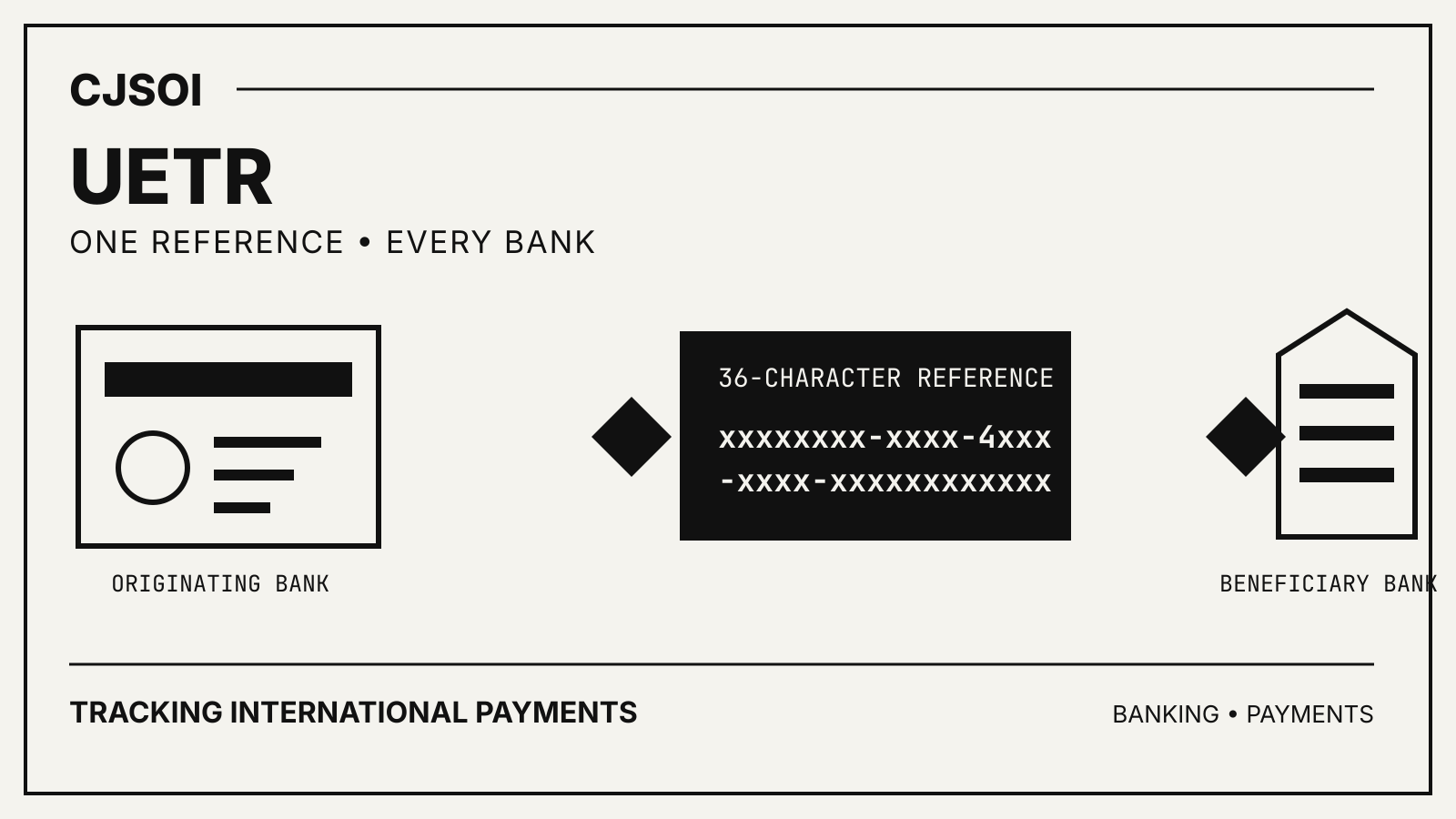
UETR payment tracking gives banks one reference for tracing a payment instruction carried over Swift. The name expands to Unique End-to-end Transaction Reference. It is a 36-character identifier that stays with the payment as it moves from the sending bank through any intermediary banks to the beneficiary bank.
The important limit is in the name: a UETR identifies the payment. It does not, by itself, give the public access to Swift’s Tracker. Your bank or payment provider still controls what status information you can see and how an investigation is opened.
Source check: Swift documentation reviewed October 21, 2026.
What a UETR identifies
Swift describes the UETR as a single reference used across the payment chain. Instead of each institution relying only on its own internal reference, the sending, intermediary and beneficiary banks can refer to the same identifier.
That matters when a transfer is delayed. A bank can use the UETR to find the payment in its own records and, where it has access, check the status reported through Swift tracking services. Swift says the reference supports status updates such as a payment being credited to the beneficiary or rejected along the route.
The identifier does not tell you the amount, beneficiary or reason for a delay when read on its own. It is a lookup key, not a complete payment record.
Where to find the UETR
The sender’s bank generates the UETR when it creates the payment instruction. A customer may see it on a transfer confirmation, payment advice or transaction detail page. Banks do not all label it in the same way, so it may appear as “UETR,” “Unique End-to-end Transaction Reference” or an end-to-end payment reference.
For the legacy MT103 message format, Swift’s implementation guidance places the UETR in field 121. In the ISO 20022 payment flow, the reference is carried in the payment-identification data. The visible format can change between bank documents even though the reference remains the same across the chain.
If the confirmation does not show it, ask the sending bank for the UETR attached to the transfer. Give the bank the payment date, amount, currency and beneficiary details so it can locate the correct instruction.
What the UETR can help a bank check
A UETR gives the payment operations team a precise reference for questions such as:
- whether the sending bank released the instruction;
- whether an intermediary bank received it;
- whether the beneficiary bank credited or rejected it;
- whether a bank reported an exception that needs investigation.
Swift compares the UETR with a parcel-tracking number because it is intended to follow one instruction from origin to destination. The comparison has limits. A parcel carrier usually exposes tracking directly to the recipient. Swift tracking is a bank service, and the level of customer visibility depends on the banks and products involved.
Some banks offer a self-service international-payment tracker. Others show a small number of status labels in online banking. A bank may also use the UETR internally while the customer receives updates through support.
What it cannot prove
A UETR does not prove that the beneficiary can use the money. A status saying that a payment reached a beneficiary bank is different from a final credit to the beneficiary’s account. Compliance review, incorrect account details, local clearing cutoffs or a request for more information can still affect the outcome.
It also does not reveal the fee charged by every bank simply by looking at the 36 characters. Swift says UETR-enabled tracking improves transparency over payment location and fees, but that information comes from the payment messages and status reports linked to the reference.
Finally, the UETR is not the same as an account number, IBAN, BIC or bank confirmation number. Those fields answer different questions. If you are reconciling a business payment, keep the UETR together with the invoice number and your bank’s own transaction reference.
Who creates and passes it on
Swift requires the originating institution to generate the UETR for the relevant payment instruction. Intermediary institutions should not replace it with a new UETR. Their systems must receive, copy and pass on the identifier that arrived with the payment.
The beneficiary bank must also be able to receive and process the reference for reconciliation. For cover payments, Swift says the institution issuing the cover payment must copy the original UETR into the related cover message.
That continuity is the practical value of the identifier. A new reference at each hop would break the end-to-end view and force operations teams to reconcile several local numbers.
UETR and Swift GPI are related, but not identical
The UETR is the identifier. Swift GPI and the Tracker are services that use it.
Swift says UETRs enable functions such as payment tracking and universal confirmations. Its API channel also offers access to GPI services, including the Tracker, corporate tracking, payment pre-validation and case resolution. Access is designed for financial institutions and connected corporate users; a consumer cannot assume that entering a UETR on any public website will retrieve an authoritative Swift record.
Treat unsolicited “UETR tracker” websites cautiously. A UETR may be less sensitive than login credentials, but it still belongs to a real payment. Use your bank’s authenticated channel or a tracker that the bank itself identifies.
What to do when an international transfer is late
Start with the sending bank. Ask it to confirm that the payment was released and provide the UETR. Then ask for the latest status and the name of the institution currently handling the payment, if the bank can disclose it.
Useful details to prepare are:
- the UETR;
- sending date and value date;
- amount and currency;
- sender and beneficiary names;
- beneficiary account or IBAN;
- your bank’s local transaction reference.
If the bank says the payment was credited, ask whether that means credited to the beneficiary bank or to the beneficiary account. If it was rejected or returned, request the reported reason and confirm whether fees were deducted.
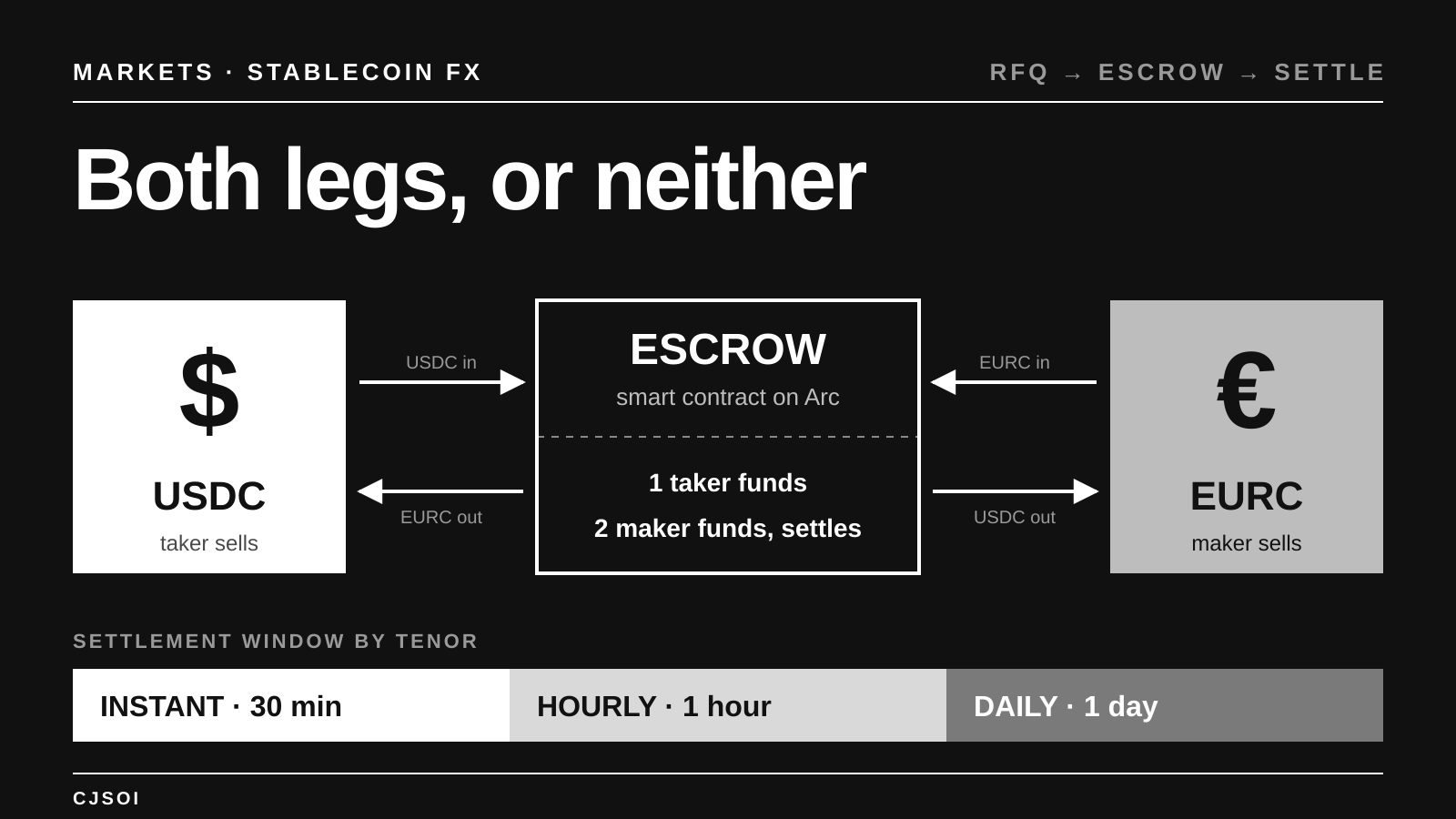
For business payments, reconcile the transfer against the invoice and settlement date rather than treating the tracking status as the accounting record. Our guide to payment versus payment explains why delivery and settlement conditions matter when two assets or currencies move together.
A short example
Suppose a supplier payment leaves Bank A, passes through Bank B and arrives at Bank C. Bank A creates one UETR. Bank B passes the same reference onward. Bank C uses it when reporting the final status.
If the supplier says the money is missing, Bank A does not have to begin with a vague search by amount alone. It can use the UETR to identify the exact instruction and check the status information available to it. The UETR does not guarantee instant delivery, but it gives every bank in the chain a common reference for the investigation.
The practical takeaway
Keep the UETR whenever you send a cross-border payment over Swift. It is the most useful identifier to quote when a bank needs to trace that instruction across institutions.
But do not confuse the identifier with unrestricted public tracking. The reliable route is still the sending bank, its authenticated payment tracker or a connected treasury service. The UETR makes the investigation precise; the bank’s access determines how much of the payment chain you can see.