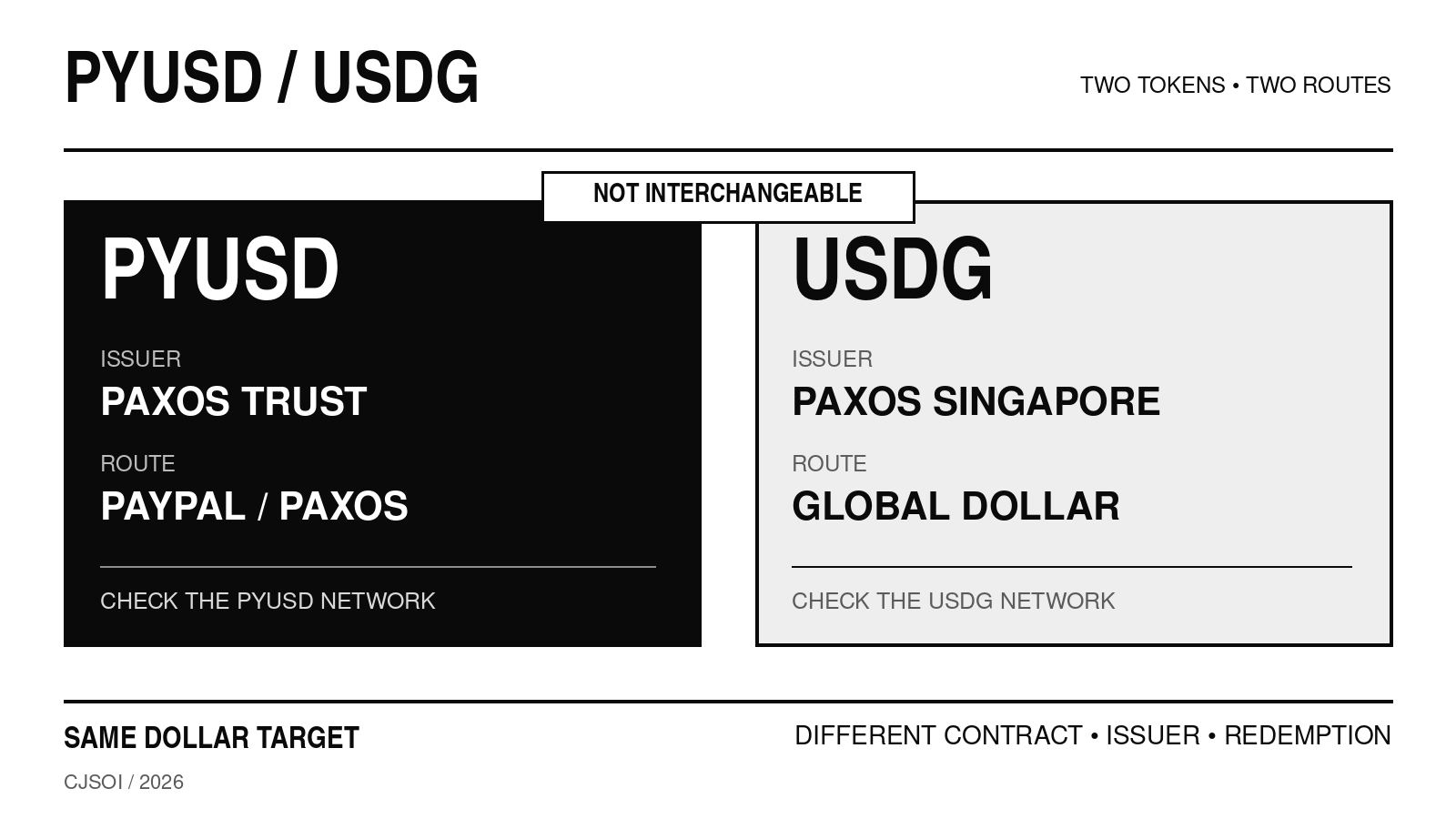
PYUSD and USDG are both dollar stablecoins issued through Paxos entities, but they are not the same token. PYUSD is PayPal’s payment-focused stablecoin issued by Paxos Trust Company, N.A. USDG is Global Dollar, issued in Singapore by Paxos Digital Singapore and also issued in the EU through Paxos Issuance Europe.
For a holder, the practical differences are the token contract and network, the issuer named in the terms, the platforms that support the asset, and the route back to dollars.
The issuer is part of the token’s identity
PayPal markets PYUSD, while Paxos issues it. PayPal’s US cryptocurrency terms state that PYUSD is issued by Paxos, not by PayPal Digital or another PayPal affiliate. Paxos describes PYUSD as a fully backed dollar stablecoin designed for payments and says its reserves are held in dollar deposits, US Treasuries and cash equivalents.
USDG uses a different issuing structure. Global Dollar’s product page names Paxos Digital Singapore Pte. Ltd. as the issuer supervised by the Monetary Authority of Singapore. The same page says Paxos Issuance Europe also issues USDG under Finnish supervision and MiCA. The relevant issuer can therefore depend on the distribution and jurisdiction.
The shared Paxos infrastructure does not make the tokens interchangeable. A PYUSD contract is not a USDG contract, and a platform that accepts one may not accept the other.
Both publish reserve information, in separate reports
Paxos maintains separate transparency pages for PYUSD and USDG. The PYUSD page says Paxos publishes monthly reserve reports and independent attestation reports. Its product page says the reserve is held in US dollar deposits, US Treasuries and cash equivalents for one-to-one redemption.
USDG has its own monthly reserve reporting and attestations. The issuer documentation says its cash and cash-equivalent reserve assets are held in segregated accounts. The reports are specific to each token; a PYUSD attestation is not evidence of the USDG reserve, and the reverse is also true.
“Backed one to one” describes the issuer’s reserve and redemption promise. It does not guarantee that every exchange trade executes at exactly one dollar or that every wallet holder can redeem directly without an eligible account. A secondary-market sale depends on the venue’s liquidity, spread and fees.
Redemption and selling are different routes
Paxos says PYUSD can be converted to dollars through PayPal and Paxos, and its product page advertises zero fees for PYUSD-to-USD conversion with those services. PayPal also says it discloses the exchange rate and applicable fees before a crypto transaction. Availability and terms depend on the account, service and jurisdiction.
USDG’s product page says the token is fully redeemable from Paxos on a one-to-one basis for US dollars. Paxos documentation describes direct purchase and redemption through its platform, subject to its customer and product requirements.
Selling either token on an exchange is separate from issuer redemption. The exchange buys or matches the token under its own order book or conversion service. Check the live amount received rather than assuming that the ticker alone produces a fee-free dollar payout.
For the broader distinction, read how stablecoin redemption works and the USDT-versus-USDC comparison.
Network support changes over time
Paxos’ PYUSD product page listed seven networks when checked on 23 October 2026: Ethereum, Solana, Stellar, Arbitrum, X Layer, Polygon and Stable. PayPal’s US terms named Ethereum, Solana, Arbitrum and Stellar as the networks supported inside PayPal’s own service. Those lists can differ because the token may exist on a blockchain before every wallet, exchange or payment app supports that deployment.
Global Dollar’s product page listed USDG on Arbitrum, Ethereum, Ink, Mantle, Robinhood Chain, Solana and X Layer. It also described support for Solana wallets and Ethereum-compatible wallets.
Treat a stablecoin as the combination of token, network and contract address. Before sending, compare the issuer’s current network list with the receiving platform’s deposit screen. Do not use an address from a different deployment just because the ticker matches.
How to send PYUSD or USDG
The sending sequence is the same for either token, but every field must match the intended asset:
- Open the receiving wallet or exchange and select PYUSD or USDG.
- Choose a supported network shown by that destination.
- Copy the address and any required memo or tag.
- In the sending wallet, select the same token and network.
- Verify the contract through the issuer’s current network page or linked explorer.
- Review the network fee and the final amount.
- Send a small test amount when the destination and minimums make that practical.
The gas asset depends on the network. Ethereum and Ethereum-compatible networks charge their native gas token; Solana charges SOL. The issuer does not set a universal blockchain fee for every wallet. Your wallet or exchange should show the fee or withdrawal charge before confirmation.
PayPal’s service can move PYUSD between eligible PayPal or Venmo accounts and supported external wallets, but the product interface still controls network availability. A PYUSD deployment listed by Paxos is not automatically available in every PayPal region or product flow.
What the Global Dollar Network changes
The Global Dollar Network is an ecosystem around USDG, not a separate stablecoin. Its members can integrate, distribute or use USDG under commercial arrangements. A wallet holder does not need to rename the asset or convert it into a different “network token.”
The network may affect where USDG is distributed and which businesses support it, but the basic checks remain issuer, contract, blockchain and redemption route. Global Dollar says anyone with a compatible wallet can send or receive USDG; direct redemption with Paxos remains subject to Paxos’ platform requirements.
The network selection guide covers deposit compatibility, and the stablecoin list separates issuer information from supported deployments.
A direct comparison
| Question | PYUSD | USDG |
|---|---|---|
| Primary product identity | PayPal USD, issued by Paxos | Global Dollar, issued through Paxos entities |
| Issuer named in current product material | Paxos Trust Company, N.A. | Paxos Digital Singapore; Paxos Issuance Europe for EU issuance |
| Reserve reporting | Separate PYUSD monthly reports and attestations | Separate USDG monthly reports and attestations |
| Direct dollar route | PayPal or Paxos, subject to service eligibility and terms | Paxos, subject to service eligibility and terms |
| Main sending risk | Wrong PYUSD network or unsupported deposit | Wrong USDG network or unsupported deposit |
The table is a routing guide, not an investment judgment. Fees, eligibility, supported chains and the responsible issuer can change. Read the current product terms for the account and jurisdiction you plan to use.