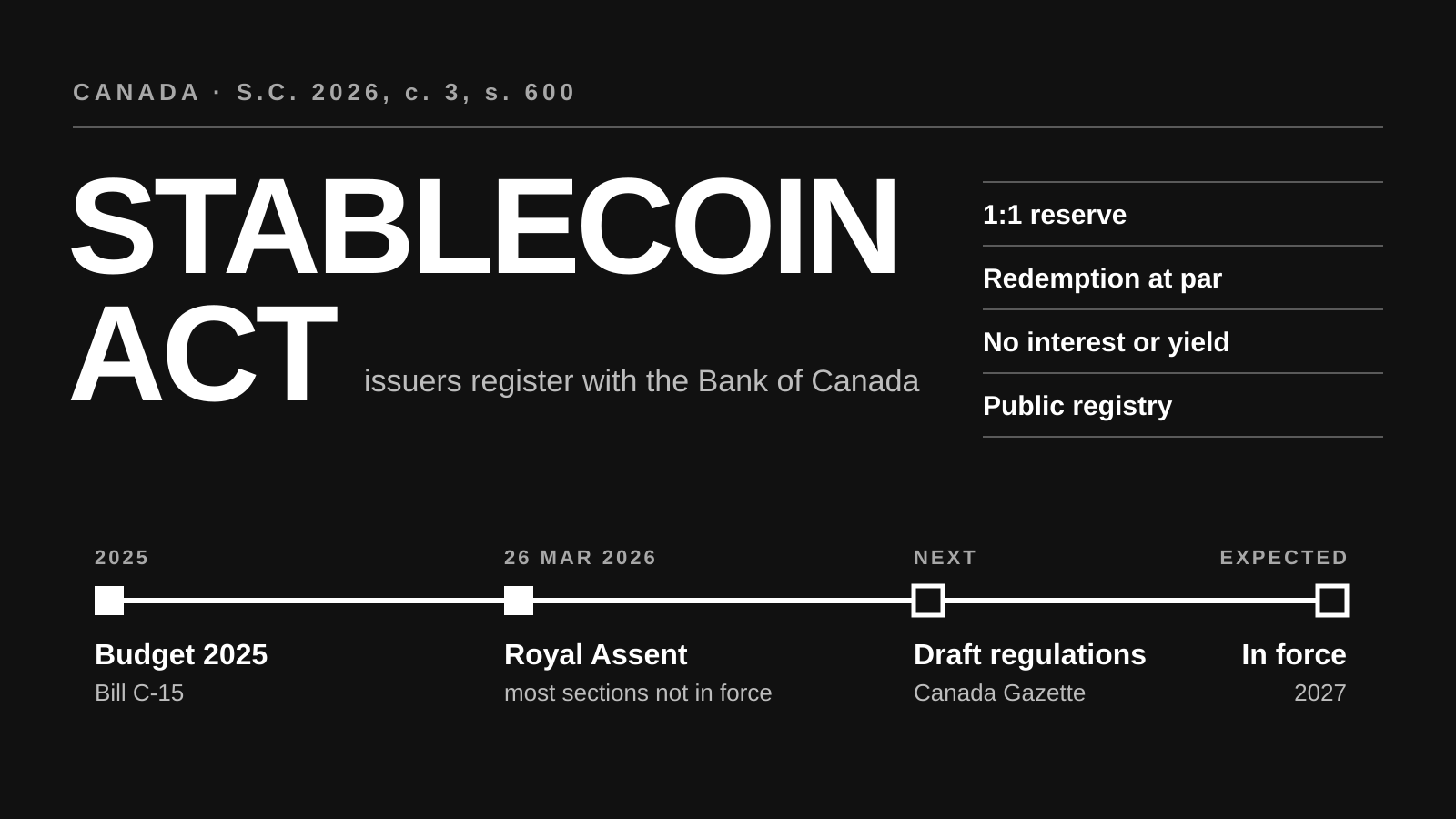
Canada’s Stablecoin Act is the federal law that will make the Bank of Canada the registrar and supervisor of companies that issue fiat-backed stablecoins to people in Canada. Parliament passed it inside the Budget 2025 Implementation Act, No. 1 (Bill C-15), and it received Royal Assent on March 26, 2026, according to the consolidated text on the Justice Laws website. Most of its sections are not yet in force: the Department of Finance is drafting the regulations, and it expects the framework to come into force in 2027.
This explainer covers who the Act applies to, what an issuer must do, and what it means for people holding a stablecoin in Canada. For how other regimes compare, see our guides on who regulates a stablecoin, the Hong Kong stablecoin license and MiCA.
Where the law stands
The Act is cited as S.C. 2026, c. 3, s. 600: section 600 of the budget bill enacts it as a separate statute. On the Justice Laws site, most provisions carry the note “The following provision is not in force.”
The Department of Finance’s framework page sets out the next steps. With Royal Assent given, Finance has begun writing the supporting regulations with the Bank of Canada. Draft regulations will be published in the Canada Gazette for consultation before they are finalized. Finance expects that work to run 12 to 18 months from early 2026, with the framework coming into force in 2027. Until then, the date is an expectation, not a fixed deadline.
The Bank of Canada’s stablecoin page describes its future role in the same terms: it will register issuers, supervise compliance, monitor risks around issuance and redemption, and take enforcement action.
Who the Stablecoin Act covers
The Act defines a stablecoin as a digital asset intended or designed to keep a stable value relative to one fiat currency. To “issue” means to create the stablecoin and make it available for purchase, directly or indirectly, by a person in Canada.
Four limits narrow the scope:
- Non-bank issuers only. Subject to the regulations, the Act does not apply to an issuer that is a financial institution as defined in the Bank Act, such as a bank or credit union, or to a central bank. Finance says prudentially regulated institutions are already covered by their own regimes. Our explainer on tokenized deposits covers the bank-issued alternative.
- Fiat-backed tokens only. Finance says stablecoins that are not fiat-backed stay with provincial and territorial securities regulators.
- Interprovincial or international use. The Act applies only to a stablecoin that has, or could reasonably be expected to have, interprovincial or international applications. Closed-loop stablecoins are excluded, subject to the regulations.
- Any currency, any home country. Finance says the framework applies to domestic and foreign issuers that make fiat-backed stablecoins available to Canadians, and it does not distinguish between Canadian-dollar and foreign-currency tokens. A US dollar stablecoin offered to Canadians is in scope.
The Governor of the Bank of Canada may also exempt an issuer from all or part of the Act where a provincial or foreign law is substantially similar.
Trading and payments sit under other regimes. Finance says securities regulators will keep supervising exchanges and crypto trading platforms that list stablecoins, and the Bank of Canada will supervise payment service providers that perform payment functions in a fiat-backed stablecoin under the Retail Payment Activities Act, once that stablecoin is prescribed in regulation.
Registration with the Bank of Canada
Under section 15, no one may issue a stablecoin unless they comply with the Act and their name is on the Bank’s list of issuers. Section 16 requires the Bank to keep that list in a public registry, together with orders, compliance agreements and directions concerning issuers.
An application must include, among other items:
- ownership, structure, subsidiaries, affiliates and third parties;
- a description of the technology, including the distributed ledgers and any smart contracts used to issue or redeem the token;
- the redemption policy and the measures taken to meet the reserve rules;
- a statement from an independent lawyer on whether those measures meet the encumbrance and custody rules;
- a statement from an independent certified accountant on the applicant’s financial condition;
- governance, risk management, data security and recovery and resolution policies;
- past enforcement actions in anti-money laundering, financial services, securities, market conduct or consumer protection;
- a fee set by the Bank.
The Minister of Finance may review an application for national security reasons and may direct the Bank to refuse it, after giving the applicant a chance to make representations. Finance adds that issuers will also be treated as money services businesses dealing in virtual currencies under Canada’s anti-money laundering law; section 5 of the Act says so directly.
Reserves and redemption
These are the rules a holder will notice most.
Redemption at par. Section 35 requires an issuer to redeem outstanding stablecoins in the reference currency, at par value. Section 36 requires a public redemption policy covering the conditions, manner and timing of redemption, any fees payable to the issuer or anyone else, and the role of third parties. The Act itself sets no deadline in days; the details are left to the regulations. Our explainer on stablecoin redemption shows how issuers handle this today.
A full reserve. Under section 37, the reserve must be worth at least the par value of the stablecoins outstanding, may be used only to redeem them, and must consist exclusively of the reference currency or other high-quality liquid assets in that currency, as set by regulation or, until regulations exist, approved by the Bank.
No pledging, separate custody. Section 38 bars the issuer from pledging or otherwise encumbering reserve assets. Section 39 requires them to be held with qualified custodians, segregated from the custodian’s and issuer’s own assets, and out of reach of their creditors in a bankruptcy, except for holders’ redemption claims.
Reporting. Section 46 requires a report to the Bank with a certified accountant’s statement on the issuer’s financial condition, the number of stablecoins outstanding, the composition and fair market value of the reserve, and whether the reserve meets the Act. A lawyer must state whether the encumbrance and custody rules are met.
What an issuer may not do
- Pay interest or yield. Section 32 bars an issuer from granting or paying any interest or yield on its stablecoin, directly or indirectly, in cash, digital assets or other consideration.
- Claim it is money, a deposit or insured. An issuer may not issue a stablecoin that is legal tender, a deposit, or insured or guaranteed by a government, and may not represent it that way (sections 33 and 34).
- Mislead the public. Section 30 prohibits false or misleading information, and the regulations may restrict specific terms, logos or symbols.
Issuers must also keep governance, risk management, data security and recovery and resolution policies, give them to the Bank and publish them.
Enforcement
Finance says the Bank can address non-compliance through compliance agreements and administrative monetary penalties. The Bank may also recommend that the Minister prohibit an issuer from issuing, and the Minister may order such a prohibition for national security reasons or in the public interest. The issuer’s name is then removed from the registry.
What changes for holders
Nothing changes yet for someone who holds USDC, USDT or another stablecoin through a Canadian platform. Once the framework is in force, the practical check will be the Bank of Canada registry: whether the issuer of a stablecoin offered in Canada is listed there.
For the issuers, reserves and redemption terms of individual coins, see our stablecoin list. For the US rules being written under the GENIUS Act, see our report on the Federal Reserve’s September 2026 proposals.
Questions
When does Canada’s Stablecoin Act take effect?
It received Royal Assent on March 26, 2026, but most of its provisions are not yet in force. The Department of Finance expects the framework to come into force in 2027, after the regulations are drafted and published in the Canada Gazette.
Who regulates stablecoins in Canada under the Act?
The Bank of Canada will register and supervise issuers. The Department of Finance leads policy and the regulations. Securities regulators keep trading platforms, and non-fiat-backed stablecoins stay with provincial and territorial securities regulators.
Does the Act cover stablecoins issued outside Canada?
Yes. Finance says it applies to domestic and foreign issuers that make fiat-backed stablecoins available to Canadians, in any reference currency.
Can a stablecoin issuer pay interest in Canada?
No. Section 32 prohibits any interest or yield, paid directly or indirectly.
Do banks need to register?
No. Subject to the regulations, the Act does not apply to financial institutions such as banks and credit unions, which are regulated under their own statutes.
Sources
Stablecoin Act, consolidated text (Justice Laws); Department of Finance Canada, Canada’s Stablecoin Framework; Bank of Canada, Stablecoins. Checked October 13, 2026.