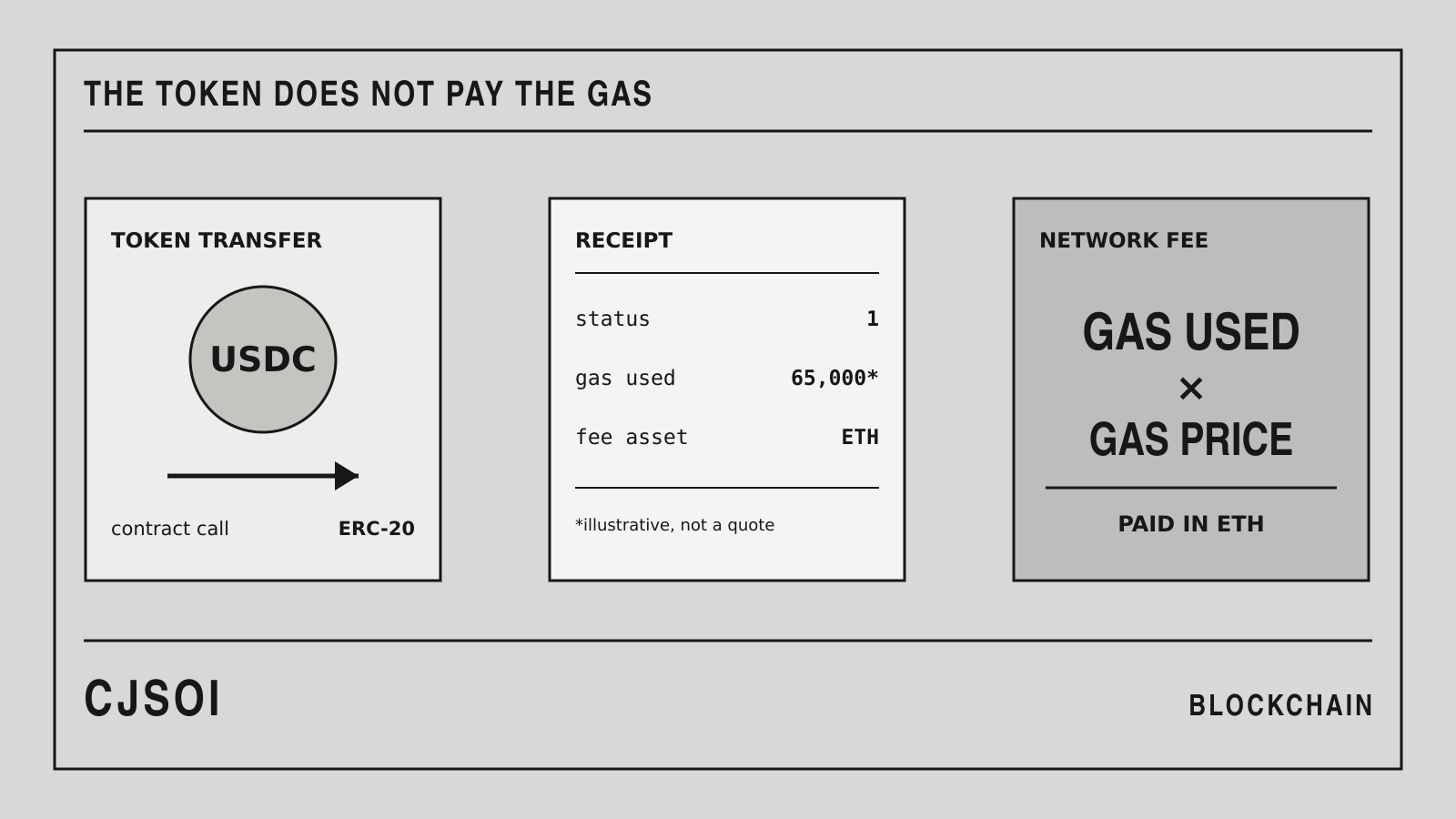
Ethereum gas fees for a USDT or USDC transfer are paid in ETH, not in the stablecoin being sent. The fee depends on the computation the transaction uses and the price of gas when a validator includes it. Sending $10 or $10,000 of the same token through the same contract call does not, by itself, make the network fee 1,000 times larger.
That is the useful distinction: the token amount is the payment value; gas pays Ethereum for executing the transaction. A wallet may combine both numbers on one confirmation screen, but they answer different questions.
The fee is gas used multiplied by gas price
Ethereum’s gas documentation ↗ gives the core formula:
gas used × (base fee + priority fee)
Gas used measures the computational work. A plain ETH transfer has a standard intrinsic cost of 21,000 gas units. An ERC-20 transfer calls a token contract, so it normally uses more gas. The exact figure can vary with the contract and the work performed; it is not a universal fixed allowance for every token.
Gas price is quoted per unit of gas, usually in gwei. Under Ethereum’s EIP-1559 fee model, it has two relevant parts:
- the base fee, set by the protocol for the block and burned;
- the priority fee, a tip that gives validators an incentive to include the transaction.
EIP-1559 ↗ also defines a maximum fee per gas. This is a ceiling, not necessarily the amount paid. If the transaction is included below that ceiling, unused headroom is not charged.
Most wallets estimate these fields. The estimate can change while a transaction waits because the base fee responds to demand for block space.
Why the stablecoin amount usually does not set the gas bill
An ERC-20 transfer asks the token contract to change balances. The contract performs essentially the same operation whether the amount represents a few dollars or a much larger payment. Ethereum charges for the computation, not a percentage of the token value.
That does not mean every transfer will cost exactly the same. Gas used can differ when a contract follows a different execution path. Gas price can also rise or fall with network demand. The point is narrower: the number of USDT or USDC units is not the direct multiplier in Ethereum’s gas formula.
This matters when comparing costs. A $2 fee would be 20% of a $10 payment but 0.02% of a $10,000 payment, even though the on-chain operation may be similar. The absolute network fee and the fee as a percentage of the payment are separate measurements.
For a broader route comparison, include exchange withdrawal charges, conversion spreads and receiving costs as well. Our full stablecoin payment cost guide separates those layers.
ETH pays the fee for a normal token transfer
Ethereum’s technical introduction to ether identifies ETH as the network’s fee asset. Holding USDT or USDC in a self-custody wallet does not automatically give that wallet the ETH needed to submit a normal mainnet transfer.
Before sending, check two balances:
- the stablecoin balance for the payment amount;
- the ETH balance for the estimated network fee.
A wallet or application can sponsor gas or bill a user another way. An exchange can also quote a withdrawal fee without exposing the underlying gas transaction. Those are product-level arrangements. They do not turn USDT or USDC into Ethereum’s native fee asset.
If the wallet offers a “gasless” flow, read who pays the on-chain fee and what the service charges instead. Sponsored does not necessarily mean free.
Our ERC-20 guide covers the separate checks for the token contract, network and recipient address.
Base fee, priority fee and the wallet’s maximum
The base fee moves with the relationship between recent gas use and the protocol’s target. When blocks use more than the target, the base fee rises; when they use less, it falls. The adjustment is protocol-driven rather than a number chosen by a wallet.
The priority fee is different. It is the portion offered to the validator for inclusion. A higher tip can help when many transactions are competing, but it does not guarantee a particular confirmation time.
Wallets also set maxFeePerGas, the most the sender is willing to pay per unit. The transaction cannot be included if that maximum is below the block’s base fee. If the ceiling is comfortably above the actual base fee plus priority fee, the sender pays the effective price and receives the unused difference back.
This is why the largest number on a wallet screen may be a maximum rather than the expected final charge. Review the interface’s labels before treating it as an invoice.
A gas limit is not the same as the final fee
The gas limit caps the number of gas units a transaction may consume. It protects the sender from unbounded execution, but setting a higher limit does not mean all of it will be spent.
Ethereum’s documentation explains that unused gas is returned. If execution completes after using 58,000 units under a higher limit, the final computation charge uses the 58,000 units, not the whole limit.
The opposite problem is more serious. If execution runs out of gas, the state changes are reverted but the gas used for the attempted work is still consumed. A low limit can therefore leave the token unmoved while ETH was spent.
Wallet estimates reduce the need to choose a limit manually. When an estimate fails repeatedly, do not keep guessing upward without checking the contract, wallet error and transaction simulation.
Failed and pending transactions are different
A pending transaction has not yet been included in a block. It may be waiting because its fee cap is too low for the current base fee or because its priority fee is uncompetitive. No final execution receipt exists yet.
A failed transaction was included and executed with an unsuccessful status. Ethereum still charges for computation already performed. The stablecoin transfer is reverted, but the sender does not automatically recover the gas fee.
Check the transaction hash in an Ethereum explorer and separate these states before acting. Repeatedly submitting replacements can create several transactions with the same intent. A wallet’s replace or cancel flow normally works through the account nonce; follow the wallet’s documented procedure rather than opening a second transfer casually.
How to estimate before sending
Use the estimate shown by the wallet immediately before signing, then verify what it represents.
- Confirm the network is Ethereum mainnet.
- Confirm the asset is the intended issuer-listed token contract.
- Check that the wallet has enough ETH as well as enough USDT or USDC.
- Distinguish the estimated fee from the maximum possible fee.
- Review any exchange or wallet service charge separately.
- If the payment is not urgent, compare the estimate after network demand changes.
For a hosted exchange withdrawal, use that platform’s current withdrawal screen. The platform may batch transactions or charge a fixed amount that does not match one user’s underlying gas usage.
For self-custody, the transaction receipt records the gas used and effective gas price after inclusion. That receipt is the better source for the final on-chain charge than the estimate shown before signing.
Sources
- Ethereum: Gas and fees ↗: fee formula, base and priority fees, gas limits, refunds and failed execution.
- Ethereum: Transactions ↗: transaction fee fields and the lifecycle from submission to inclusion.
- EIP-1559 ↗: canonical specification for base fee, priority fee and maximum fee.
Official documentation checked October 13, 2026. Wallet interfaces and live fee estimates can change; verify the values displayed at signing.
Questions
Do I need ETH to send USDT or USDC on Ethereum?
For a normal self-custody Ethereum mainnet transfer, yes: ETH pays the network fee. A sponsored wallet or exchange can present another billing arrangement, which should be checked separately.
Does sending more USDT increase the Ethereum gas fee?
The token amount is not the direct multiplier in the gas formula. Gas depends on computation used and gas price. The fee can still differ between transactions because contract execution and network demand differ.
Do I pay the full gas limit?
No. The gas limit is a ceiling on units. Unused gas is returned. The final charge uses gas actually consumed multiplied by the effective gas price.
Why did a failed transfer still cost ETH?
If the transaction was included and execution failed, Ethereum still charges for computation already performed. The token movement is reverted, but the gas fee is not automatically refunded.