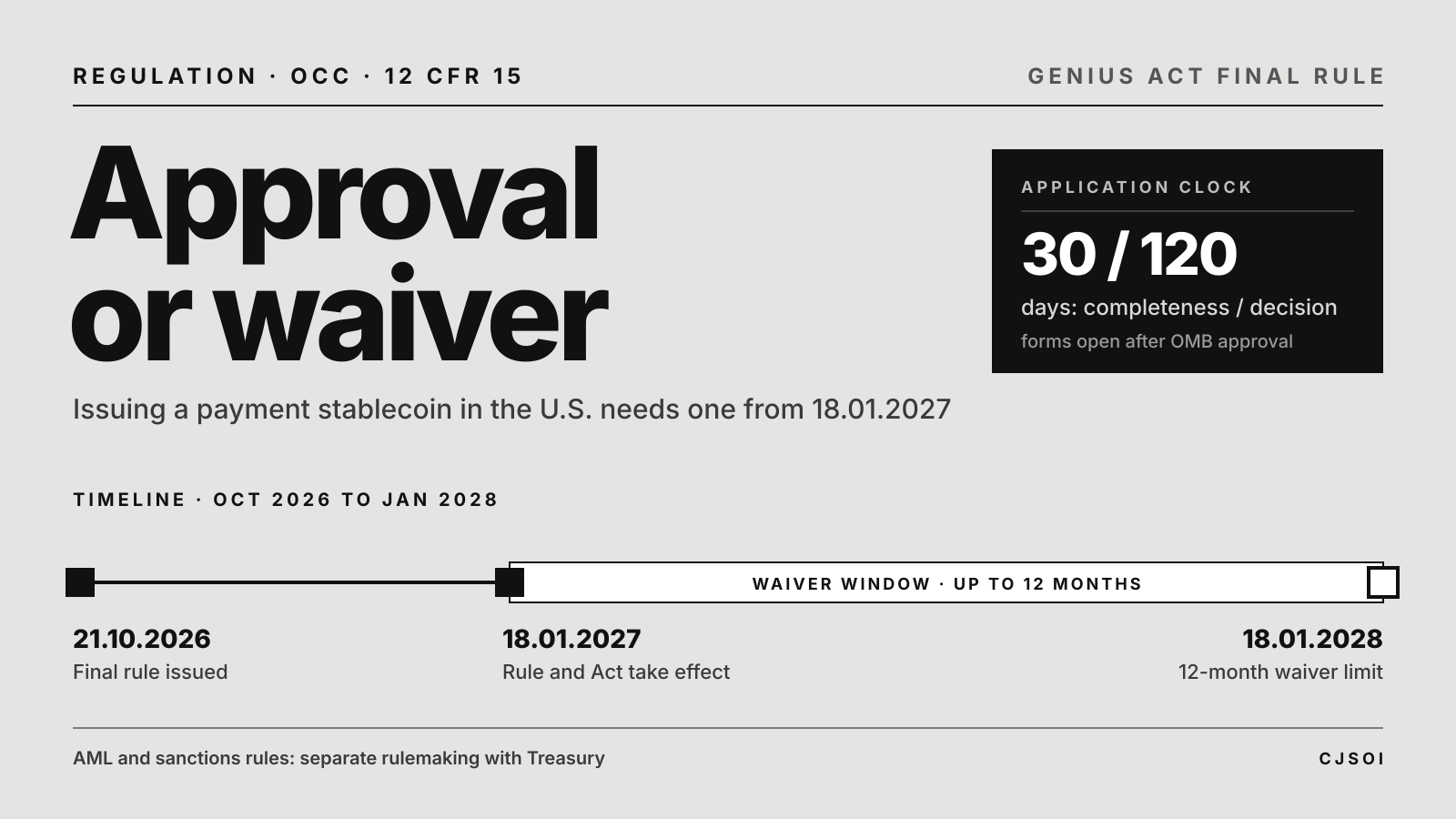
The Office of the Comptroller of the Currency (OCC) has issued its final rule implementing the GENIUS Act for payment stablecoin issuers under its jurisdiction. The OCC announced the OCC GENIUS Act final rule on October 21, 2026 in News Release 2026-92. The rule and the Act both take effect on January 18, 2027.
The rule sets requirements for permitted payment stablecoin issuers and foreign payment stablecoin issuers that the OCC oversees, and for certain custody activities of OCC-supervised banks. It does not cover Bank Secrecy Act, anti-money laundering or sanctions requirements. The OCC says those will come in a separate rulemaking coordinated with the Treasury Department.
Who the rule covers
According to OCC Bulletin 2026-50, the final rule applies to:
- national banks, federal savings associations and federal branches, and their subsidiaries;
- foreign payment stablecoin issuers;
- nonbank companies that seek to be, or are, approved as federal qualified payment stablecoin issuers;
- state qualified payment stablecoin issuers where the OCC has regulatory or enforcement authority under the Act.
Most of the requirements sit in a new Part 15 of Title 12 of the Code of Federal Regulations. The bulletin lists its subjects: permitted activities, reserve assets, redemption, risk management, audits and reports, the move of state issuers to the federal framework, custody, applications, supervision of foreign issuers, revocation of approval, and capital with an operational backstop. The rule also amends the OCC’s capital, prompt corrective action, fee and procedure rules.
The OCC published its proposal on February 25, 2026, and says it received hundreds of comments from crypto companies, community banks, trade groups and academics before finalizing it.
Applications and waivers
From January 18, 2027, a person generally must be approved as a permitted payment stablecoin issuer to issue a payment stablecoin in the United States, and issuing without approval carries criminal penalties. Bulletin 2026-51 explains how issuers already operating in the country can keep going while their applications are reviewed:
| Step | What the OCC says |
|---|---|
| Applications open | After the Office of Management and Budget approves the forms; date to be announced |
| Completeness check | Within 30 days of receiving an application |
| Decision | No later than 120 days after an application is substantially complete |
| Waiver | Available to issuers with a substantially complete application pending; up to 12 months from January 18, 2027 |
The OCC says it generally expects to grant existing U.S. issuers a waiver from the prior-approval requirement. It has not found general reasons to waive other parts of the Act or the rule, and it expects new issuers that are not yet operating in the United States to wait for approval before starting.
Comptroller Jonathan V. Gould said the rule provides “strong standards for reserve backing, redemption, and risk management.”
Reporting forms
In Bulletin 2026-52, the OCC published revised weekly and quarterly reporting forms for issuers it supervises, open for comment for 30 days after they appear in the Federal Register. Subject to OMB approval, the weekly form would start with the January 25, 2027 report date and the quarterly form with the March 31, 2027 report date.
The Federal Reserve is writing its own rules for the issuers it supervises; see our report on the Fed’s stablecoin proposals. For how U.S., EU and UK supervisors divide the work, read Who Regulates a Stablecoin?, and for what redemption means for a holder, What Happens When You Redeem a Stablecoin?. Issuer details for USDC, PYUSD and other dollar tokens are on the stablecoin list.
Questions
When does the OCC stablecoin rule take effect?
On January 18, 2027, the same day as the GENIUS Act.
Can existing issuers keep issuing after January 18, 2027?
Only with approval or a waiver. The OCC says it generally expects to grant waivers to existing U.S. issuers that have a substantially complete application pending, for up to 12 months.
Does the rule include anti-money laundering requirements?
No. Bank Secrecy Act, anti-money laundering and sanctions rules will follow in a separate rulemaking with the Treasury.
Sources
- OCC News Release 2026-92, “OCC Advances U.S. Digital Asset Leadership with Final Rule to Implement GENIUS Act,” October 21, 2026
- OCC Bulletin 2026-50, “GENIUS Act Regulations: Final Rule,” October 21, 2026
- OCC Bulletin 2026-51, “GENIUS Act: Waivers and Application Submission Guidance,” October 21, 2026
- OCC Bulletin 2026-52, “GENIUS Act: Revised Reporting Forms and Instructions,” October 21, 2026
More from the Regulation desk.