Gross vs net settlement determines whether payment obligations move one by one or are offset before money changes hands. A customer may see a payment accepted long before final money moves between participating institutions, so the model affects liquidity, exposure and timing.
In real-time gross settlement, each payment is settled individually as it is processed. In deferred net settlement, a group of payment obligations is accumulated and only the net positions are settled at specified times. Both models can support fast customer experiences, but they manage liquidity, credit exposure and failure differently.
Gross settlement moves each instruction
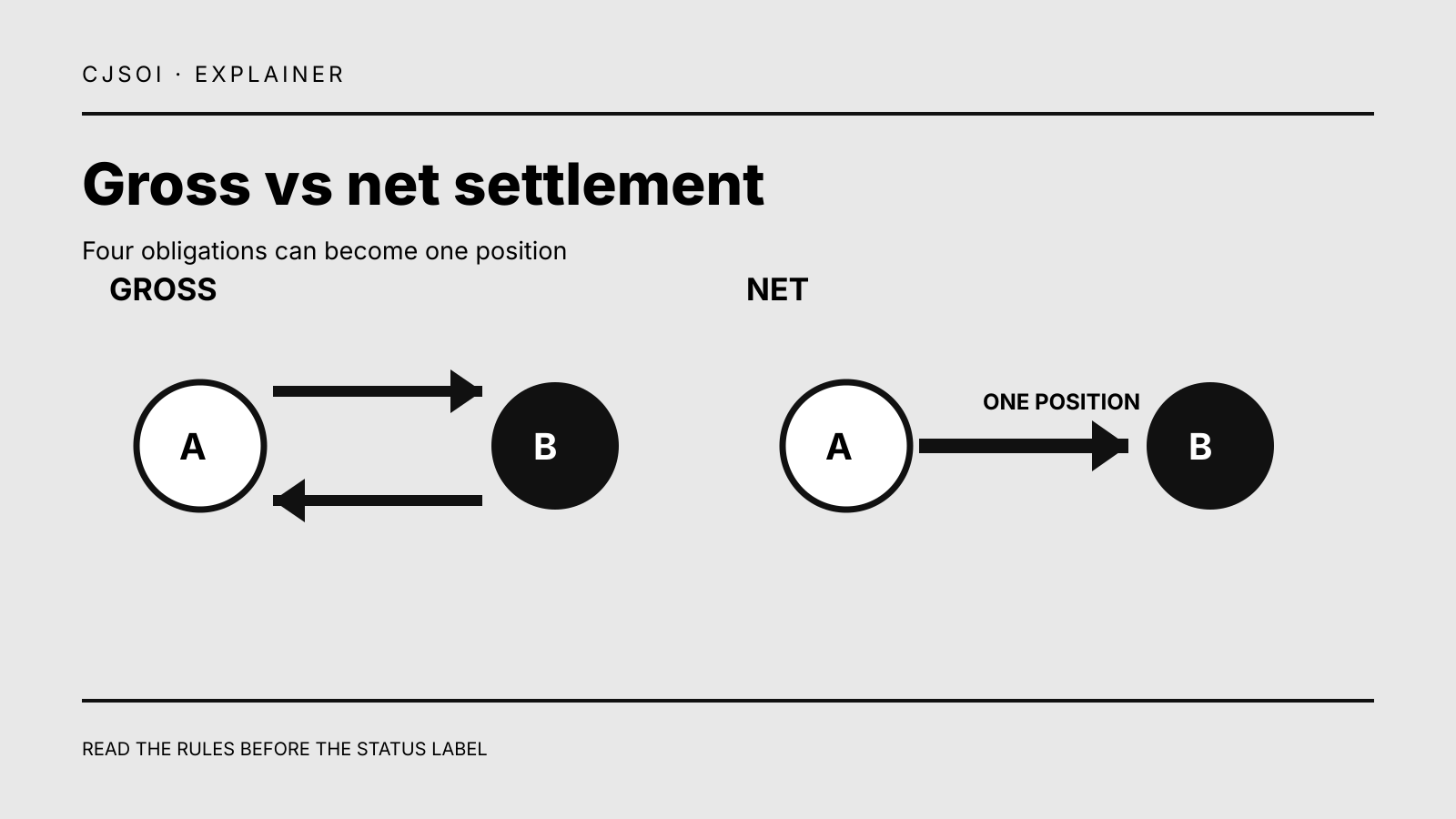
A gross system settles each payment separately. If Bank A sends 10 million units to Bank B and Bank B later sends 8 million back, the system settles two full instructions.
A real-time gross settlement system, or RTGS, processes and settles those individual instructions continuously during its operating day. The Bank for International Settlements describes RTGS as processing and settling payment instructions between banks individually and continuously.
The benefit is clarity. Once a payment reaches final settlement under the system’s rules, it does not wait for an end-of-day batch. The cost is liquidity: participants need funds or eligible intraday credit to settle outgoing payments as they arrive.
RTGS does not mean every consumer payment is instant. A bank may hold a customer instruction for screening or fraud checks before it enters the wholesale system. The beneficiary bank may also apply its own posting rules after settlement.
Net settlement offsets obligations
A net system groups obligations before settlement. Suppose the same two banks exchange payments:
- Bank A owes Bank B 10 million.
- Bank B owes Bank A 8 million.
Bilateral netting leaves Bank A with a 2 million obligation to Bank B. In a multilateral system, each participant’s payments to all other members are combined into one net debit or credit position.
Netting reduces the amount of settlement money participants need. It also creates a period in which accepted payment obligations remain unsettled. If a participant cannot meet its net debit at the settlement time, the system needs rules for loss allocation, collateral, limits, unwinding or another default procedure.
The BIS report New developments in large-value payment systems contrasts deferred net settlement with RTGS: DNS systems settle net positions at designated times, while RTGS settles payments individually on a gross basis.
Clearing, settlement and finality are different
These terms are often compressed into “the payment went through,” but they answer different questions.
Clearing covers the transmission, validation, matching and calculation that prepares obligations for settlement.
Settlement is the discharge of those obligations through the movement of money or another settlement asset.
Finality is the point at which the transfer is irrevocable under the applicable system rules and law.
A customer notification, an API status and bank-to-bank final settlement can occur at different times. That is why a payment provider must document which event each status represents.
The same distinction appears in securities markets. Our explainer on delivery versus payment shows how the cash and securities legs are coordinated so that one does not settle without the other.
The liquidity trade-off
Gross settlement asks participants to fund each outgoing payment. A busy bank can recycle incoming funds, use queued-payment controls or obtain intraday credit, but its liquidity need is still tied to the sequence and timing of instructions.
Net settlement compresses many gross obligations into a smaller net amount. It can therefore use settlement liquidity efficiently. The trade-off is exposure between settlement cycles and dependence on the system’s default arrangements.
Neither design is automatically “safer” in every implementation. The risk depends on the settlement asset, legal finality, participant rules, collateral, limits, operational resilience and how a failed participant is handled.
Hybrid designs
Modern payment systems often combine features rather than choosing a pure model.
A system can:
- settle high-value payments individually;
- net retail batches at intervals;
- use bilateral or multilateral offsetting before an RTGS settlement;
- queue instructions until liquidity is available;
- run frequent settlement cycles;
- provide liquidity-saving mechanisms that offset compatible queued payments.
A fast retail payment can appear immediate to the customer while participating banks settle through a separate arrangement. The front-end speed does not by itself reveal the wholesale settlement model.
A worked example
Four payment instructions arrive during a settlement cycle:
- Bank A pays Bank B 7 million.
- Bank B pays Bank A 3 million.
- Bank A pays Bank B 2 million.
- Bank B pays Bank A 1 million.
Gross settlement moves 13 million across four instructions. Bilateral net settlement leaves Bank A owing Bank B 5 million.
The calculation is simple:
- A to B: 7 + 2 = 9 million
- B to A: 3 + 1 = 4 million
- net: 9 − 4 = 5 million from A to B
This example shows liquidity compression, not profit or fee savings. The original obligations still matter for customer accounts, reconciliations and dispute handling.
What an operator should document
A bank, wallet or payment API integrating with a payment rail should be able to answer:
- What does “accepted” mean?
- When is the participant’s position calculated?
- What settlement asset is used?
- Is settlement gross, net or hybrid?
- How often does settlement occur?
- What happens if a participant lacks funds?
- When is the transfer legally final?
- Can an instruction be queued, rejected or revoked?
- Which event should trigger customer fulfillment?
- How are the operator’s ledger and the settlement account reconciled?
Those questions are more useful than describing a rail as simply “instant.”
Stablecoins do not remove the distinction
A token transfer can settle on a blockchain, but a stablecoin payment can still contain off-chain clearing and netting. An exchange, wallet or merchant processor may update customer balances internally and move tokens later in aggregate.
The token transfer also may not settle the issuer’s redemption obligation. Redeeming a stablecoin for bank money introduces another system, cut-off time and eligibility rule.
For cross-border bank routes, correspondent banking adds further ledgers and settlement relationships. A payment can be final in one layer while another leg remains pending.