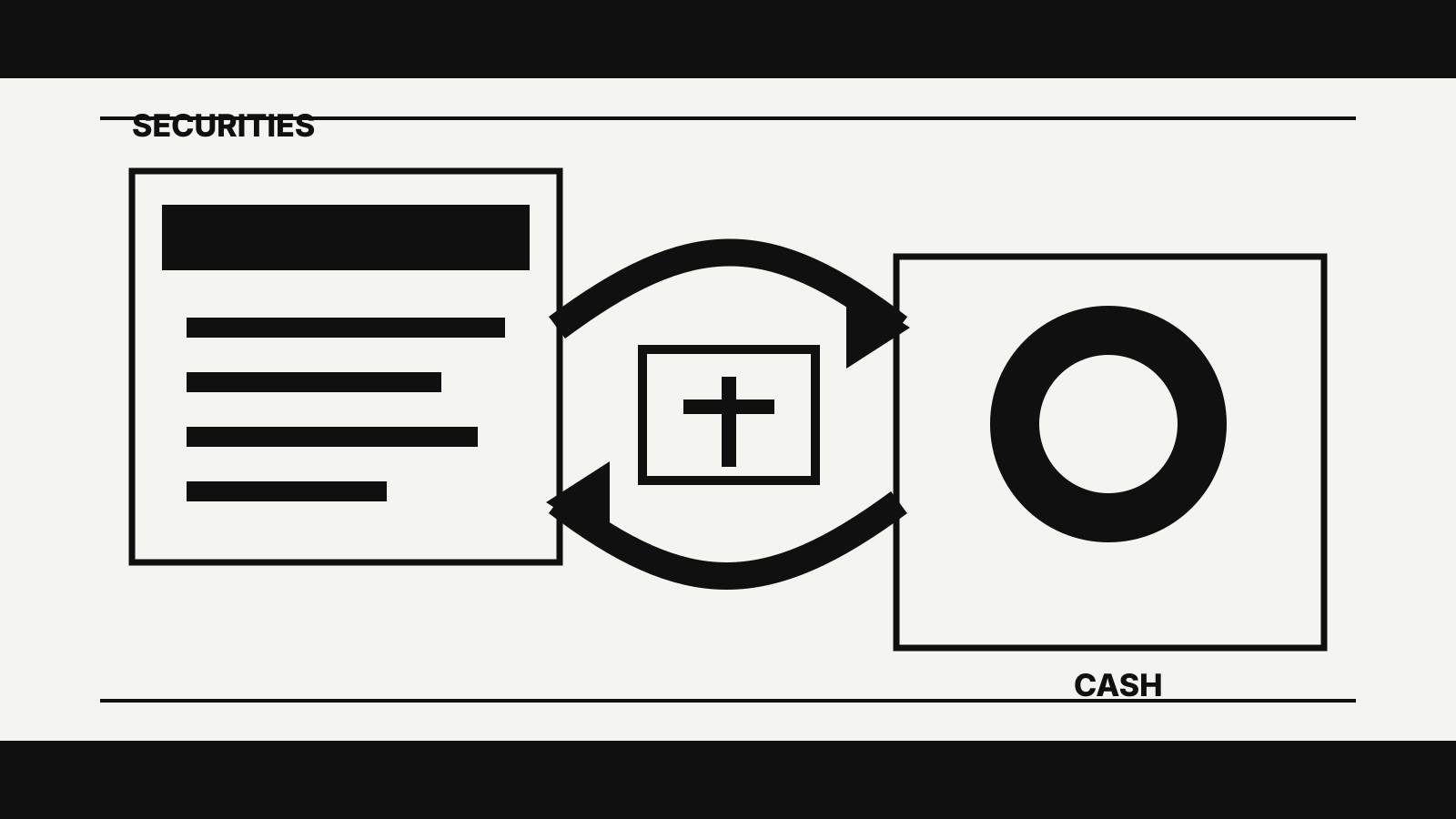
Delivery versus payment, or DvP, is the settlement rule that links the transfer of securities to the transfer of cash. The security moves if and only if the payment moves. The purpose is simple: neither party should deliver its side of a securities trade while the other side fails.
That sentence hides several design choices. DvP can be gross or net, immediate or deferred, and run on one platform or across coordinated systems. Understanding those choices matters because “the trade matched” and “the trade settled” are not the same event.
Source review: Bank for International Settlements material checked on 27 October 2026.
The problem DvP is designed to remove
Imagine a buyer owes €1 million for a bond. If the bond is transferred first and the buyer’s cash then fails, the seller has lost the bond but has not been paid. If cash moves first and the bond fails to arrive, the buyer has the mirror-image exposure.
The Committee on Payments and Market Infrastructures calls that principal risk: the risk of losing the full value delivered. DvP links the two legs so that the final transfer of securities occurs only when the final transfer of funds occurs.
This is different from market risk. The price of the bond can still change between trade and settlement. It is also different from replacement-cost risk: if a trade fails before either principal is delivered, a party may still have to replace it at a worse price.
Trade, clearing and settlement
A securities transaction usually passes through three separate stages.
- Trade execution: buyer and seller agree the instrument, price and quantity.
- Clearing: the parties’ obligations are calculated, matched and, in some systems, netted.
- Settlement: ownership of the security and the payment become final.
DvP belongs to the settlement stage. A broker screen saying “filled” does not mean cash and securities have finally moved. Settlement systems also need rules for legal finality, operating hours, participant defaults and what happens when one leg cannot be completed.
The three classic DvP models
The BIS’s original DvP framework describes three broad models. They all link delivery and payment, but they do it in different ways.
Model 1: gross securities and gross funds
Each trade settles separately. The system transfers the security and the corresponding cash on a trade-by-trade basis.
This arrangement can give participants a clear, immediate link between the two legs. Its cost is liquidity: buyers need enough cash, and sellers need enough securities, for each transaction when it reaches the settlement queue.
A model 1 system may use queues or liquidity-saving mechanisms, but those are operating features around the core gross-for-gross design.
Model 2: gross securities and net funds
Securities transfers are processed individually during the cycle, while payment obligations are settled on a net basis at the end of the cycle.
The system therefore needs a robust mechanism to ensure the final payment will occur. If securities have already moved during the day and the net cash settlement later fails, an operator guarantee or other risk control becomes important.
Model 3: net securities and net funds
Both securities and cash obligations are netted, with the final net positions settled at the end of the processing cycle.
Netting can reduce the quantity of securities and cash that participants must deliver. The trade-off is a stronger dependency on the settlement system’s rules for defaults, unwind, loss allocation and liquidity. A late failure can affect more than one bilateral trade because obligations have been combined.
What “atomic” settlement adds
Newer tokenised platforms often use the word atomic for transactions in which both legs execute together as one programmed operation. That can implement a form of DvP, but the label does not answer every risk question.
A system still needs to establish:
- whether the cash leg is commercial-bank money, central-bank money or a token claim;
- when the transfer is legally final;
- what happens if a smart contract, bridge or network stops;
- who can reverse, freeze or correct an erroneous transfer;
- how participants obtain intraday liquidity; and
- whether assets on different platforms can be coordinated safely.
The BIS has noted that DvP can be achieved on a single platform or through coordination between platforms. Technology changes the mechanism, not the need to define finality and failure handling.
A worked settlement example
Suppose Dealer A sells 100 bonds to Dealer B for €980 each. The cash leg is €98,000.
In a model 1 arrangement, the settlement instruction links delivery of the 100 bonds to the €98,000 payment. If Dealer B does not have the funds when the instruction is processed, the bond transfer does not become final either. The instruction may wait in a queue or fail under the system’s rules.
In a net arrangement, Dealer B’s payment may be offset against amounts it is due to receive from other trades. This can lower its final cash requirement. But participants now depend more heavily on the clearing and default procedures that turn many gross obligations into one net amount.
The arithmetic is easy. The risk analysis sits in the settlement rules.
What DvP does not guarantee
DvP is a control against principal risk in the linked transaction. It does not promise that:
- the asset keeps its market value;
- a counterparty never defaults;
- a settlement instruction completes on time;
- the cash asset is free of issuer or bank risk;
- the legal title is recognised in every jurisdiction;
- the custodian or platform remains available; or
- a net settlement system can absorb every participant failure.
A delayed trade can still create funding costs, market exposure and operational work even when DvP prevents one-sided delivery.
Questions to ask about a settlement system
A product description that says only “DvP supported” is incomplete. Ask:
- Which DvP model is used?
- Are the cash and securities legs gross or net?
- What money settles the payment leg?
- At what point is each transfer legally final?
- Can an instruction wait in a queue, and when is it cancelled?
- What happens if a participant lacks cash or securities?
- Does a central counterparty, guarantee fund or operator cover a shortfall?
- Are the two legs on one ledger or coordinated across systems?
- What are the cut-off times and operating days?
- How are errors, sanctions holds and insolvency handled?
For the foreign-exchange version of the same idea, read CJSOI’s explainer on payment versus payment. PvP links two currency payments; DvP links a securities transfer to payment.
The practical takeaway
DvP is not a speed claim. It is a conditional-settlement rule. The strongest reading of a DvP statement identifies both legs, the point of finality, the model used and the procedure for a failed participant.
That detail lets investors, issuers and operators distinguish a useful settlement control from a vague promise that a trade is “instant” or “atomic.”