A stablecoin reserve attestation is a report on a defined statement made by an issuer, tested against stated criteria as of a particular date. It can provide useful evidence about the assets and tokens included in that statement. It is not a blanket guarantee that every holder can redeem instantly, that the issuer will remain solvent, or that the reserve looked the same on every day of the period.
That distinction matters because “attested,” “audited” and “transparent” are often used as if they mean the same thing. They do not. A careful reader starts with the report’s scope and date, then asks what was tested, by whom and under which standard.
Documentation date: This explainer was checked on 26 October 2026 against Circle’s transparency materials, Tether’s transparency page and the AICPA’s current attestation-standards index. Issuer statements below are identified as claims.
What an attestation covers
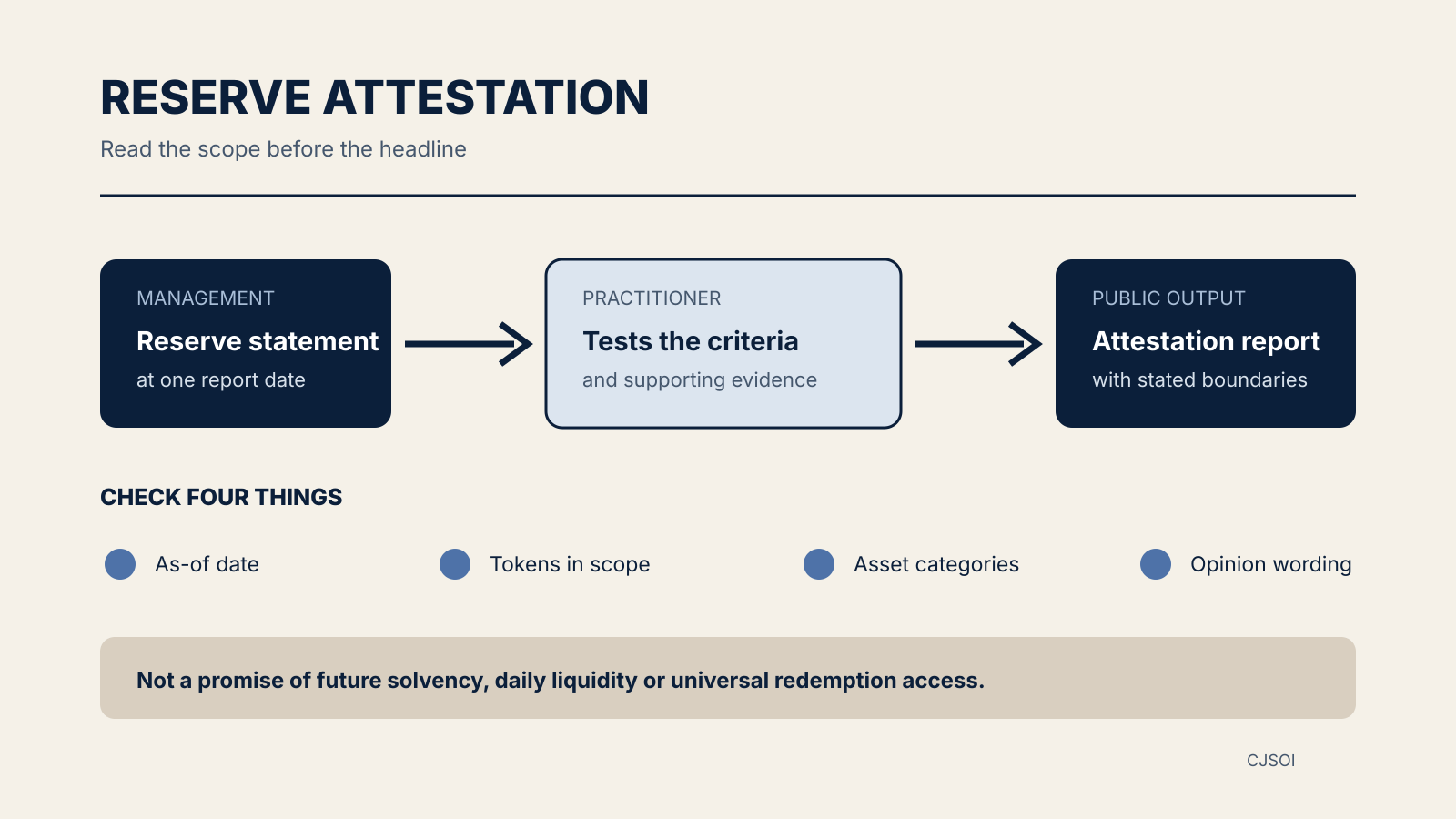
An attestation engagement gives assurance on a specific subject matter or assertion. In a stablecoin reserve report, management may state that reserve assets met or exceeded tokens in circulation on the report date, or describe the composition of those assets.
The independent practitioner evaluates that statement using the criteria named in the report. Circle explains the distinction this way in its own materials: its reserve attestation addresses management’s reserve assertions, while a financial-statement audit addresses financial statements. The issuer also says its practitioner confirms blockchain balances and obtains bank or asset-manager information from third parties.
Those are useful tests. Their meaning still depends on the exact report. Before relying on the headline, read:
- the entity and token covered;
- the reporting date or period;
- the reserve assets included;
- the circulation figure used;
- the criteria and professional standard;
- the practitioner’s conclusion;
- any qualifications, exclusions or limitations.
An attestation for one token should not be assumed to cover another token issued by an affiliated company. A report dated at month-end should not be described as a continuous daily test unless it says so.
Start with the as-of date
The report date is the fastest way to avoid over-reading an attestation. A point-in-time report compares defined balances at that moment. It does not, by itself, prove the same relationship existed every hour before or after it.
Circle currently says it publishes weekly USDC reserve holdings and mint-and-burn flows, while a Big Four accounting firm provides monthly assurance that reserve value exceeds USDC in circulation. The weekly disclosure and monthly assurance are different evidence layers. One is more frequent issuer disclosure; the other is third-party assurance on a defined report.
Tether’s transparency page says token circulation metrics are typically refreshed daily and states that its assets exceed liabilities. Those are issuer claims on a live page. To understand the independent assurance, a reader must locate the separate assurance report and inspect its date, subject and conclusion.
A dashboard timestamp, an issuer statement and an independent report should therefore be labelled separately.
Match the reserve number to the circulation number
A reserve comparison needs two sides:
- the assets included as reserves;
- the token liability or circulation measure they are compared with.
Check whether the report identifies the relevant blockchain supply and any tokens authorised but not in circulation. Where tokens exist on several networks, the method should explain how balances are aggregated and how bridged or third-party representations are treated.
Settlement timing can complicate the comparison. Circle’s 2022 explanation notes that blockchain activity runs continuously while banks and securities settlement operate on different schedules. It says its reports reconcile timing differences so a pending Treasury purchase or redemption is not double counted.
This is a practical point rather than a footnote. A reserve report should explain how cash in transit, redemptions awaiting settlement or Treasury trades are classified.
For a broader view of how the liability changes when holders return tokens, read what happens when you redeem a stablecoin. The reserve report and the redemption process describe related but different questions.
Read the asset categories, not just the total
“Backed by reserves” does not describe liquidity, credit risk or maturity on its own. Look for the asset breakdown.
Common categories can include:
- bank deposits;
- short-dated government securities;
- overnight repurchase agreements;
- money-market fund shares;
- secured loans, precious metals, bitcoin or other investments, depending on the issuer.
Two portfolios with the same reported total can behave differently under heavy redemptions. Cash at banks may be immediately available but concentrated at particular institutions. Treasury bills are liquid markets, but transactions still settle. Longer-dated or less liquid assets may take more time or price risk to convert.
Circle’s transparency page lists categories such as bank deposits, overnight reverse Treasury repo and Treasury securities with maturities under three months for USDC reserves. Tether’s public page makes the broad claim that its tokens are backed by reserves; its detailed reports are where readers need to inspect the category mix.
Do not convert an asset label into a stronger claim. “U.S. Treasury bill” is not the same as “cash.” “Bank deposit” does not identify the bank, account protections or access terms unless the report provides them.
The stablecoin reserves in bank deposits explainer covers why issuers keep some reserve money in the banking system and what concentration can mean.
Check the opinion wording
An attestation report normally identifies management’s assertion, the practitioner’s responsibilities and the conclusion. Small wording changes matter.
Ask:
- Does the practitioner say the statement is fairly stated or that specified criteria were met?
- Is the conclusion unmodified, qualified or limited?
- Are any procedures described as agreed-upon procedures rather than an examination?
- Does the report restrict who may use it?
- Is the accounting firm independent under the named standard?
Do not treat a list of procedures as an audit opinion. In an agreed-upon procedures engagement, the practitioner reports findings from procedures selected by the engaging parties; the reader evaluates those findings. An examination engagement provides an opinion on the subject matter against criteria. The report title and standard tell you which type you are reading.
The AICPA’s current index says Statements on Standards for Attestation Engagements apply to the preparation and issuance of attestation reports for nonissuers. The report itself should name the applicable section or standard.
What a reserve attestation does not prove
Even a clean point-in-time report has boundaries.
Future solvency. It is evidence about the defined subject at the report date, not a promise that assets will always exceed liabilities.
Redemption access for every holder. Direct redemption can depend on account eligibility, jurisdiction, minimum size, fees and compliance checks. A token may trade on an exchange even when a retail holder cannot redeem directly with the issuer. See the stablecoin redemption guide.
Market price. Reserve sufficiency does not force secondary-market buyers to pay exactly one unit during stress.
Operational availability. An attestation does not test whether a redemption portal, banking rail or blockchain will be available when needed unless the report includes that subject.
All company liabilities. A reserve assertion may compare assets with tokens in circulation without presenting the issuer’s complete balance sheet. An audited financial statement has a different scope.
Custody and legal priority. Asset ownership, segregation and treatment in insolvency depend on legal documents and jurisdiction, not the reserve total alone.
Build an evidence stack
No single disclosure answers every stablecoin-risk question. A stronger review combines several layers:
| Evidence | Useful question | Main limit |
|---|---|---|
| Live transparency page | What does the issuer currently report? | Usually issuer-published |
| Reserve attestation | Did a practitioner test a defined assertion? | Scope and date are limited |
| Audited financial statements | What do the full financial statements show? | Less frequent; entity scope matters |
| Regulatory filing | What must the issuer disclose to a regulator? | Rules differ by jurisdiction |
| Redemption terms | Who can redeem, how and at what cost? | Terms can change |
| Onchain data | What supply and movements are visible? | Does not prove offchain assets |
The stablecoin list can help identify the issuer and product, but it is a starting point. The source report and issuer terms remain the evidence for the current reserve and redemption claims.
A five-minute reading routine
When a new report appears:
- Save the report URL and publication date.
- Record the as-of date separately.
- Name the legal entity and token in scope.
- Write down the reserve total and circulation measure exactly as defined.
- Copy the asset categories without merging unlike assets.
- Identify the engagement type and standard.
- Read the conclusion and every qualification.
- Compare the report date with the latest issuer dashboard.
- Check whether redemption terms changed.
- Avoid extending the conclusion beyond its wording.
This routine makes comparisons between issuers more honest. It also shows when a new report changes the evidence and when it merely repeats an established format.