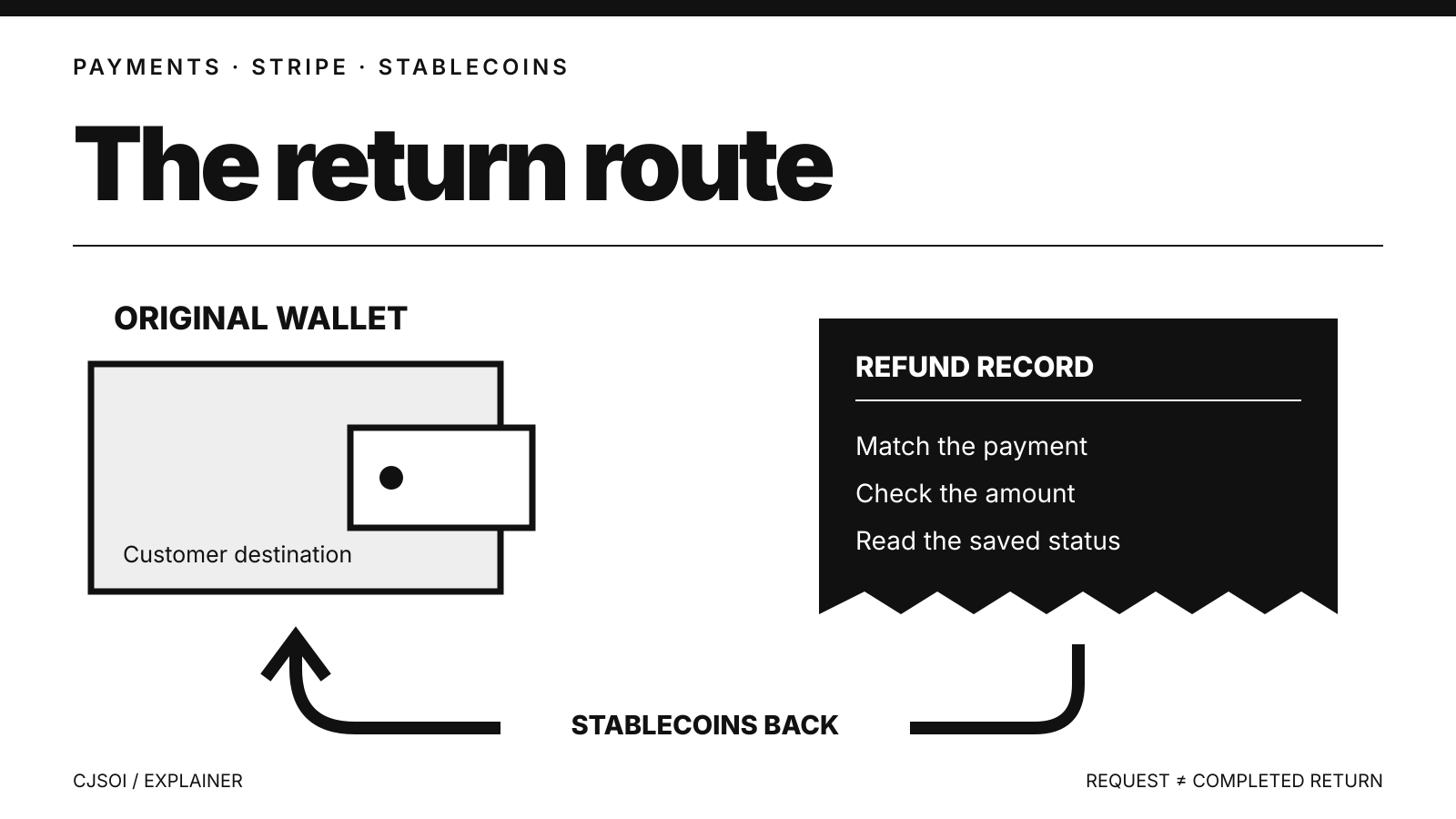
Stripe stablecoin refunds return stablecoins to the customer’s original wallet. Stripe documents support for both full and partial refunds, using its refund flow. For a merchant, the operational task is to connect the correct original payment to the approved amount, then follow the saved refund’s status. A customer-service promise alone is not proof that funds have been returned.
This guide covers Stripe’s stablecoin payment method, based on documentation checked on 25 October 2026. It does not describe every crypto checkout, an exchange withdrawal or a direct token transfer. Confirm that the payment actually used this product before applying its rules.
Identify the payment before choosing a refund route
Find the original order and its Stripe payment record. Check the amount and currency, payment method and any refunds already associated with it. Keep that record separate from a wallet screenshot or a support message naming the same customer.
Stripe’s stablecoin payment documentation says the refund returns as stablecoins to the original wallet. That product-specific destination matters when a customer asks for a return to a newly supplied address. Do not treat a merchant’s general refund screen as a tool for sending money to any wallet.
There is a broader design lesson here. The destination policy belongs in the checkout’s support procedure before a refund is needed. A support agent should know when the documented flow can be followed and when the customer’s circumstances require escalation. An address copied into a chat is not a substitute for that procedure.
Our guide to how businesses accept stablecoin payments explains the earlier connection between an order, payment instructions and settlement. The refund record should remain linked to that same order.
Distinguish approval from a completed refund
A merchant can agree that a customer is owed money before the payment system has processed the return. Keep the commercial decision and the processing state separate in both internal records and customer messages.
Stripe’s Refund object reference lists possible statuses including pending, requires_action, succeeded, failed and canceled. It also connects the refund to its original charge or PaymentIntent. These are fields in Stripe’s general refund model; their presence does not mean every payment method uses every transition.
Build the support wording around the state actually observed. “Approved” can describe the merchant’s decision. “Submitted” can describe a request that has been saved. Do not say “completed” merely because an agent clicked a button or an API request returned an identifier.
For reconciliation, retain the refund ID and its relationship to the order. If a later status changes, a colleague should be able to find the same record without reconstructing the agent’s browser session.
Control the cumulative amount of partial refunds
Stripe’s refund guide permits multiple refunds against a charge, but their total cannot exceed the original amount. Its Dashboard flow supports selecting a partial amount, while an API request can identify the original charge or PaymentIntent.
Consider a fictional USD 240 order with an earlier USD 60 refund. Before requesting a further USD 90 return, the cumulative amount would be USD 150 and the arithmetic remainder USD 90. These are merchant-ledger calculations, not a quoted token-conversion rate or a claim about an actual transaction.
The useful control is to check both previous attempts and completed records. If a colleague has already started a refund, a second support agent should investigate that attempt before creating another. A customer’s second message about the same issue should not automatically become a second return.
The order ledger also needs a reason for the refund, such as a returned line item or an agreed adjustment. Without that connection, a correct cumulative total can still conceal a refund against the wrong purchase.
Do not copy card timing into a wallet response
Payment-method scope matters when reading a large refund guide. Stripe’s general documentation contains card and bank-specific sections, including statement references and arrival estimates. Those passages should not become a guaranteed stablecoin refund time merely because they appear on the same page.
Give the customer the state and evidence available for their particular payment. If the documentation or saved record does not establish a completion time, say that it remains unconfirmed. Avoid turning the speed of the original checkout into a promise about a later refund.
Likewise, a full refund of the customer-facing amount and the merchant’s total processing cost are different calculations. Stripe says its original transaction processing fees are not returned. Check the applicable pricing before promising that the business recovers every cost. This guide does not estimate a network fee or a merchant’s negotiated charges.
Keep refund messaging and finance records consistent
A useful internal record links the order, original payment, refund decision, amount, currency, refund ID and observed status. Add the time of the status check so the next agent knows whether it is current. Store only the customer information the support process needs.
For the fictional USD 240 order, a note saying “refund 90” is ambiguous. It does not identify whether USD 90 is the new adjustment, cumulative amount or unpaid remainder. A precise note would describe the new adjustment and retain the prior USD 60 return as a separate event.
Choose one record as the authoritative source for processing state. Email correspondence can explain why the refund was agreed, but the payment record should establish what was attempted. If the system reports failure, investigate that saved attempt before offering an alternative payment route.
An alternative reimbursement is a separate business decision with its own destination checks and accounting consequences. It should not be improvised from a customer’s newly supplied bank details or wallet address. Escalate where the documented flow does not fit, and retain the reason for the chosen resolution.
The amounts above are fictional examples. This article does not report hands-on tests or promise a refund outcome.