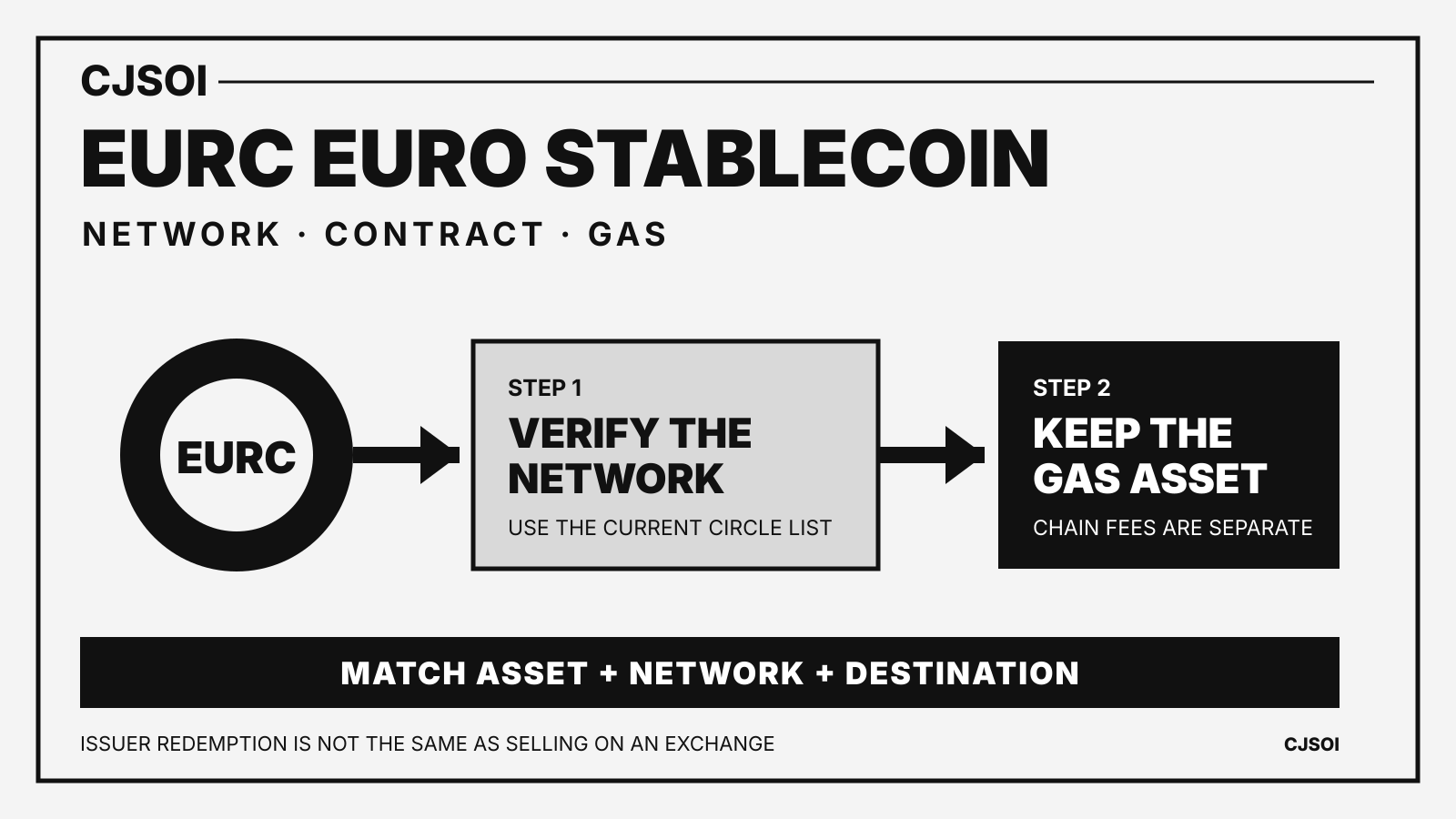
EURC is a euro-backed stablecoin issued by Circle France. Sending it safely means matching four things: the EURC token, the blockchain, the receiving service’s supported deposit route and the network’s fee asset. A euro ticker alone does not establish any of them.
Quick answer Circle lists native EURC on Arc, Avalanche, Base, Cronos, Ethereum, Plasma, Solana, Stellar and World Chain. Check the current EURC contract list before sending. Select the same network at both ends, follow any memo requirement and keep the chain’s native asset available for fees.
This guide explains the transfer and redemption mechanics from Circle’s documentation and European rules checked on 25 October 2026. It is not investment advice, and it does not assume that every wallet or exchange supports every Circle deployment.
What EURC is
EURC is designed to track one euro. Circle says it backs EURC with euro-denominated reserves and issues the token through Circle Internet Financial Europe SAS, a French electronic money institution authorised by the ACPR. The issuer classifies EURC as an e-money token under the EU Markets in Crypto-Assets Regulation, usually shortened to MiCA.
Three claims need to stay separate:
- The token claim: EURC represents a claim against its issuer under the applicable terms.
- The market price: an exchange order can trade above or below one euro because of liquidity, spread or fees.
- The blockchain record: a confirmed transaction proves that tokens moved on a particular chain. It does not prove that an exchange credited the right customer.
Circle’s EURC page says the token is redeemable one-to-one for euro. The actual route depends on the holder, location, account eligibility and the issuer’s checks.
EURC runs on several blockchains
EURC is not one address reused everywhere. Circle publishes a separate native token address for each supported blockchain. When checked on 25 October 2026, its list covered nine networks:
| Network | What to verify before sending |
|---|---|
| Arc | EURC contract and receiving service support |
| Avalanche C-Chain | C-Chain selection and native EURC contract |
| Base | Base network and native EURC contract |
| Cronos | Cronos network and native EURC contract |
| Ethereum | Ethereum network and ERC-20 EURC contract |
| Plasma | Plasma network and native EURC contract |
| Solana | Solana mint and recipient support |
| Stellar | EURC asset code, issuer and required memo |
| World Chain | World Chain network and native EURC contract |
The list can change. Copying an address from an old post, search result or wallet label is weaker than checking Circle’s current contract page and the receiving service’s live deposit screen.
A bridged token can carry the same name or target while using a different contract and issuer route. Circle Mint’s documentation warns against depositing unsupported assets. Do not treat a similar ticker, logo or price as proof that a token is the native EURC Circle supports.
The fee is paid in the chain’s own asset
EURC is the transferred asset, not automatically the fee asset. A wallet normally needs the blockchain’s native token for gas or transaction fees.
On Ethereum and EVM-compatible chains, the wallet pays the network fee in the chain’s native gas asset. On Solana, the fee payer needs SOL. On Stellar, the account needs XLM for network fees and minimum-balance requirements. The exact fee is set by network conditions and the transaction, not by the EURC balance.
An exchange withdrawal fee is a separate charge. A service may combine its own fee with the estimated network cost, set a minimum withdrawal or pause a route. Read the final confirmation screen instead of copying a fee quoted elsewhere.
How to send EURC safely
- Open the destination first. Select EURC in the receiving wallet or exchange.
- Choose a supported network. If the destination does not list the intended chain, do not improvise.
- Copy the destination details after selecting the network. Include a memo or reference when the receiver requires one.
- Verify the native EURC contract or mint. Use Circle’s current contract-address page.
- Select the same network in the sending service. A compatible-looking address is not enough.
- Keep enough of the network’s native asset for fees.
- Review the withdrawal minimum, service fee and amount the recipient should receive.
- Send a small test when the destination is new and minimums make that practical.
- Check both records. Confirm the on-chain transaction, then confirm that the receiving service credited it.
The network selection guide explains why an address alone does not identify the intended deposit route.
A Stellar transfer may need a memo
Stellar deserves a separate check because custodial services often use one address plus a memo to identify a customer. Circle’s support guidance warns users to include the required Memo ID when depositing EURC on Stellar to Circle Mint. A transaction can succeed on Stellar while the service cannot assign it automatically without that memo.
Retrieve the memo from the current deposit screen. Do not reuse a memo from an earlier transfer or another account. If a service says no memo is required, follow that service’s current instructions rather than adding one from a different destination.
Moving EURC between chains is not a normal wallet transfer
Sending EURC from one Ethereum address to another Ethereum address is a same-chain transfer. Moving value from Ethereum EURC to Solana EURC needs a cross-chain route.
Circle says eligible Circle Mint customers can swap EURC across supported blockchains through Mint and its APIs. That operation removes or rebalances value on one chain and makes the supported native asset available on another. It is not achieved by putting a Solana address into an Ethereum transfer.
A third-party bridge is a separate product with its own smart contracts, liquidity and token representation. Before using one, check whether the result is native EURC on the destination chain or a bridged wrapper. The stablecoin list separates issuer information from network deployments, while the MiCA data page tracks euro-denominated e-money tokens without implying that their contracts are interchangeable.
Redemption is different from selling EURC
A sale on an exchange converts EURC at the venue’s quoted price and under its fee schedule. Issuer redemption follows Circle France’s policy.
Circle’s MiCA redemption policy, updated 15 September 2026, says EURC holders have a right to redeem at par value subject to the policy’s conditions. Circle Mint customers use their account agreement. Other business holders need a redemption-only Circle Mint account and must pass the required checks. Retail holders can use Circle France’s dedicated process, provide an EEA bank-account IBAN and complete identity and transaction verification.
Circle says an eligible retail redemption should be paid within five business days after the tokens arrive and the checks are complete, unless discrepancies are found. Bank charges, conversion costs or incoming-deposit fees can still exist outside Circle’s control.
The practical distinction is simple:
| Route | What determines the result |
|---|---|
| Sell on an exchange | Order book or conversion quote, venue fees and available liquidity |
| Redeem with Circle France | Eligibility, identity and transaction checks, supported bank details and the redemption policy |
| Transfer onchain | Correct contract, network, destination details and network fee |
For the broader mechanics, see what happens when a stablecoin is redeemed.
Common failure modes
Wrong network
The sender chooses a chain that the receiver does not support for EURC. The blockchain can confirm while the receiving service never credits the deposit automatically.
Wrong contract
The wallet sends a bridged or imitation euro token instead of Circle’s native EURC contract. A familiar ticker does not fix the mismatch.
Missing fee asset
The wallet holds EURC but not enough of the network’s native token to pay the fee.
Missing memo
The transfer reaches a custodial Stellar address without the customer-identifying memo. Recovery depends on the service and may require support.
Confusing sale and redemption
A holder expects an exchange to provide the issuer’s one-to-one redemption terms. The exchange uses its own price, spread and fees.