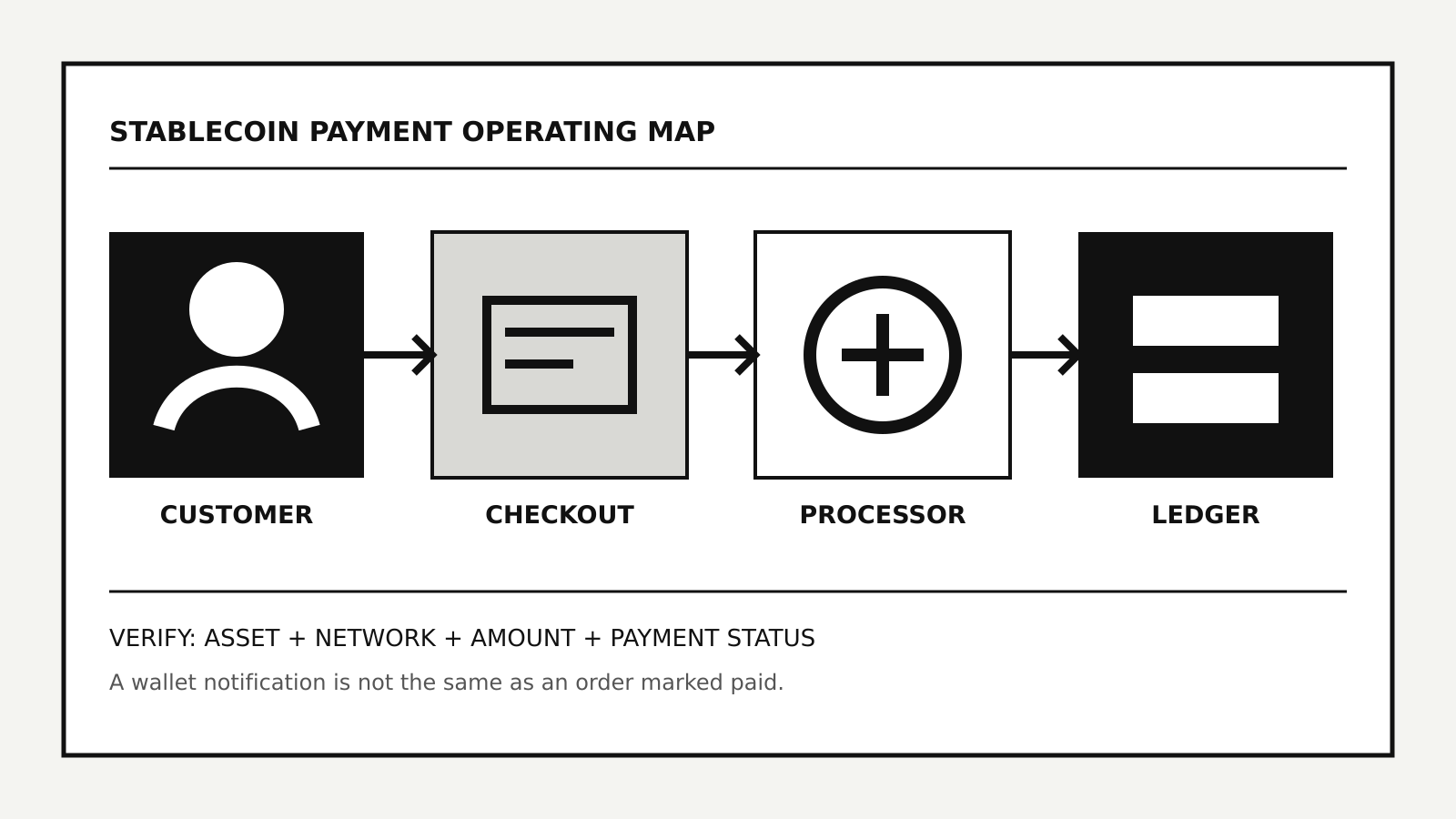
A business can accept stablecoin payments through a hosted processor, an integrated payments API or a wallet it controls. The right route depends less on the token logo than on what the business must do after a customer clicks pay: quote an amount, identify the order, wait for the right status, refund accurately, reconcile the sale and handle custody.
For most merchants, a processor-led checkout is the simpler starting point. Direct wallet acceptance gives more control but moves network selection, monitoring, key security and accounting into the merchant’s own systems.
Reviewed against Stripe and Circle documentation on 29 October 2026. Product availability, supported assets and networks change; verify the current documentation before launch.
Three ways to accept stablecoin payments
| Route | What the customer sees | What the business operates | Main trade-off |
|---|---|---|---|
| Hosted checkout | A payment page with wallet and network choices | Product, order and fulfilment systems | Fastest integration, provider controls supported routes |
| Payments API | Checkout inside the business product | API calls, webhooks, retries and reconciliation | More control, more implementation work |
| Direct wallet | A wallet address or payment request | Wallets, chain monitoring, confirmations, refunds and treasury | Maximum control, maximum operational responsibility |
All three can move the same stablecoin. They do not create the same business process.
Route one: use a hosted stablecoin checkout
A hosted checkout lets a payments provider own the wallet connection and much of the network-specific flow. The merchant creates an order or payment session, redirects the customer to the provider’s page, and waits for the provider to report a completed payment.
Stripe’s stablecoin payments documentation says customers choose a supported stablecoin, wallet and network. Completed payments settle into the merchant’s Stripe balance in local currency. Stripe currently lists USDC on several networks, with additional supported assets and regional restrictions. The same page documents refunds, a per-transaction limit and the absence of chargeback-style disputes for this payment method.
Those details are provider-specific. A business should not describe “stablecoin payments” as if every processor supports the same tokens, countries, networks, settlement currency or refund behavior.
Hosted checkout is usually suitable when the business wants:
- a familiar order and refund workflow;
- local-currency settlement rather than holding tokens;
- a provider-owned list of supported networks;
- less wallet and key management;
- payment status through the same platform used for other methods.
The merchant still needs to test what happens when the customer closes the page, sends from an unsupported wallet, pays the wrong amount or returns to the shop before the provider’s server-side confirmation arrives.
Route two: integrate a payments API
An API integration keeps more of the payment experience inside the product. The business creates a payment request with an amount and an order reference, shows the wallet flow, and listens for signed server events that change the order state.
The difficult part is not generating an address. It is building a reliable state machine.
A useful order model separates:
- Created — the customer has an amount and payment route.
- Pending — a transaction has been seen but is not yet accepted as paid.
- Paid — the provider or chain policy has reached the required status.
- Fulfilled — the product or service has actually been delivered.
- Refund pending — a refund was requested but is not complete.
- Refunded — the refund reached the provider’s final state.
Do not let the browser decide that an order is paid. The customer can close the tab, reload, spoof a success screen or return before the back end has received the authoritative status. Use the provider’s signed webhook or a server-to-server status query, make event handling idempotent and store the provider’s payment and event identifiers.
An idempotent handler can receive the same event twice without fulfilling twice. That matters because webhooks are commonly retried when your endpoint times out or returns an error.
Route three: accept directly to a business wallet
Direct wallet acceptance removes the processor from the onchain transfer. The business publishes or generates a destination address and monitors the relevant chain.
This can reduce provider dependence, but the business must define every rule that a processor would otherwise define:
- which exact token contract or mint is accepted;
- which networks are supported;
- whether one address is reused or a new address is generated per order;
- how a transfer is matched to an invoice;
- how many confirmations or what finality signal marks it paid;
- who controls keys and approves outgoing refunds;
- how unsupported or bridged assets are handled;
- how balances are converted, held or transferred.
The asset name alone is not enough. Circle’s supported chains and currencies page pairs each supported asset with a specific chain. It warns that unsupported tokens and some bridged forms may not be credited and may result in lost or stuck funds.
A business accepting directly should publish one unambiguous payment route per order: asset, network, destination, amount, expiry and reference. “Send USDC” is incomplete if the network is not stated.
Match the payment to the order
Bank transfers often carry a reference. Onchain transfers may not have a merchant-friendly memo, and two customers can send the same amount.
Common matching methods include:
- a unique deposit address for each order;
- a provider payment-session ID;
- a unique amount within a narrow tolerance;
- a supported memo or destination tag;
- a signed payment request that binds the order and amount.
Unique addresses are clearer for reconciliation but add address-management work. Unique amounts can fail when prices move, fees are deducted or two orders collide. Memos work only on networks and custodians that preserve them.
Whichever method you choose, store the quoted asset, network, destination, amount, quote expiry, transaction identifier and final order status together.
Decide when “paid” is paid
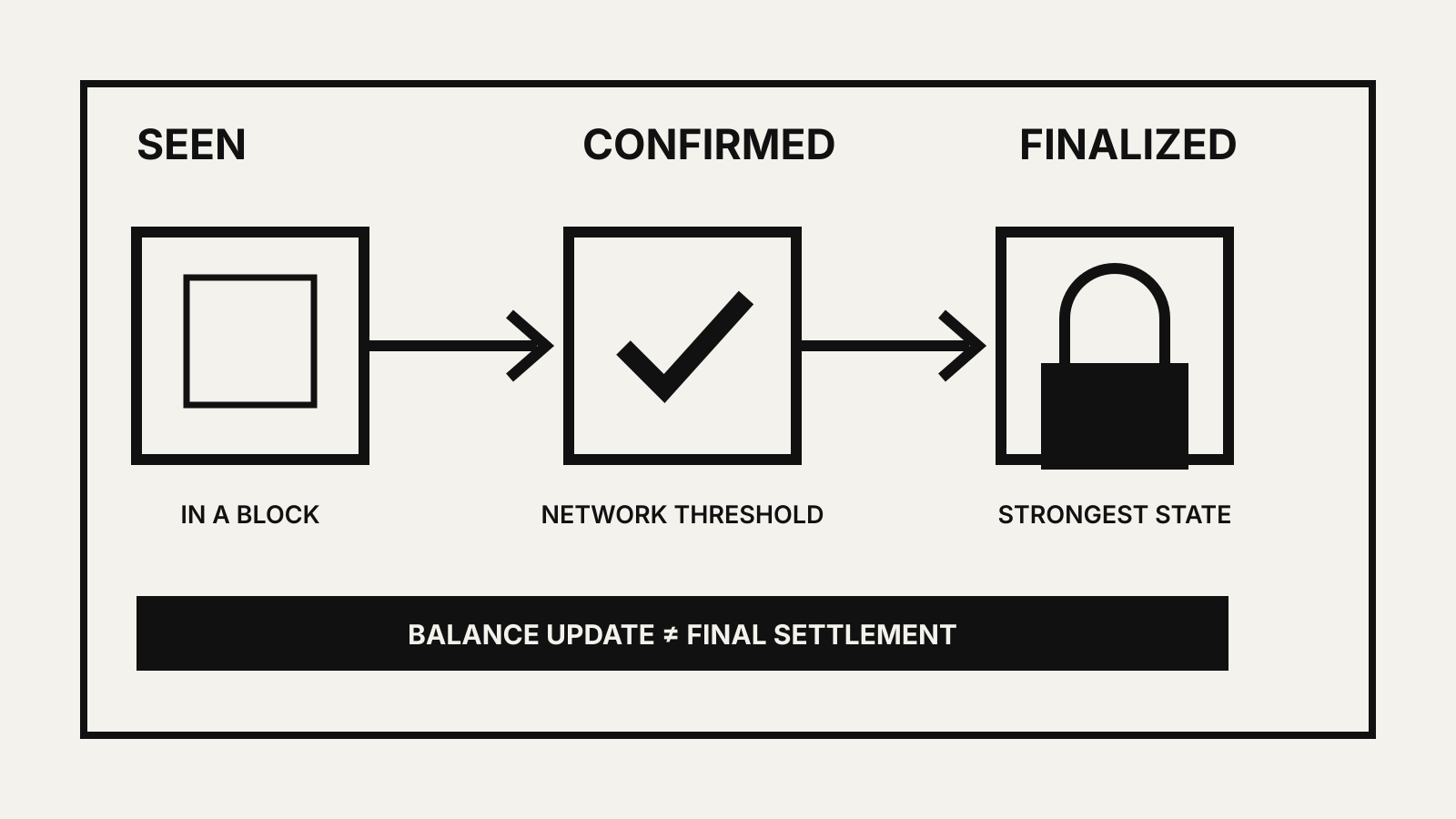
A transaction appearing in a wallet is evidence that it was broadcast or observed. It may not yet satisfy the business’s acceptance policy.
Different networks expose different confirmation and finality models. Processors can abstract that policy, while a direct wallet integration must implement it. Our explainer on stablecoin payment confirmations separates seen, confirmed and finalized states.
For low-value digital goods, a business may accept a provider’s completed state quickly. For a high-value order, it may wait for stronger finality. The rule should be explicit, tested and consistent. It should also cover reorgs, dropped transactions and provider status delays.
Refunds need their own workflow
A stablecoin refund is a new payment. It does not reverse the original blockchain transaction.
Stripe says stablecoin refunds return to the customer’s original wallet. That is a clear provider rule, but businesses still need to record the requested amount, the provider’s refund identifier and the final status. Partial refunds must add up correctly and should never exceed the captured amount.
Direct-wallet refunds are riskier. Automatically refunding the sending address can be wrong when the original payment came from an exchange or custodial service. Ask for a destination through an authenticated customer process, validate the asset and network, and require approval for large amounts.
Do not promise a refund time until the business has separated internal approval, provider processing and onchain settlement.
Reconcile value, fees and settlement
The sale amount, token amount and bank settlement can differ.
A useful reconciliation record contains:
- invoice currency and gross sale value;
- token and network used;
- quoted token amount and expiry;
- provider fee or network fee;
- transaction or payment ID;
- local-currency settlement amount and date;
- refund amount and status;
- accounting value used for the sale.
If a processor converts to local currency, store the provider’s settlement record. If the business holds the stablecoin, it needs a treasury and accounting policy for the token after receipt. That policy is separate from whether the checkout technically succeeded.
Security and access controls
Stablecoin acceptance introduces two kinds of credentials: payment-provider credentials and wallet keys.
For a processor integration:
- keep API secrets on the server;
- verify webhook signatures;
- restrict dashboard roles;
- rotate credentials;
- separate test and live environments;
- log refund and payout changes.
For direct custody:
- do not keep a treasury key in the web application;
- separate receiving from spending;
- use approval thresholds for refunds and transfers;
- back up recovery material securely;
- test recovery before accepting material balances;
- monitor for an address or network being changed in the checkout.
A compromised destination address can redirect every new sale while the storefront appears normal. Treat payment configuration like bank-account details.
A launch checklist
Before enabling the payment method:
- Confirm the business and customer countries are supported.
- List the exact assets and networks shown in checkout.
- Decide whether settlement is local currency or stablecoin.
- Create test orders for correct, wrong and partial amounts.
- Verify signed server events and idempotent handling.
- Test delayed confirmation and abandoned checkout.
- Test full and partial refunds.
- Reconcile a payment from order to settlement.
- Document customer support for wrong-network payments.
- Set key, credential and approval controls.
- Review tax, accounting, sanctions and consumer-law obligations for the business’s jurisdictions.
- Recheck provider documentation before each material product change.
Stablecoin payments are not one feature switch. They are a chain of decisions from quote to settlement. A business is ready when it can reproduce that chain for a normal payment, an exception and a refund.