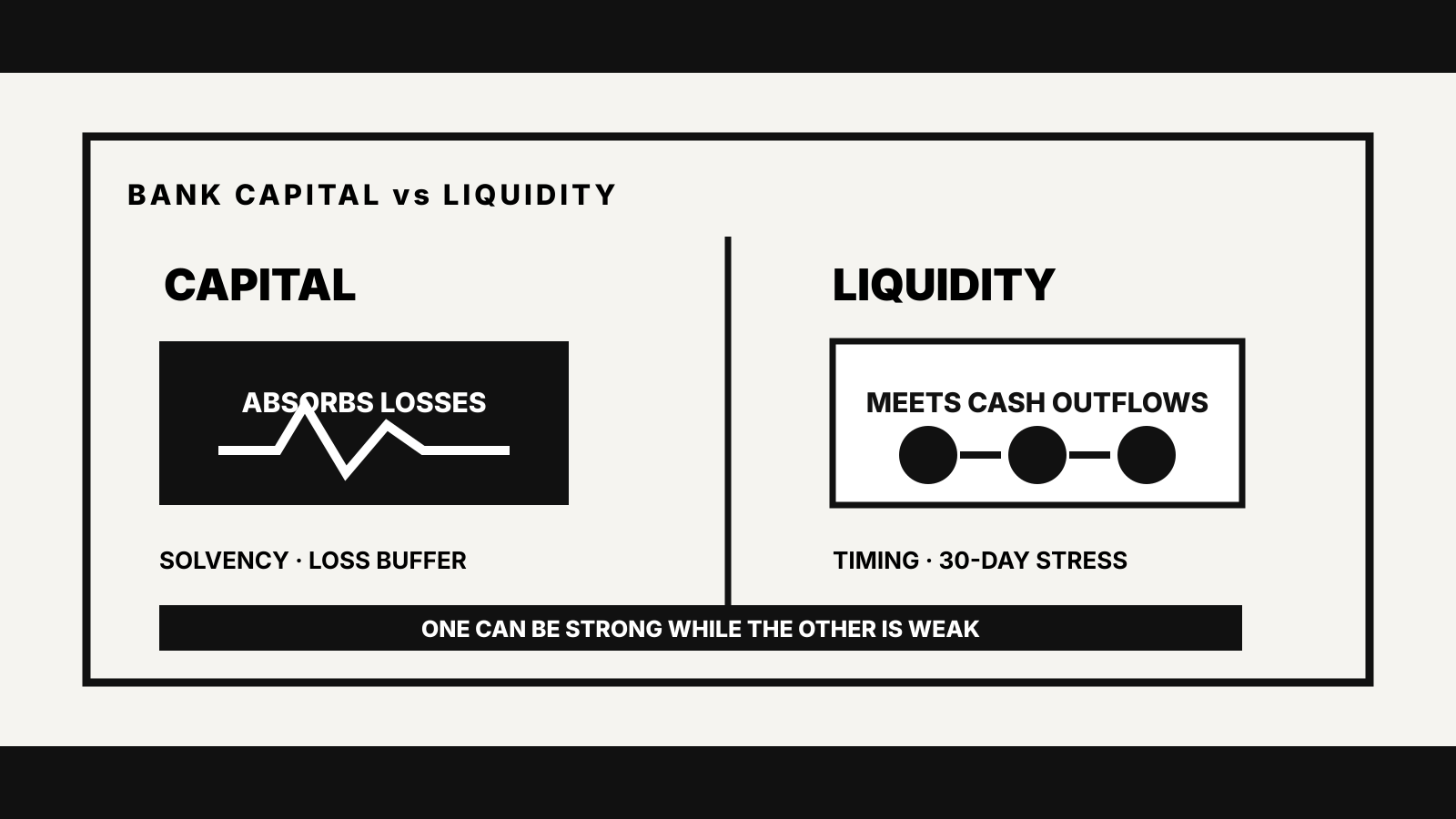
Bank capital and bank liquidity solve different problems. Capital is the loss-absorbing layer between a bank’s assets and most of its liabilities. Liquidity is the ability to meet cash outflows when they fall due. A bank can have valuable assets and positive capital but still face a liquidity crisis if it cannot turn those assets into usable cash quickly enough.
The distinction matters when reading bank results, stablecoin reserve arrangements or a custodian’s claims. “Well capitalised” does not mean “holding enough immediately available cash”, and a large stock of liquid assets does not prove that a bank can absorb severe credit losses.
Capital protects against losses
A simplified bank balance sheet has assets on one side—loans, securities, reserves at the central bank and other claims—and liabilities on the other—deposits, wholesale funding and debt. Equity sits beneath the liabilities as the residual claim.
If a borrower fails to repay, the bank records a loss. That loss reduces profit and then equity. Capital requirements are designed to ensure that a bank has a sufficient loss-absorbing layer relative to the risks it takes.
The Basel Committee’s definition of capital separates eligible regulatory capital into Common Equity Tier 1 (CET1), Additional Tier 1 and Tier 2. These categories are not interchangeable. CET1 is the highest-quality layer and includes common shares and retained earnings after regulatory adjustments. Other instruments must meet specific conditions before supervisors count them.
Capital ratios compare eligible capital with a denominator. The risk-based ratio uses risk-weighted assets, so different exposures carry different weights under the framework. Basel also has a leverage ratio, a non-risk-based backstop intended to restrict excessive leverage.
A capital ratio is therefore not simply “cash divided by deposits”. It is a measure of eligible loss-absorbing resources against exposure.
Liquidity protects against a timing mismatch
Banks routinely fund longer-lived assets with liabilities that customers or markets can withdraw sooner. A mortgage may pay over decades, while a depositor may ask for money today. This maturity mismatch is part of banking, but it creates liquidity risk.
A bank can be solvent on paper—its assets exceed its liabilities—yet unable to make a payment now because the assets cannot be sold or pledged fast enough without a large discount.
Basel’s Liquidity Coverage Ratio standard addresses short-term stress. Its numerator is a stock of unencumbered high-quality liquid assets (HQLA). The denominator is total net cash outflows over a prescribed 30-day stress period.
In compact form:
LCR = stock of HQLA ÷ total net cash outflows over 30 days
The standard requires HQLA to be liquid in markets during stress and ideally eligible at a central bank. It also places operational conditions on the assets: a bank must be able to monetise them, and they cannot be tied up for another purpose.
This does not mean every asset with a quoted price is HQLA. The framework considers characteristics such as low credit and market risk, ease and certainty of valuation, market depth and evidence that the asset remains liquid in stress.
One bank, two different shocks
Consider a simplified bank with $100 billion of assets, $94 billion of liabilities and $6 billion of equity.
A $4 billion credit loss reduces the assets to $96 billion. Liabilities remain $94 billion, so equity falls to $2 billion. That is a capital shock: the bank has absorbed a loss, and the concern is whether enough eligible capital remains.
Now consider a different event. Depositors request $10 billion in a day, but the bank has only $3 billion of immediately usable cash and cannot sell or pledge other assets quickly enough. The assets may still be worth more than the liabilities. The immediate problem is liquidity.
The two shocks can interact. A forced sale at a deep discount may turn a liquidity problem into a capital loss. Doubts about solvency can also cause depositors and counterparties to withdraw funding, making the liquidity problem worse.
Why borrowing does not replace capital
A bank can meet a temporary cash need by borrowing against eligible collateral or obtaining market funding. That can improve liquidity because usable cash arrives.
Borrowing also creates or increases a liability. It does not erase losses on the asset side or create common equity. If a bank’s assets are genuinely worth less than its liabilities, more debt may postpone a cash shortfall but does not repair the capital position.
The reverse is also true. Raising equity improves the loss-absorbing layer, but the bank must still manage the form and location of its liquid resources. Capital that cannot be converted into settlement funds at the right entity and currency does not automatically meet today’s payment.
Capital rules and liquidity rules work together
The Basel framework has several layers because one number cannot capture every failure mode.
| Question | Main measure | What it addresses |
|---|---|---|
| Can the bank absorb risk-weighted losses? | CET1 and total capital ratios | loss absorption relative to risk |
| Is leverage excessive even if risk weights are low? | leverage ratio | a simple non-risk-based backstop |
| Can the bank withstand 30 days of stressed outflows? | Liquidity Coverage Ratio | short-term liquidity resilience |
| Is funding stable over a longer horizon? | Net Stable Funding Ratio | structural funding mismatch |
The ratios use regulatory definitions, not everyday meanings. A reader should check the scope, date, entity and currency in a disclosure before comparing two banks.
What this means for stablecoin and payment users
A payment firm may hold customer money at one or more banks. A stablecoin issuer may place reserve assets with custodians and banks. Those arrangements create exposure to the institutions, legal entities and account structures involved.
A bank’s capital and liquidity disclosures can inform the analysis, but they do not answer every product-level question. You still need to know:
- which legal entity owes the customer or token holder;
- whether assets are segregated or part of the firm’s estate;
- which assets back the claim;
- who may redeem directly and on what terms;
- whether cash is concentrated at one institution;
- what happens if a bank, custodian or payment rail is unavailable.
For the distinction between a bank deposit and a token claim, read Tokenized Deposits and Stablecoins. For issuer disclosures, see Stablecoin Reserve Attestations.
A reading checklist
When a bank says it is “strong” or “liquid”, look for the actual metric.
- Is the figure a capital ratio, a liquidity ratio or an accounting cash balance?
- Which entity and reporting date does it cover?
- Is it a regulatory minimum, a management target or the reported result?
- What is in the numerator and denominator?
- Are restrictions, currency mismatches or encumbrances relevant?
- Is the disclosure consolidated across a group or specific to one bank?
This checklist avoids treating capital, cash and liquidity as synonyms.