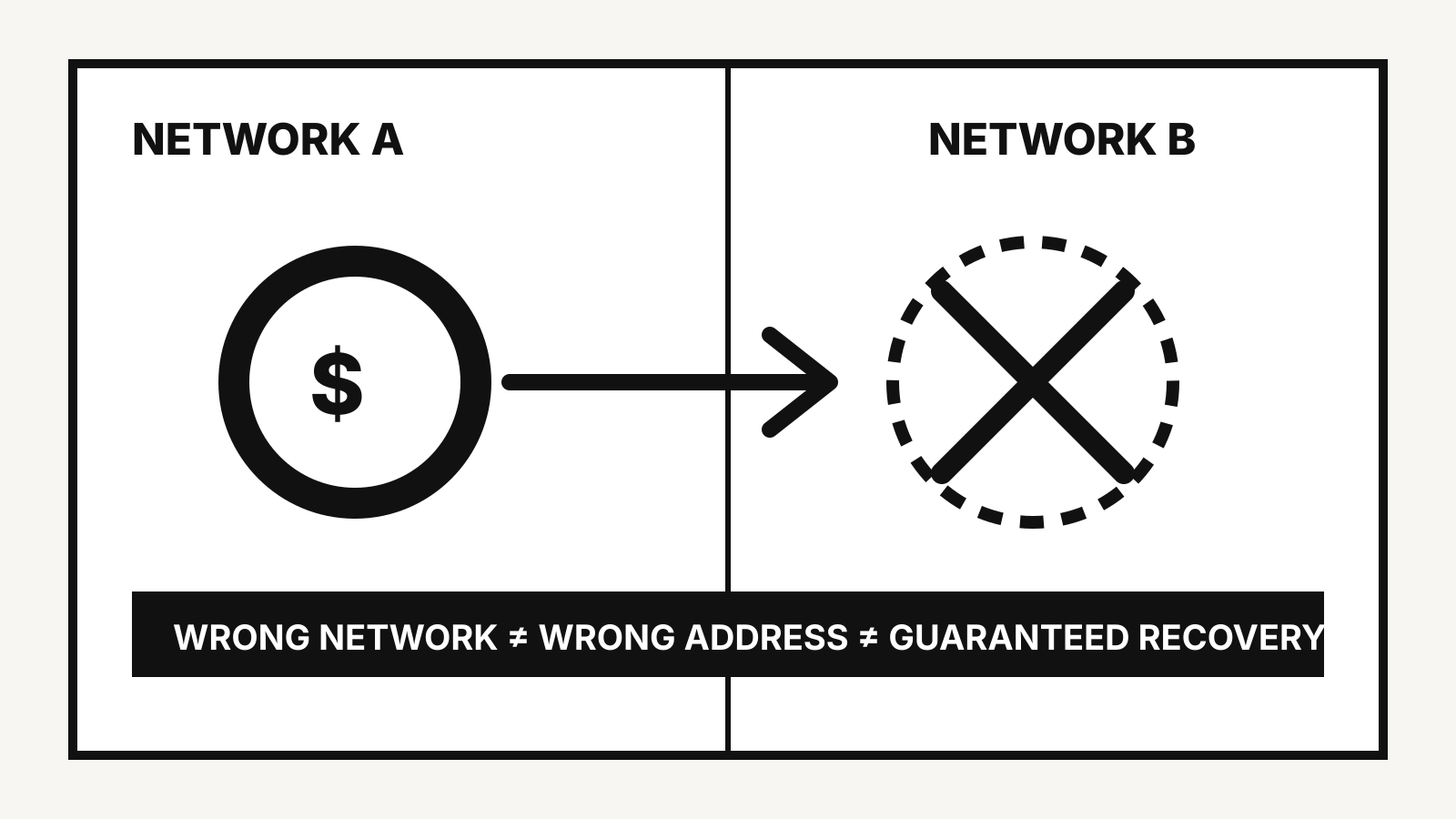
A stablecoin sent to the wrong network can create two very different problems. The transfer may have gone to an address you control on another compatible network, or it may have reached an incompatible address, exchange deposit system or bridge contract that you cannot operate. The first problem is sometimes recoverable with the right wallet configuration. The second may require a custodian or issuer, and recovery may be impossible.
The blockchain does not know what network you intended to use. Once a valid transaction is finalized, a wallet interface, exchange support desk or token issuer cannot simply reverse it like a card charge.
First identify what went wrong
Do not start by sending another transaction. Record the transaction hash, sending address, destination address, token contract, network, amount and time. Then open the transaction in that network’s official or widely used block explorer.
Check four facts:
- Did the transaction succeed on-chain?
- Which token contract moved?
- Which address received it?
- Who controls that address on the network where the transfer actually settled?
That last question decides the recovery path. A familiar string of characters does not prove that the same wallet or exchange supports the asset on both networks.
Wrong network is not always the same as wrong address
Many Ethereum-compatible networks use the same address format. A self-custody wallet may therefore control the same address on Ethereum, Base, Arbitrum or another EVM network because the address is derived from the same private key.
If you sent a supported token to your own address on the wrong EVM network, the asset may already be under your control. The wallet may simply be showing a different network or hiding the token. Switching networks and adding the verified token contract can reveal the balance.
That does not mean every same-looking address is recoverable. An exchange can assign one deposit address while only monitoring selected networks. A smart-contract address may have no function for returning tokens. A non-EVM destination may use a completely different key system. Never import a seed phrase or private key into an unknown “recovery” website.
A wrong address is more severe. Circle’s support guidance for USDC sent to the wrong address or network says transfers to an unintended address are irreversible and Circle cannot recover them. For a wrong network, Circle directs users to verify the transaction in a block explorer, switch the wallet to the destination network and confirm that the wallet supports USDC there.
If you control the receiving wallet
For a self-custody wallet, take these steps without exposing the recovery phrase:
- confirm the destination address is derived from your wallet;
- select the network where the transaction actually settled;
- add the correct official token contract if the asset is not displayed;
- make sure the wallet supports that network and token standard;
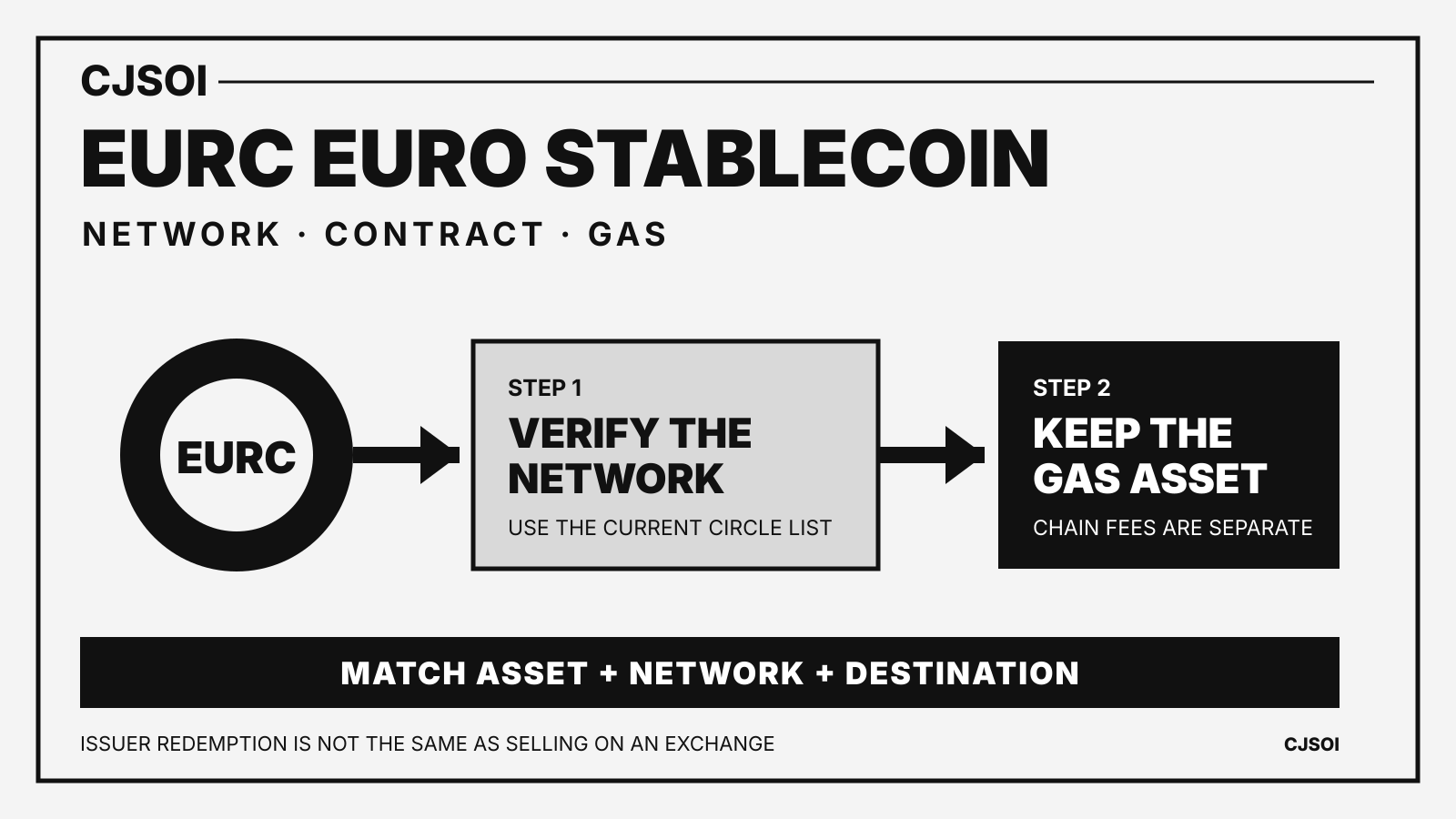
- keep enough of the network’s native token to pay any later transaction fee.
Use the issuer’s official token-contract list or the network’s official explorer. A scam token can copy a stablecoin name and symbol. The contract address, not the ticker alone, identifies the asset.
If the token arrived on a supported network but you wanted it elsewhere, use a bridge only after checking that the bridge supports the exact asset and route. A bridge is a new transaction with its own smart-contract, liquidity and finality risks; it is not an undo button.
If an exchange or custodian controls the address
When the destination is an exchange, broker or custodial wallet, only that operator has the keys. Open a support case through its official website or app. Provide the transaction hash, token contract, amount, network, deposit address and account identifier requested by the provider.
The operator may recover the asset manually if it controls the address on the destination network and has a secure process for unsupported deposits. It may charge an administrative fee or decline because the amount is below its threshold, the network is unsupported, or recovery would create operational or compliance risk.
A successful transaction shown by the block explorer proves settlement on that network. It does not prove that the exchange credited the deposit, supports the token or has agreed to attempt recovery.
Do not pay a person who contacts you privately and claims to be exchange support. Recovery cases attract impersonation scams because the transaction details are public and the sender is already under pressure.
Issuer recovery is narrow and discretionary
Stablecoin issuers do not have a general power to reverse every mistake. Whether an issuer can help depends on the token’s contract, the destination, the network and the issuer’s published policy.
Tether’s token recovery policy says recovery requests are considered case by case and are not guaranteed. The page lists a minimum eligible amount above $1,000 and says a recovery fee may be the greater of $1,000 or up to 10% of the amount. It also says the process may take months and requires identity verification and transaction information.
Those terms make issuer recovery a last resort, not a routine support channel. A request can fail even when the transaction is visible and the amount is large enough.
Circle’s Cross-Chain Transfer Protocol offers an instructive contrast. CCTP burns USDC on a source chain and mints USDC on a destination chain after an attestation. Circle states that transfers are irreversible and that its Cross-Chain Transfer Service cannot recover funds sent to an incorrect or incompatible address. Protocol-native cross-chain movement reduces reliance on pooled bridge liquidity, but it does not remove address risk.
Smart contracts can trap otherwise valid tokens
A contract address may be valid and still lack a withdrawal function for an unsupported token. Sending a stablecoin to a bridge, staking contract, token sale or application contract outside its intended call flow can leave the tokens inaccessible.
The contract developer may be unable to help if the code is immutable or no admin recovery function exists. An upgradeable contract may have an administrator, but that does not guarantee a recovery policy or permission to move the funds.
Before transferring to a contract, confirm that the interface generated the intended contract call. A plain token transfer to a contract address is not necessarily equivalent to depositing through the application’s function.
A recovery checklist
Work through the case in this order:
- Save the transaction hash and take screenshots of the sending interface.
- Confirm the status, network, token contract and destination in a block explorer.
- Determine whether you, a custodian or a smart contract controls the destination.
- If you control it, switch to the settled network and add the verified token contract.
- If a custodian controls it, use only its official support channel.
- Check the issuer’s current recovery policy only if the issuer is relevant to that token and network.
- Do not send “verification funds,” disclose a seed phrase or sign an unexplained transaction.
This sequence separates a display problem from a custody problem before money is spent on a recovery attempt.
Prevent the next wrong-network transfer
The safest procedure is operational, not technical:
- copy the deposit network as well as the address;
- compare the full network name, not only a ticker such as USDC or USDT;
- verify the token contract when several versions exist;
- send a small test amount first;
- wait for the receiving service to credit the test;
- use a saved address book only after confirming the network field;
- pause if a wallet automatically switches networks or a bridge changes the destination token.
A test transfer has a cost, but it limits the loss when an address, network or deposit route is wrong.
CJSOI’s guide to delivery versus payment explains the broader idea behind these controls: settlement design can reduce a specific risk, but it does not remove every failure around the transaction. Stablecoin transfers are similar. On-chain finality can prove what happened without proving that it matched the sender’s intention.