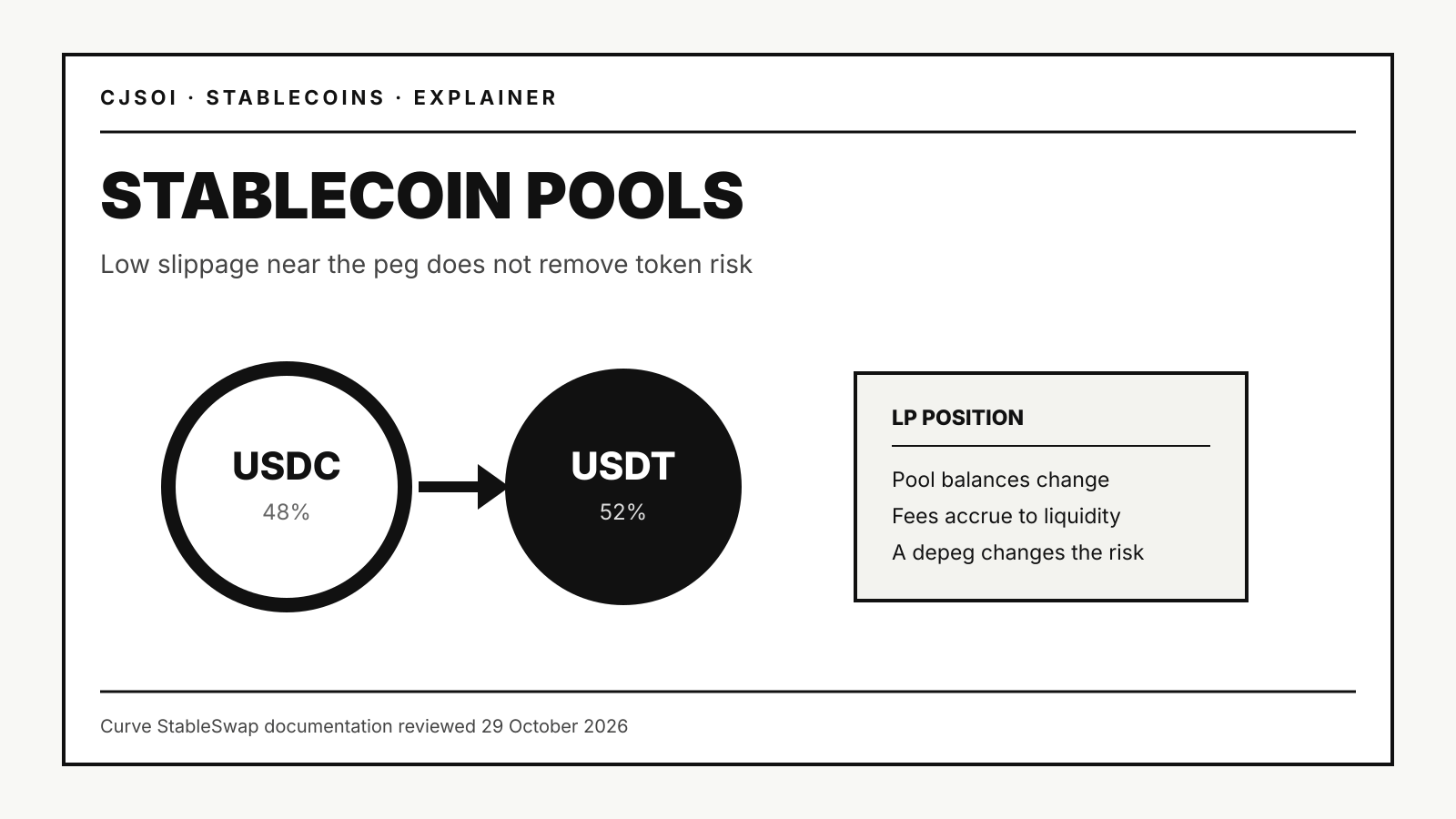
A stablecoin liquidity pool is a smart contract that holds two or more tokens and quotes swaps between them. The pool can make USDC-to-USDT trades efficient when both tokens trade near one dollar. It cannot guarantee that either token keeps its peg, remains redeemable or avoids issuer and contract risk.
For a liquidity provider, the important question is not only the advertised fee. It is what assets the position can turn into when traders rebalance the pool.
Reviewed against Curve’s StableSwap and StableSwap-NG documentation on 29 October 2026. Pool parameters, token contracts and incentives change; inspect the live contract and current documentation before using a pool.
The short answer
| Participant | What the pool does | What it does not do |
|---|---|---|
| Trader | Quotes a swap from one pool token into another | Guarantee the received token’s future value or redemption |
| Liquidity provider | Issues a position representing a share of pool assets and accrued fees | Keep the position in its original token mix |
| Stablecoin issuer | May issue or redeem one of the tokens under its own terms | Operate every market pool that contains the token |
| Pool contract | Applies an invariant, fee rules and token accounting | Remove smart-contract, oracle or depeg risk |
A pool is a market venue. Issuance and redemption remain separate systems.
How a two-token pool works
Imagine a pool containing USDC and USDT. A trader sends USDC to the contract and receives USDT. The pool’s USDC balance rises and its USDT balance falls.
The contract does not ask another trader to take the opposite side at that moment. Its pricing formula changes the quote as the balances move. Arbitrageurs may later trade against the difference between the pool price and prices elsewhere, pushing the pool back toward the broader market.
A liquidity provider deposits tokens and receives a position or LP token representing a claim on the pool. Fees from swaps increase the value attributed to that position, subject to the pool’s design.
The provider does not own a fixed number of each token. Its share is a percentage of changing pool balances.
Why stablecoin pools use a different curve
A basic constant-product automated market maker uses the relationship often written as:
x × y = k
That design keeps a price available at any balance, but it can create meaningful slippage even when two assets are expected to trade at almost the same value.
Curve’s StableSwap explanation describes a hybrid invariant. Near the target price, it behaves more like a constant-sum market, concentrating liquidity around parity. As the pool moves farther from balance, the curve behaves more like a constant-product market.
The result is usually lower slippage for similarly priced assets near their peg. The trade-off appears when one asset moves far from the expected value: the quote changes sharply and the pool can become heavily concentrated in the weaker token.
The amplification factor
Curve uses an amplification factor, usually shown as A, to control how tightly liquidity is concentrated around the target price.
A higher A can produce deeper liquidity and smaller price movement near one dollar. It also lets the pool become more imbalanced before the quoted price moves sharply.
A lower A spreads liquidity more broadly. The price responds earlier as balances move.
There is no universally safe A. A high value improves the near-peg trading experience while increasing the cliff-like behavior when the peg breaks materially. The appropriate value depends on how closely the assets are expected to track and how quickly the market should respond to imbalance.
What a liquidity provider actually earns
An LP position can receive several forms of return:
- a share of swap fees;
- protocol incentives paid in another token;
- yield already embedded in a vault or interest-bearing token;
- changes in the relative value of the pool assets.
These should be separated. Swap fees come from trading. Incentives may be temporary emissions. A yield-bearing token can accrue independently of pool activity. A change in the value of one stablecoin can overwhelm all three.
A displayed annual percentage rate is normally a backward-looking or estimated figure based on recent volume, incentives and position value. It is not a contractual rate.
Why the position changes its token mix
Suppose a provider deposits equal dollar values of two stablecoins. If traders sell token A into the pool and remove token B, the pool accumulates A.
The LP’s position therefore gains exposure to more A and less B. This is expected market-making behavior. The pool offers the asset traders want to sell and gives out the asset they want to buy.
If A later returns to its peg, arbitrage can rebalance the pool and fees may compensate the LP. If A does not recover, the LP can be left holding a large share of the impaired asset.
That is the central stablecoin-pool risk: liquidity providers tend to acquire the token the market is trying to exit.
Depeg risk is not ordinary price noise
Stablecoins can trade below their target for different reasons:
- uncertainty about reserves or redemption;
- an issuer, custodian or banking disruption;
- a smart-contract exploit;
- a freeze or blacklist event;
- congestion or failure on a network;
- thin liquidity on one venue;
- a problem with a bridged representation.
The pool sees balances and trades. It does not independently prove that a redemption claim is sound.
When one token loses its peg, the pool may become extremely imbalanced. A 50/50 position can turn into a position dominated by the weaker token. Fees earned before the event may be small compared with the loss.
Dynamic fees and imbalance
StableSwap-NG can use dynamic fees. Curve’s documentation says trades that worsen an imbalance can pay more than trades that restore balance.
This can reward LPs when liquidity is scarce and give traders an incentive to move the pool toward balance. It is still a pricing mechanism, not insurance.
A higher fee does not make a troubled token redeemable. It does not reimburse an LP if the token fails. It only changes the cost of the swap under the contract’s rules.
Plain pools, base pools and metapools
A plain pool holds two or more tokens directly.
A base pool contains established assets that other pools can use as a shared liquidity layer. A metapool pairs a new token with the LP token of a base pool.
This structure lets a new stablecoin access deeper liquidity without requiring a separate pair against every base asset. It also makes exposure harder to read. A metapool position can include:
- the new stablecoin;
- a claim on the base pool;
- the underlying tokens held by that base pool;
- contract and routing dependencies across both layers.
Curve says base-pool LPs are not directly exposed to tokens in the metapool. Metapool LPs, however, hold the metapool asset and the base-pool LP token, so they inherit the base pool’s risks.
Token types matter
StableSwap-NG supports several asset types, including standard ERC-20 tokens, rebasing tokens, oracle-priced tokens and ERC-4626 vault tokens.
Those labels change the accounting:
- a rebasing token can change balances without a transfer;
- an ERC-4626 token represents a claim on underlying vault assets;
- an oracle-priced token depends on an external rate;
- a bridged token adds messaging, custody or lockbox dependencies.
Do not treat two tokens as equivalent because both display one dollar in a wallet.
Smart-contract and administration risk
A pool can have audited code and still carry implementation risk. Review:
- the exact pool contract and factory;
- whether contracts are upgradeable;
- who controls administrative functions;
- which tokens and contract addresses are accepted;
- oracle dependencies;
- emergency pause or kill functions;
- fee settings;
- previous audits and unresolved findings.
Permissionless deployment means anyone may create a pool. A familiar ticker does not prove that the token contract is genuine.
Use the verified contract address from the issuer or protocol’s official deployment documentation. Never rely on search results, a wallet logo or the pool name alone.
Slippage, price impact and minimum received
A swap quote should include:
- the amount sent;
- the expected amount received;
- the minimum amount accepted;
- pool and routing fees;
- network cost;
- price impact;
- transaction deadline.
The minimum received protects against the quote worsening before execution. Setting it too loose can expose the transaction to avoidable loss or manipulation. Setting it too tight can make the transaction fail in a moving market.
For large trades, compare the pool quote with the issuer’s direct redemption route and centralized venues where accessible. One route may be cheaper but require different eligibility, custody or timing.
A checklist for liquidity providers
Before depositing:
- Verify every token contract and chain.
- Identify the issuer and direct redemption terms for each stablecoin.
- Read the pool type and invariant.
- Check the A value, base fee and dynamic-fee rules.
- Measure current balance and recent imbalance.
- Separate swap fees from token incentives.
- Trace base-pool and metapool exposure.
- Review upgrade and administrative controls.
- Decide what depeg would trigger an exit.
- Test withdrawal with a small amount.
- Record tax lots and fee income separately.
- Recheck the position after any issuer, custodian or bridge event.
A position that cannot be explained without an interface is difficult to monitor safely.
A checklist for traders
Before swapping:
- Confirm source and destination contract addresses.
- Check the network.
- Read expected and minimum received.
- Inspect price impact and pool imbalance.
- Compare direct and routed quotes.
- Set an appropriate deadline.
- Verify the received token before sending it onward.
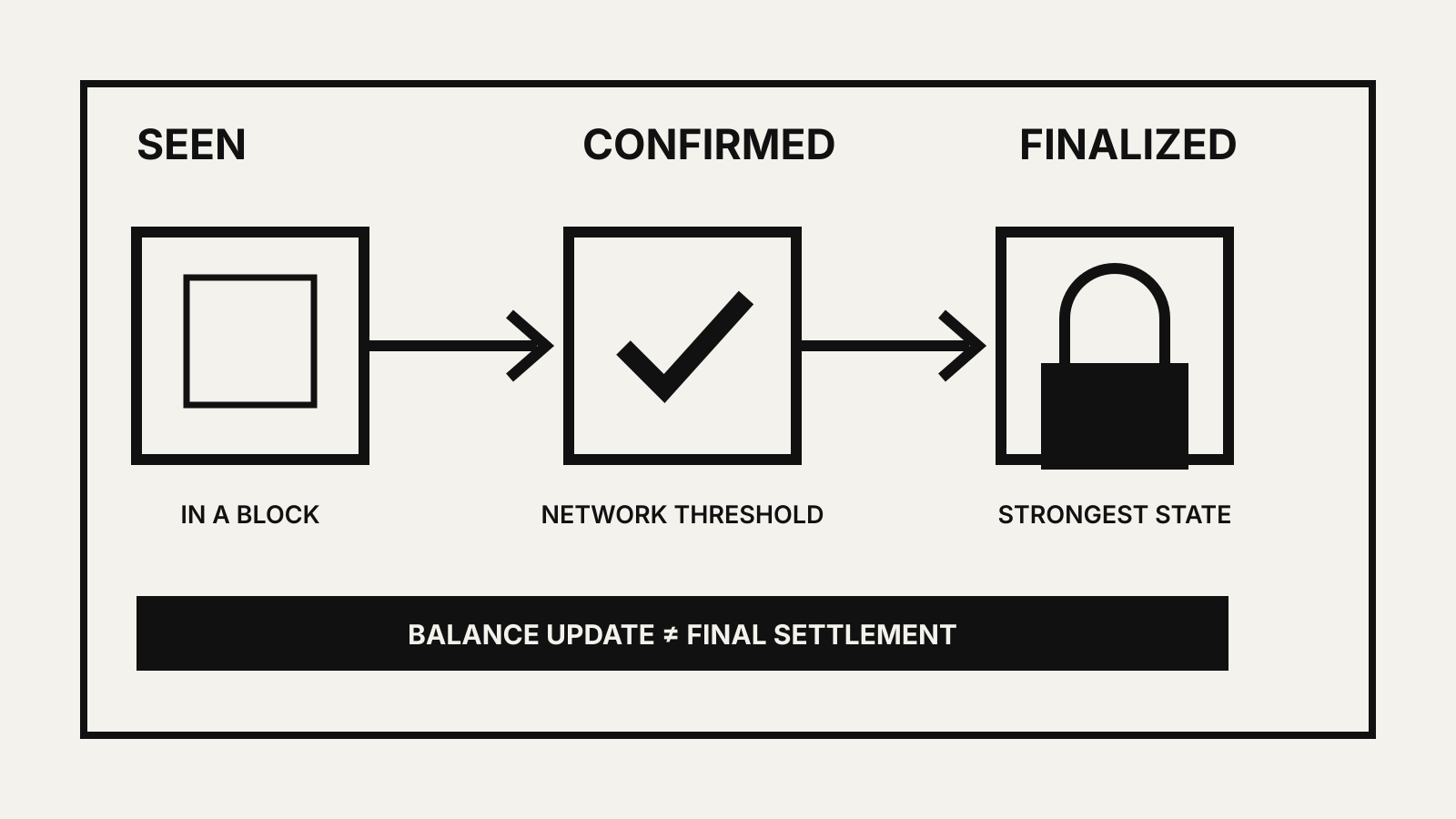
- Wait for the required confirmations before treating the swap as final.
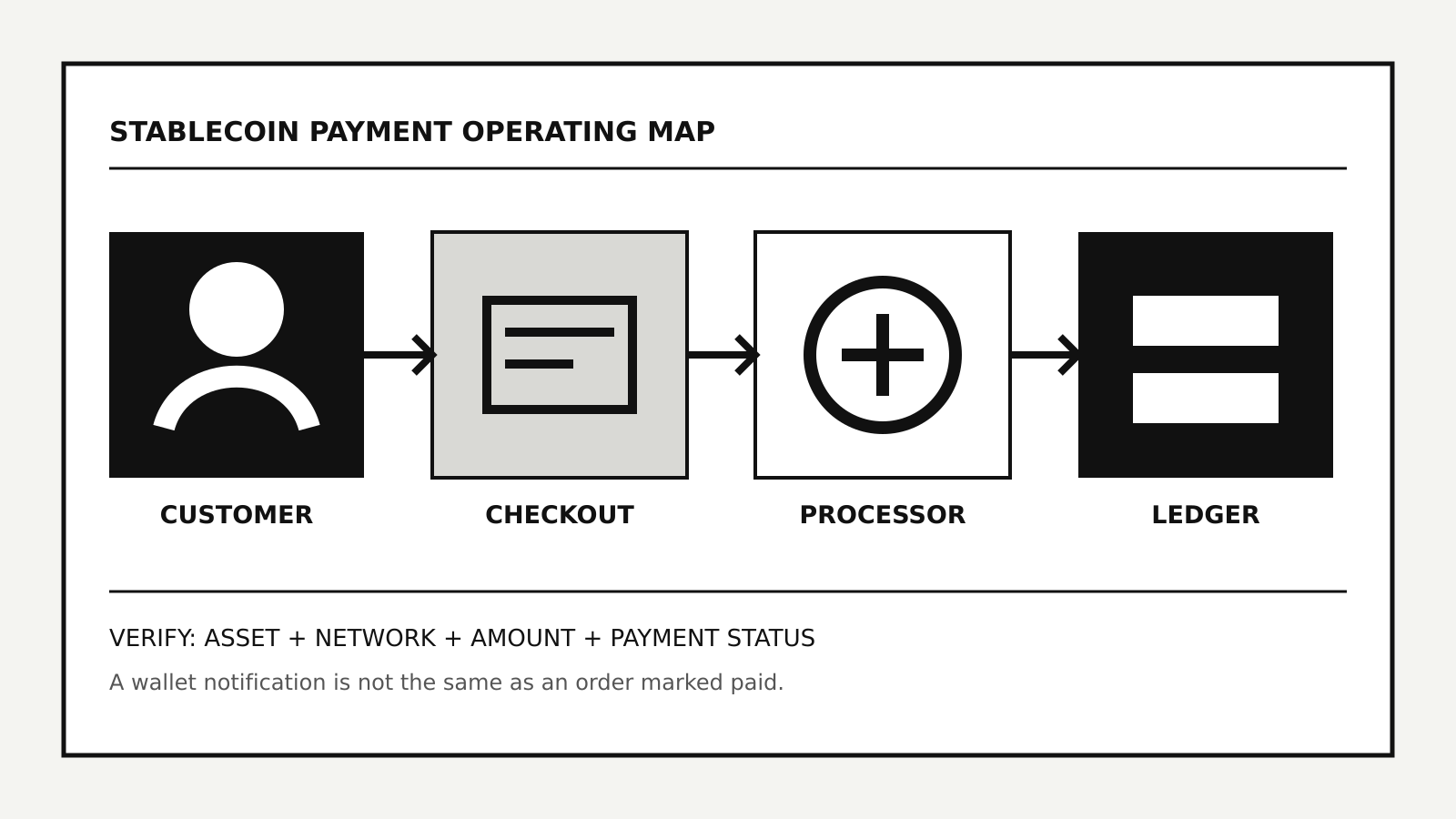
Our guide to stablecoin payment confirmations explains why a wallet notification and final settlement are different. Businesses using stablecoins should also separate trading from the merchant payment workflow.