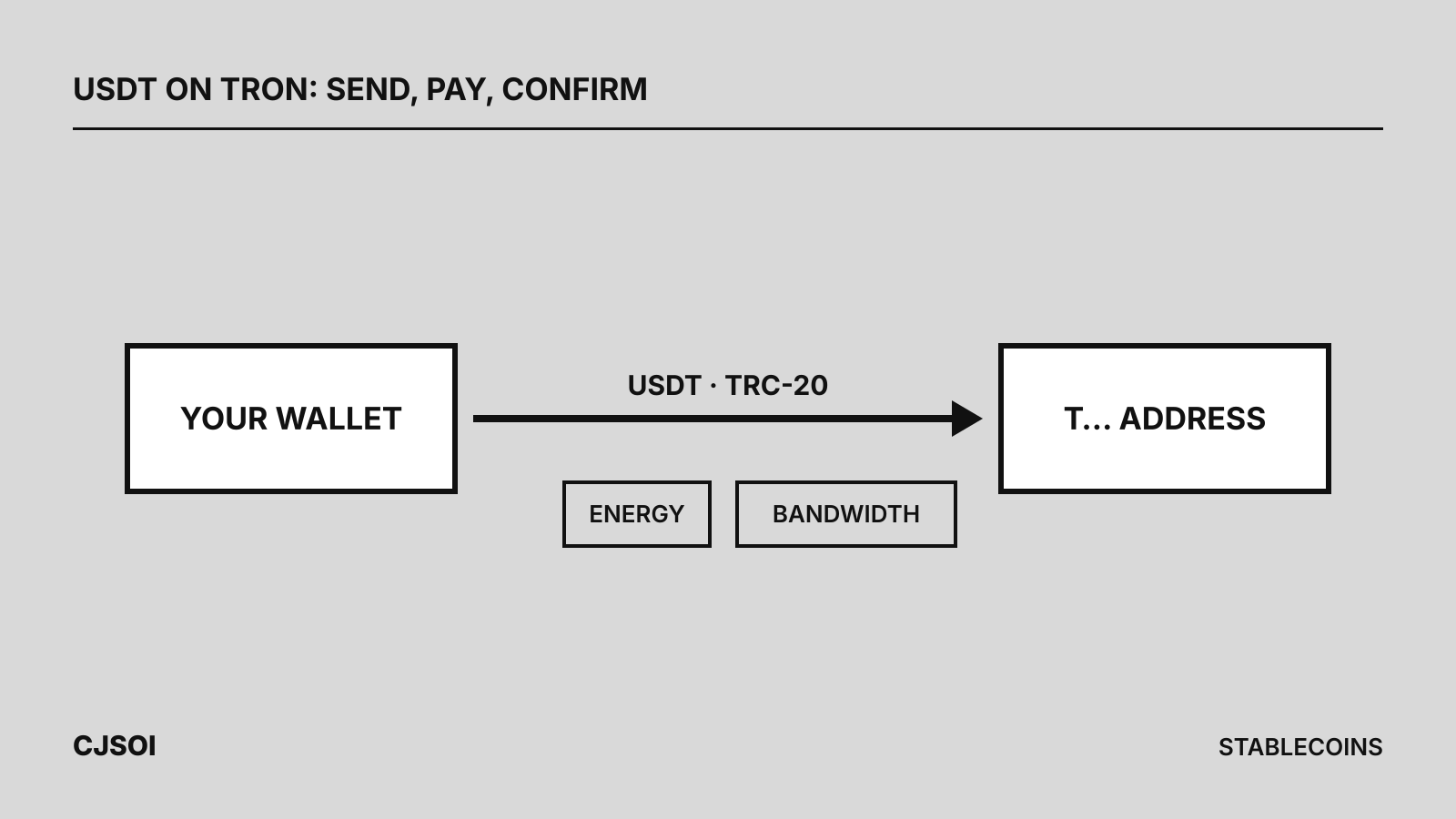
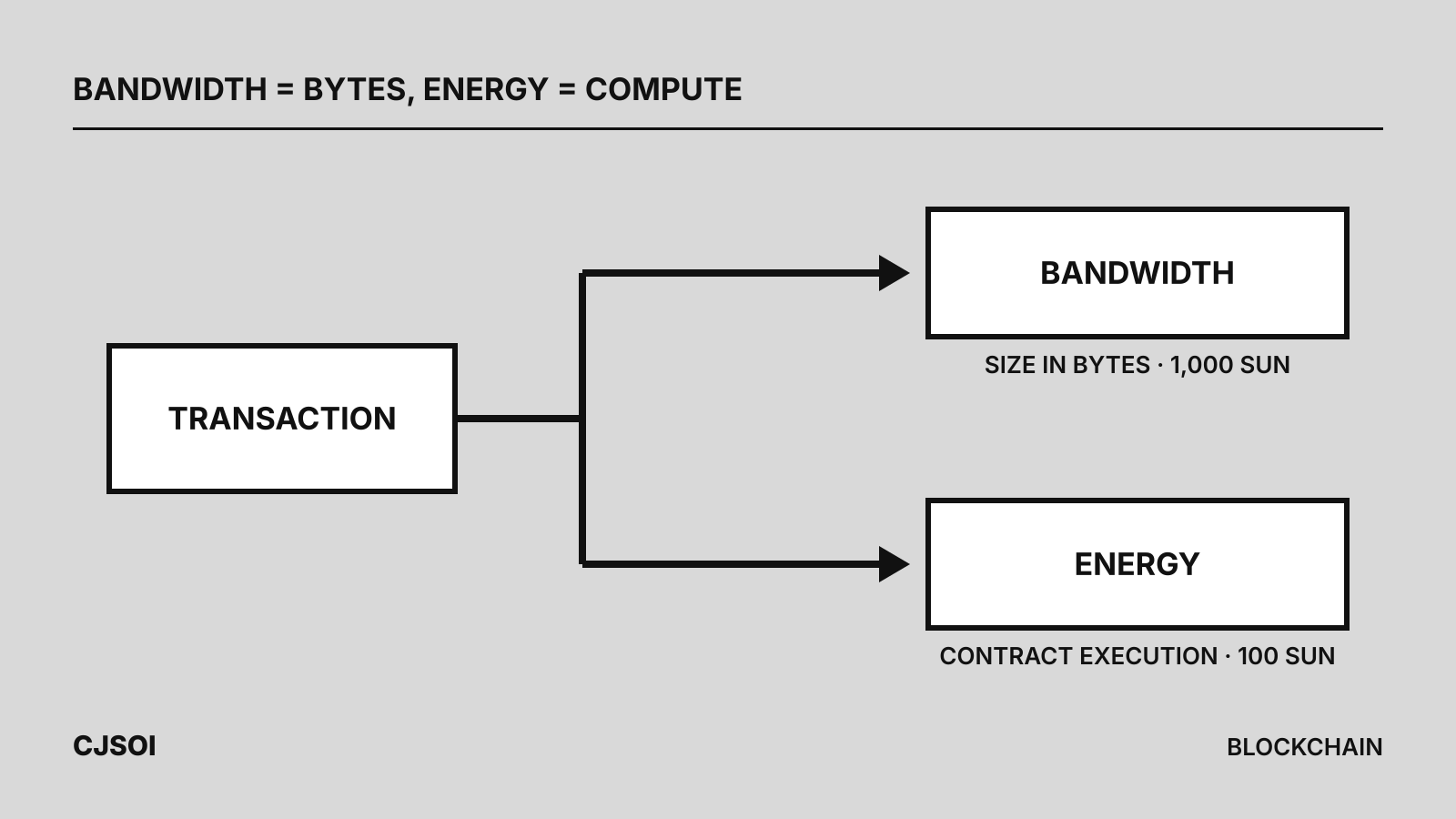
On TRON, bandwidth pays for the size of a transaction and energy pays for the computation a smart contract performs. Every transaction uses bandwidth. Only smart contract calls also use energy. A TRX transfer needs bandwidth alone; a USDT (TRC-20) transfer needs both: about 345 bytes of bandwidth and roughly 64,000 to 130,000 energy.
Every activated account gets 600 free bandwidth a day; there is no free energy. When you run short of either, the network burns TRX: 1,000 sun per byte of bandwidth and 100 sun per unit of energy. That is why people rent energy (see the comparison of energy rental services) but rarely think about bandwidth.
What each resource pays for
TRON’s developer documentation describes two metering resources. Bandwidth covers “the byte size of every transaction stored on-chain”: one byte uses one bandwidth, and every transaction except read-only queries consumes it. Energy covers smart contract execution: each TRON Virtual Machine instruction has a fixed energy cost, and a contract call’s total is the sum of those costs.
| Bandwidth | Energy | |
|---|---|---|
| Pays for | Transaction size in bytes | Smart contract execution |
| Free daily quota | 600 per account | None |
| Burn price if you have none | 1,000 sun (0.001 TRX) per byte | 100 sun (0.0001 TRX) per unit |
| Network supply per day | 43,200,000,000 | 180,000,000,000 |
| Recovery | Rolling 24 hours | Rolling 24 hours |
Which transactions use which
TRONSCAN’s support center puts it simply: regular transactions such as transfers, staking and unstaking “consume only bandwidth.” Anything that calls a contract uses both.
- TRX transfer: bandwidth only. The TRON docs use a 270-byte TRX transfer as their example.
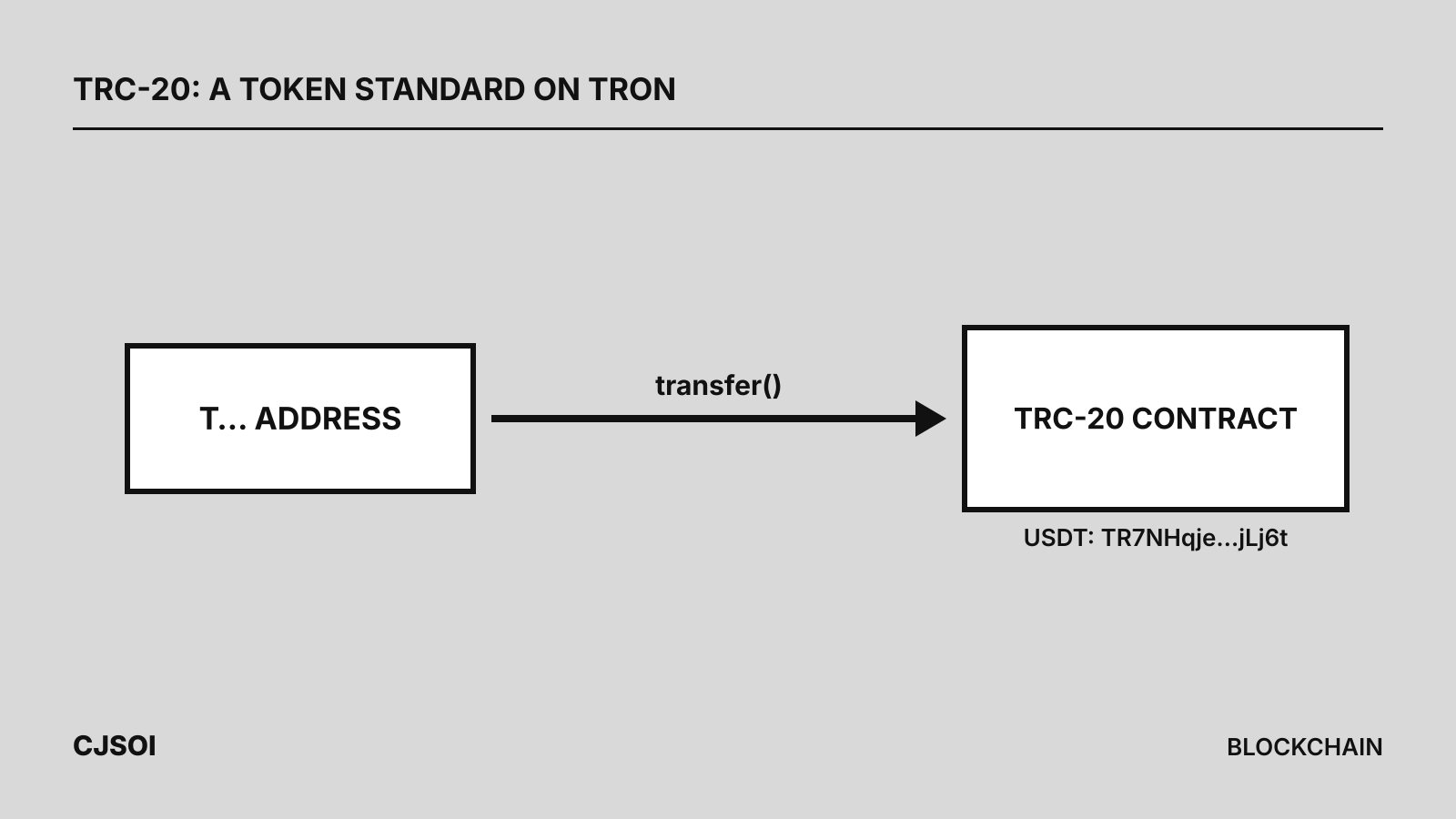
- TRC-20 transfer (USDT, USDC and other contract tokens): bandwidth plus energy. For what makes a token TRC-20, see what TRC-20 means.
- Swaps, approvals and other contract calls: bandwidth plus energy.
For USDT the energy figure depends on the recipient. The TRON docs give about 64,000 energy for a transfer to an address that already holds USDT and about 130,000 to an address with a zero USDT balance. USDT’s contract is also at the maximum dynamic-energy factor, which multiplies its base cost by 4.4.
The free 600 bandwidth and how it shrank
Each activated account receives 600 free bandwidth per day, refilled on a rolling 24-hour cycle. The quota (getFreeNetLimit) is set by committee proposal and has been cut twice:
- 5,000 at genesis
- 1,500 from proposal #69 (September 2021)
- 600 from proposal #87 (July 2023), still the value today
In practice, 600 bandwidth covers two TRX transfers of about 270 bytes, or one USDT transfer of about 345 bytes, per day (calculation: 600 ÷ 270 = 2.2; 600 ÷ 345 = 1.7). It does nothing for energy.
Prices and their history
When your stake and free quota fall short, TRX is burned from your balance. Both rates are chain parameters:
- Bandwidth: 1,000 sun per byte (
getTransactionFee), set by proposal #67 in July 2021. - Energy: 100 sun per unit (
getEnergyFee). It was 420 sun from proposal #79 (December 2022), cut to 210 by proposal #95 (September 2024), then to 100 by proposal #104, effective August 29, 2025.
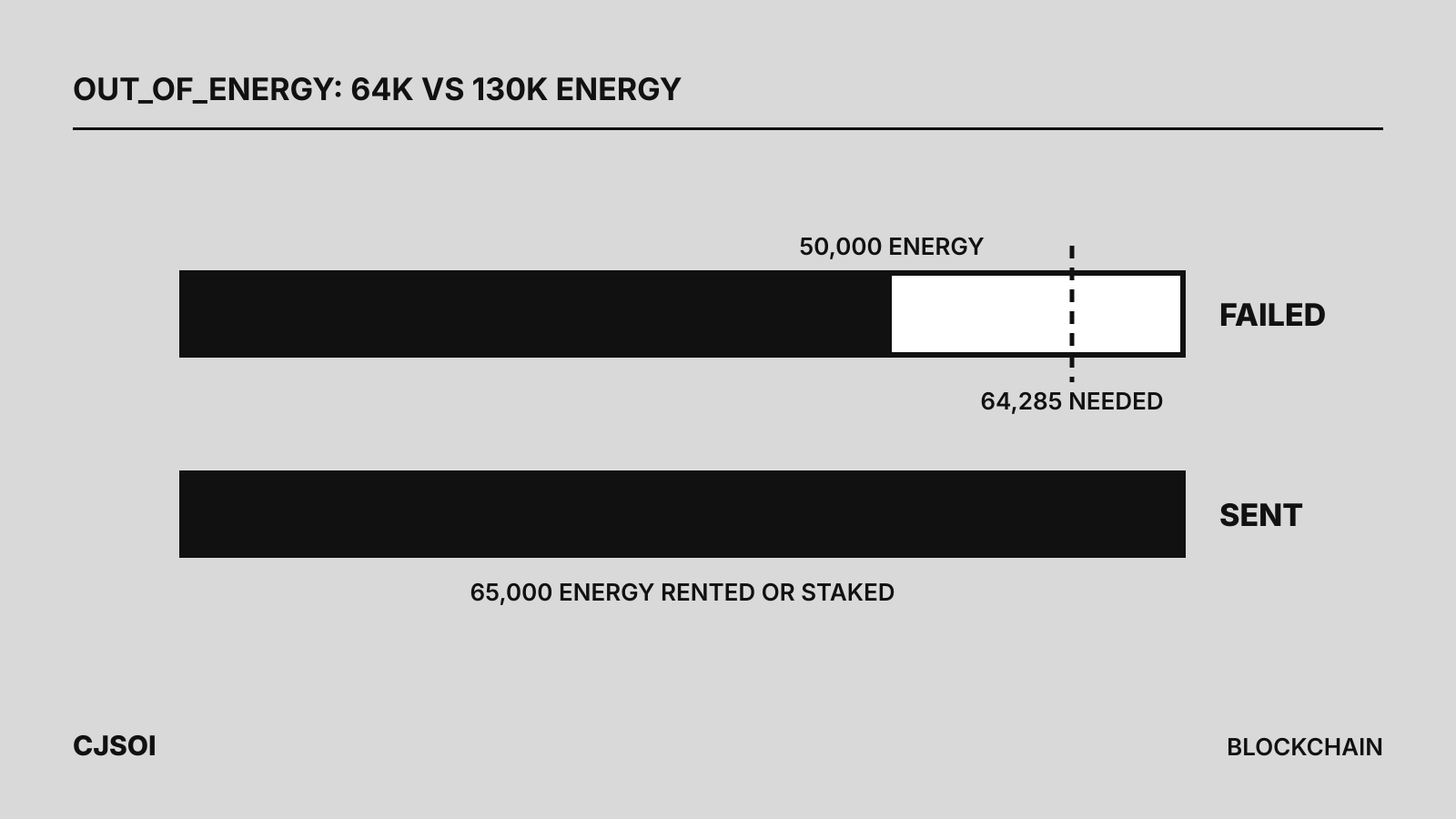
The docs spell out the charging order. For bandwidth: staked bandwidth, then the free 600, then a TRX burn of the full transaction size × 1,000 sun. For energy: your staked or delegated energy (and any share the contract’s deployer covers), then a TRX burn capped by the transaction’s fee_limit. If that cap is too low, the call fails with an out-of-energy error; our guide to running out of energy on TRON covers that case.
How both resources recover
Staked bandwidth, the free quota and staked or delegated energy all recover continuously over a rolling 24-hour window. The docs say that if you use your whole allotment at once, the same amount is available again 24 hours later. Rented energy simply ends with the rental period, used or not.
How to get each one
There are three routes, and they apply to both resources:
- Burn TRX. No setup; the most expensive option for energy.
- Stake TRX (Stake 2.0). Staking with
FreezeBalanceV2gives you a share of the fixed daily supply for either bandwidth or energy, proportional to your stake against everyone else’s. Your share drifts as total stake changes. From the network totals on September 30, 2026, one staked TRX yielded about 9.7 energy or 1.6 bandwidth per day (derived from the docs’ formula, not a published figure). Unstaking takes 14 days. - Receive a delegation. A staker can lend energy or bandwidth to your address with
DelegateResourceContractwhile keeping their TRX staked. Rental services sell exactly this.
Energy rental is where the market is. On September 30, 2026, renting 65,000 energy for an hour cost about 1.1 to 3.1 TRX across the services we track; current prices and terms are in our TRON energy rental comparison. Some services sell bandwidth too. TronZap, for example, rents energy with no registration when you send TRX to one address (delivered within a minute, lasting 1 hour), and also offers bandwidth, energy-and-bandwidth bundles and address activation; TronSave lets buyers order either resource on its marketplace. Bandwidth rental mainly matters for high-volume senders.
How to see your energy and bandwidth
- In a wallet. TronLink shows your resources and handles staking from its “Stake” page, where you choose “TRON Power and Bandwidth” or “TRON Power and Energy.”
- On TRONSCAN. Search your address to see its resources, or connect a wallet and open Resources to reach the Stake 2.0 page, where “My Resources” > “Resource Overview” lists staked and delegated amounts. Any transaction’s page shows how much bandwidth and energy it consumed and how much TRX was burned.
- Through the API.
wallet/getaccountresourcereturns the raw numbers. Remaining free bandwidth isfreeNetLimit − freeNetUsed, remaining staked bandwidth isNetLimit − NetUsed, and remaining energy isEnergyLimit − EnergyUsed.
Check both before sending USDT: enough energy with no bandwidth left still means a small TRX burn.
Worked example: one USDT transfer
Take two real transactions from November 27, 2025 that the TRON docs link as examples. Both sent USDT from an account with no staked resources.
To an address that already holds USDT:
- Energy: 64,285 × 100 sun = 6,428,500 sun, about 6.43 TRX (calculation)
- Bandwidth: 345 bytes. Paid by burning in the example: 345 × 1,000 sun = 0.345 TRX
- Total with nothing staked or rented: about 6.77 TRX (calculation)
To an address with a zero USDT balance:
- Energy: 130,285 × 100 sun = 13,028,500 sun, about 13.03 TRX (calculation)
- Bandwidth: the same 345 bytes, 0.345 TRX if burned
- Total: about 13.37 TRX (calculation)
With the 600 free bandwidth unused, the 0.345 TRX disappears. With 65,000 rented energy, the first case costs only the rental (about 1.1 to 3.1 TRX on September 30, 2026). The second would still burn about 65,285 energy, about 6.5 TRX (calculation), so order enough for a new recipient.
Energy decides the cost of a USDT transfer; bandwidth decides whether you pay an extra third of a TRX. For the full sending walkthrough see how to send USDT on TRON, and for how TRON compares with other chains on fees see choosing a network and what a stablecoin payment costs.