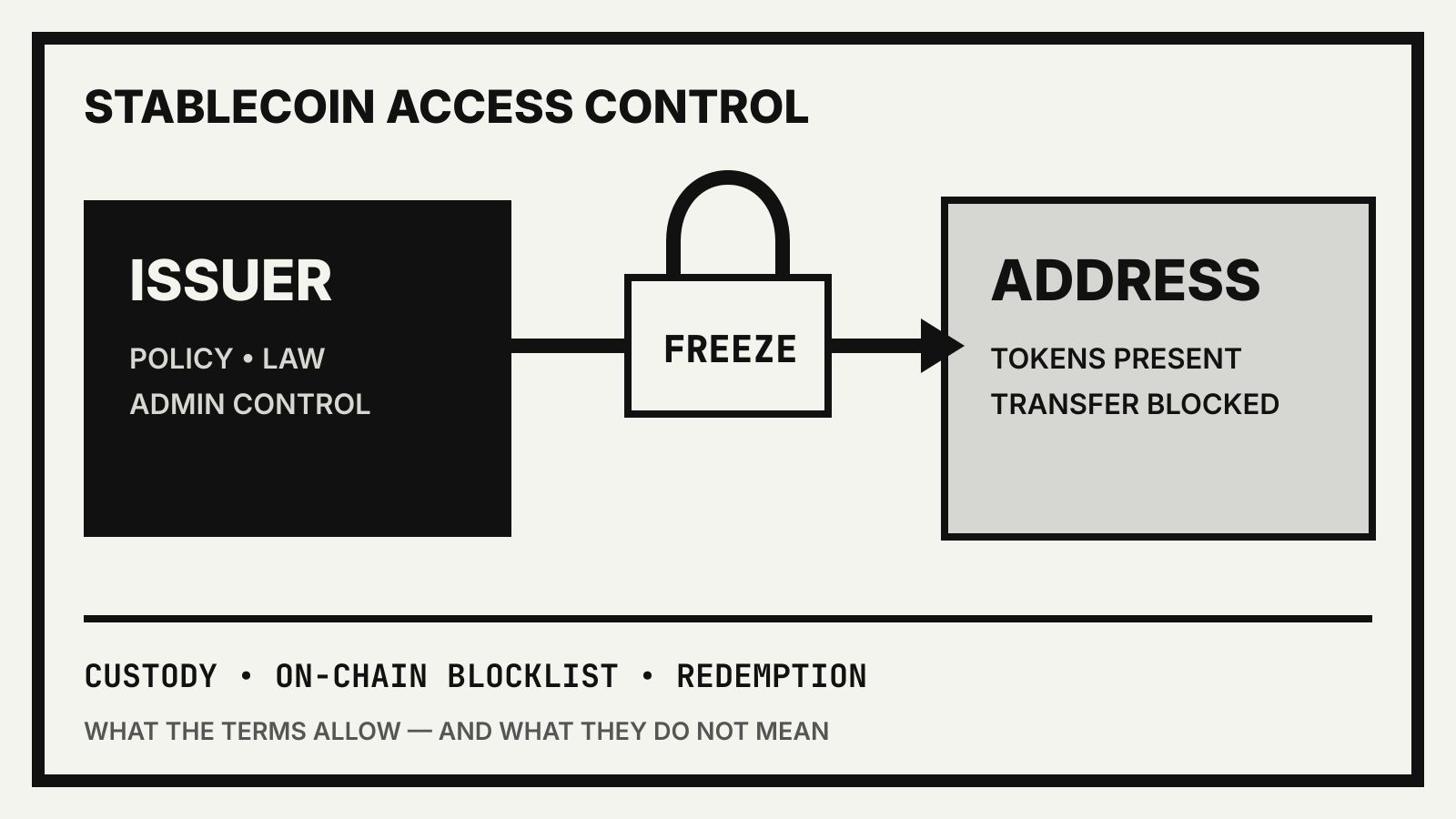
For a centralized stablecoin with issuer-controlled contract functions, the answer can be yes: an issuer may be able to stop transfers to and from a blockchain address, freeze tokens held in its own custody, or refuse redemption. Those are different actions. The exact power depends on the token contract, the issuer’s terms, the governing law and where the tokens are held.
This guide compares the public rules for USDC and USD₮. It does not assume that every stablecoin has the same controls.
Sources and terms checked November 1, 2026. Circle’s USDC Terms were last updated October 15, 2026; Tether’s legal terms were last updated February 26, 2026.
A “freeze” can mean three different things
The word is often used for separate technical and legal events:
| Action | What changes | Where it happens |
|---|---|---|
| Account restriction | The provider blocks login, purchases, redemptions or other services | The issuer’s platform |
| Custodial freeze | Assets in an address or account controlled by the provider cannot move | The custodian’s systems or wallets |
| On-chain blocklist | The token contract rejects transfers involving a listed address | On the blockchain |
The distinction matters. A person can still control the private key to a self-custody wallet while the token contract refuses to move the issuer’s tokens from that address. The wallet itself has not been confiscated, and unrelated assets in the same wallet are not automatically frozen by the stablecoin issuer.
A platform restriction is different again. It can stop direct redemption even when tokens remain transferable on-chain. Our stablecoin redemption guide explains why holding a token and qualifying for direct redemption are separate questions.
What Circle’s USDC terms say
Circle’s USDC Terms apply differently to Circle Mint customers and other holders, but Section 13 addresses blocked addresses for both groups.
The terms say Circle may block certain USDC addresses associated with illegal activity or violations of its terms. For Circle-custodied addresses, it may freeze the associated USDC temporarily or permanently. The terms also say Circle may block transfers of USDC to and from an address on-chain under its separate access-denial policy.
Circle’s two-page Stablecoin Access Denial Policy narrows how that control is described. When access is denied, all Circle stablecoin controlled by the address is blocked from on-chain transfer. The policy says individual tokens cannot be singled out inside the address.
The policy lists limited exceptions for using that control. They include protecting the security or integrity of the stablecoin network, responding to compromised privileged keys, and complying with qualifying legal orders. It also describes urgent cases involving law enforcement, sanctions or national-security threats while formal legal process is pending.
Circle’s terms add two consequences that are easy to miss:
- transfers to or from a blocked address may affect the holder’s Circle account and redemption rights;
- a valid government order may require Circle to freeze USDC or surrender associated reserve dollars.
That does not mean every flagged transfer automatically produces forfeiture. It means the published terms reserve those powers for the circumstances they describe.
What Tether’s terms say
Tether’s legal terms combine platform controls with broader language about tokens and addresses.
Section 2 says Tether may suspend or terminate access to services, freeze Tether tokens held by a user, or terminate a Tether wallet when required by law, when it considers the action prudent, or when the terms or applicable law have been violated.
Section 6 covers delays or suspension of site access, purchases and redemptions. Its examples include suspected prohibited use, government direction, pending litigation or investigation, attempted unauthorized access, and circumstances that could create legal liability or unacceptable risk.
Section 8 goes further. It lists freezing or confiscating funds or tokens, blacklisting a digital-token address that holds Tether tokens, and suspending services among the actions that may follow prohibited use. It also says Tether may deliver property to government or law-enforcement authorities where law or circumstances warrant.
These clauses should not be compressed into “Tether can take any wallet.” The terms name powers over Tether tokens, Tether services and listed addresses. They do not give Tether control over every asset in a self-custody wallet.
Self-custody does not remove issuer control
Self-custody protects the private key from an exchange or hosted-wallet provider. It does not remove functions built into a centrally issued token contract.
That creates two control layers:
- Wallet control: the key holder decides which transactions to sign.
- Token control: the issuer’s contract decides whether a signed token transfer is valid under its rules.
If an address is blocklisted, the owner may still sign a transaction, but the token contract can reject the transfer. Other assets can continue to work if their own contracts and networks do not impose a corresponding restriction.
Bridged assets add another layer. A bridge may lock native tokens and issue a representation elsewhere. Restrictions can arise from the original issuer, the bridge contract, the custodian or the destination token. See our guide to a stablecoin sent to the wrong network for the separate recovery problem.
What a blocklist does not prove
A blocklist entry is an operational fact, not a complete public explanation of the underlying case. It does not by itself establish criminal guilt, final forfeiture or the outcome of a legal dispute.
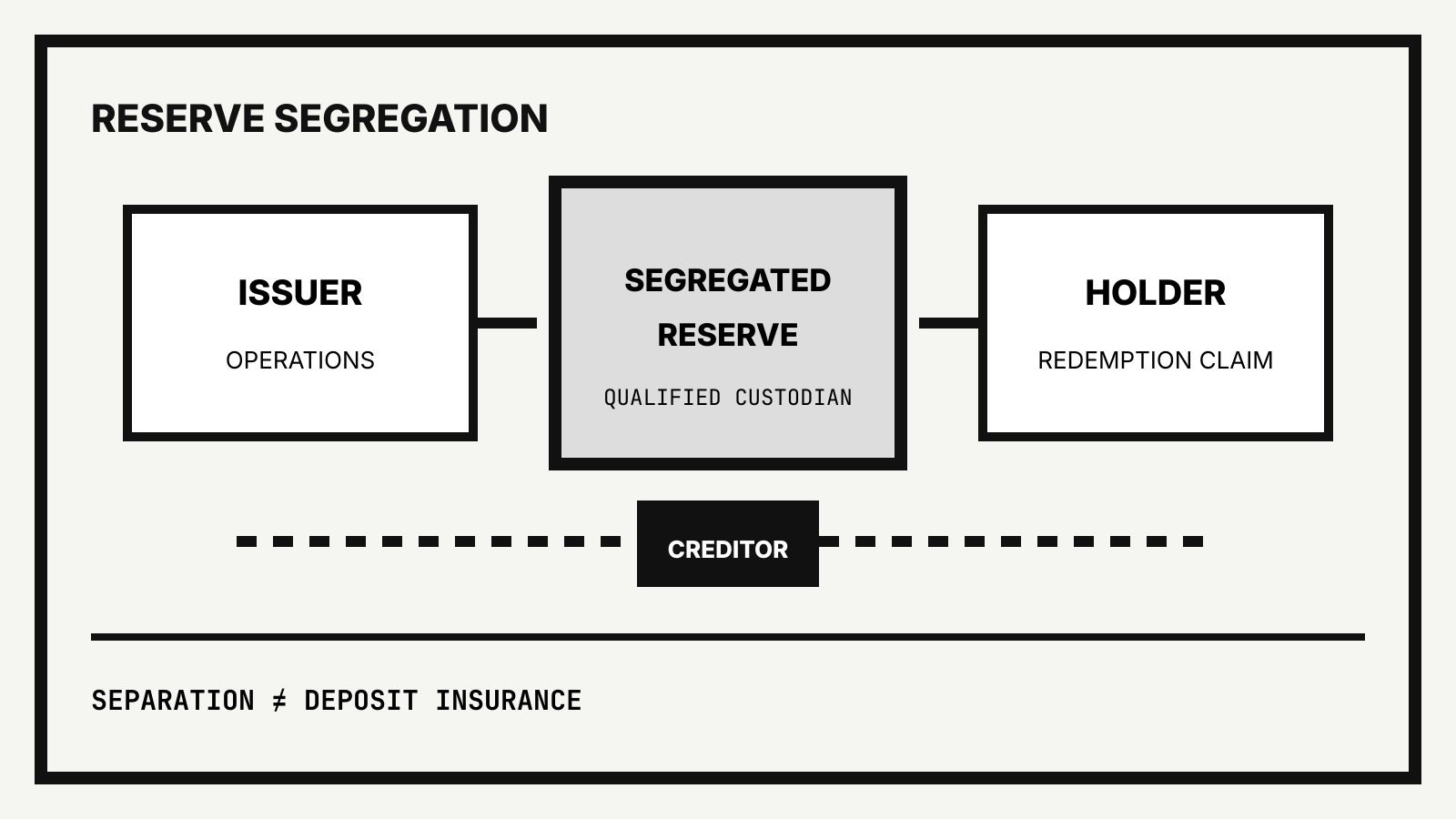
It also does not prove that reserves are missing. Token-transfer control and reserve custody answer different questions. Our reserve segregation explainer covers the legal and operational boundary around backing assets.
Finally, issuer controls are not identical across stablecoins. Even USDC and USD₮ use different terms, entities, supported networks and customer rules. The USDT vs USDC comparison covers their reserve and redemption structures. A holder should read the current contract and issuer terms for the exact token and network being used.
A practical check before receiving a stablecoin
Before accepting a large payment or using a stablecoin in a treasury workflow:
- Confirm the token contract and network from the issuer’s official page.
- Check whether the token contract has pause, blocklist or similar administrative controls.
- Read the issuer’s current terms for address restrictions and direct redemption eligibility.
- Identify whether a custodian, exchange or bridge adds another control layer.
- Keep transaction records and the commercial reason for the payment.
- Do not attempt to route around sanctions, legal orders or a provider restriction.
- If an address is blocked unexpectedly, use the issuer’s official support and legal process rather than an unsolicited recovery service.