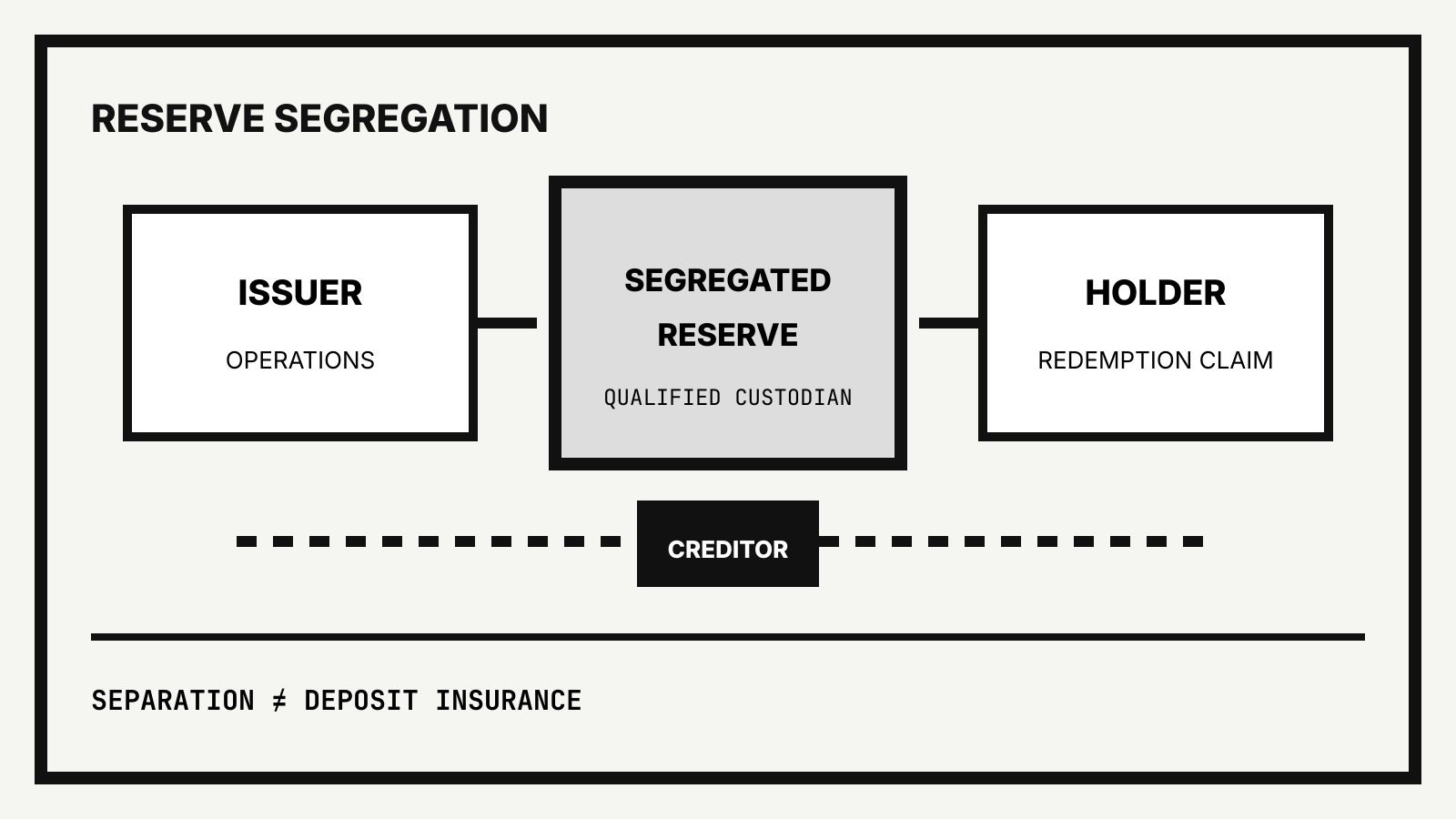
Reserve segregation is a legal and operational boundary: assets backing a stablecoin are held apart from the issuer’s own operating money and, under some regimes, protected from claims by the issuer’s or custodian’s general creditors.
That boundary can improve a holder’s position if the issuer fails. It does not by itself guarantee immediate redemption, preserve every reserve asset at par, prevent fraud or turn the token into an insured bank deposit.
Rules, policies and source documents checked on November 1, 2026. Legal rights depend on the issuer, custody structure and governing jurisdiction.
What “segregated” should mean
The word is useful only when documents answer four questions:
- Whose assets are they? The reserve should be identified as backing token holders, not as free operating cash.
- Where are they held? A named class of qualified custodian is stronger than a vague reference to financial institutions.
- Who can claim them? The structure should address creditors of both the issuer and the custodian.
- What may the issuer do with them? Lending, pledging or rehypothecation can change the risk even if accounts are labelled separately.
A separate account is an operational fact. Bankruptcy remoteness is a legal conclusion that depends on statutes, contracts, trust arrangements and custody law. Readers should not assume the first automatically proves the second.
A current legislative example: Canada
Canada’s Department of Finance says its stablecoin framework received Royal Assent, while supporting regulations were still being developed when the page was updated on March 31, 2026. The government expected the framework to come into force in 2027.
The framework requires a one-for-one reserve of high-quality liquid assets held separately from the issuer’s other assets at a qualified custodian. It also says reserves must be protected from claims by the issuer’s creditors and the custodian’s creditors if either becomes insolvent.
That language shows the intended function of segregation: preserve the reserve for redemption rather than let it become part of the failed company’s general estate. Canada’s regime also calls for clear redemption policies and treats the token as neither legal tender, a bank deposit nor an insured product.
Our Canada Stablecoin Act explainer covers the wider registration and supervision framework.
An issuer-specific example: USAT
Anchorage Digital’s USAT policies and disclosures, effective December 1, 2025 and updated August 21, 2026, describe an express South Dakota trust for reserve assets. The policy says the reserve is segregated from Anchorage Digital Bank’s own assets and is not to be lent, pledged or rehypothecated, apart from limited arrangements allowed to facilitate lawful redemption.
Those terms apply to USAT and its documented structure. They should not be copied across to another stablecoin. The same disclosure also says direct issuance and redemption are available only to eligible Anchorage clients and that the token is not legal tender or protected by FDIC or SIPC insurance.
This combination matters: segregation may strengthen the legal claim to reserve assets, while access rules still determine who can redeem directly.
What segregation protects against
A well-formed structure can address three specific problems.
1. Mixing reserve and operating cash
Commingled money is harder to identify and reconcile. Separate custody and records make it easier to show which assets back outstanding tokens.
2. General creditors of the issuer
If the issuer becomes insolvent, general creditors may seek its assets. A statute or enforceable trust structure can help keep the reserve outside that pool.
3. General creditors of the custodian
A reserve is not fully protected merely because it sits with a third party. The framework must also address what happens if the custodian fails.
These protections are valuable because token holders otherwise may be left with only an unsecured claim against a failed issuer. But the exact priority and recovery process require legal analysis of the governing documents and jurisdiction.
What segregation does not solve
| Risk | Why it remains |
|---|---|
| Market-value risk | A reserve asset can fall below its expected value. |
| Liquidity risk | Assets may not convert to cash quickly enough for redemptions. |
| Operational risk | Payments, banks, blockchains or custodians can be unavailable. |
| Access risk | A holder may need an intermediary because direct redemption is restricted. |
| Fraud or bad records | A label does not prove the assets exist or match liabilities. |
| Legal dispute | Courts may still need to determine ownership, priority and procedure. |
| Venue risk | An exchange holding the token can fail independently of the issuer. |
The Bank of Canada’s analytical note The Financial Stability Risks of Cryptoassets explains how reserve illiquidity, losses and weak disclosure can amplify runs. Segregation can improve the insolvency position without eliminating the need for liquid assets, credible reporting and functioning redemption.
Segregation is not an attestation
A reserve attestation asks whether specified assets and liabilities met stated criteria at a particular time. Segregation asks how the assets are held and protected.
One does not prove the other. A report may show sufficient assets without establishing bankruptcy remoteness. A trust or statutory structure may set out segregation without proving the reserve balance on a later date.
Read both the legal documents and the latest independent report. Our reserve attestation guide explains how to check scope, date and limitations.
Segregation is not deposit insurance
A stablecoin can hold reserves at banks without making each token an insured deposit. Government insurance normally protects eligible deposits under a defined scheme, subject to account and coverage rules. A token holder may have a claim on the issuer or a trust, rather than a direct insured account at the bank.
This distinction is explicit in Canada’s framework and in USAT’s disclosures. It also explains why “backed by bank deposits” needs more analysis; see our guide to stablecoin reserves held at banks.
How to evaluate an issuer’s claim
Look for documents that answer the following:
- the legal owner or beneficiary of the reserve;
- the custodian type and eligible jurisdictions;
- whether sub-custodians may be used;
- permitted reserve assets and concentration limits;
- rules on lending, pledging and rehypothecation;
- the treatment of issuer and custodian insolvency;
- reconciliation and independent reporting frequency;
- direct redemption eligibility, minimums, fees and timing;
- procedures for a wind-down or mass redemption.
If the issuer says only that assets are “held separately,” treat the claim as incomplete until the legal and custody details are available.