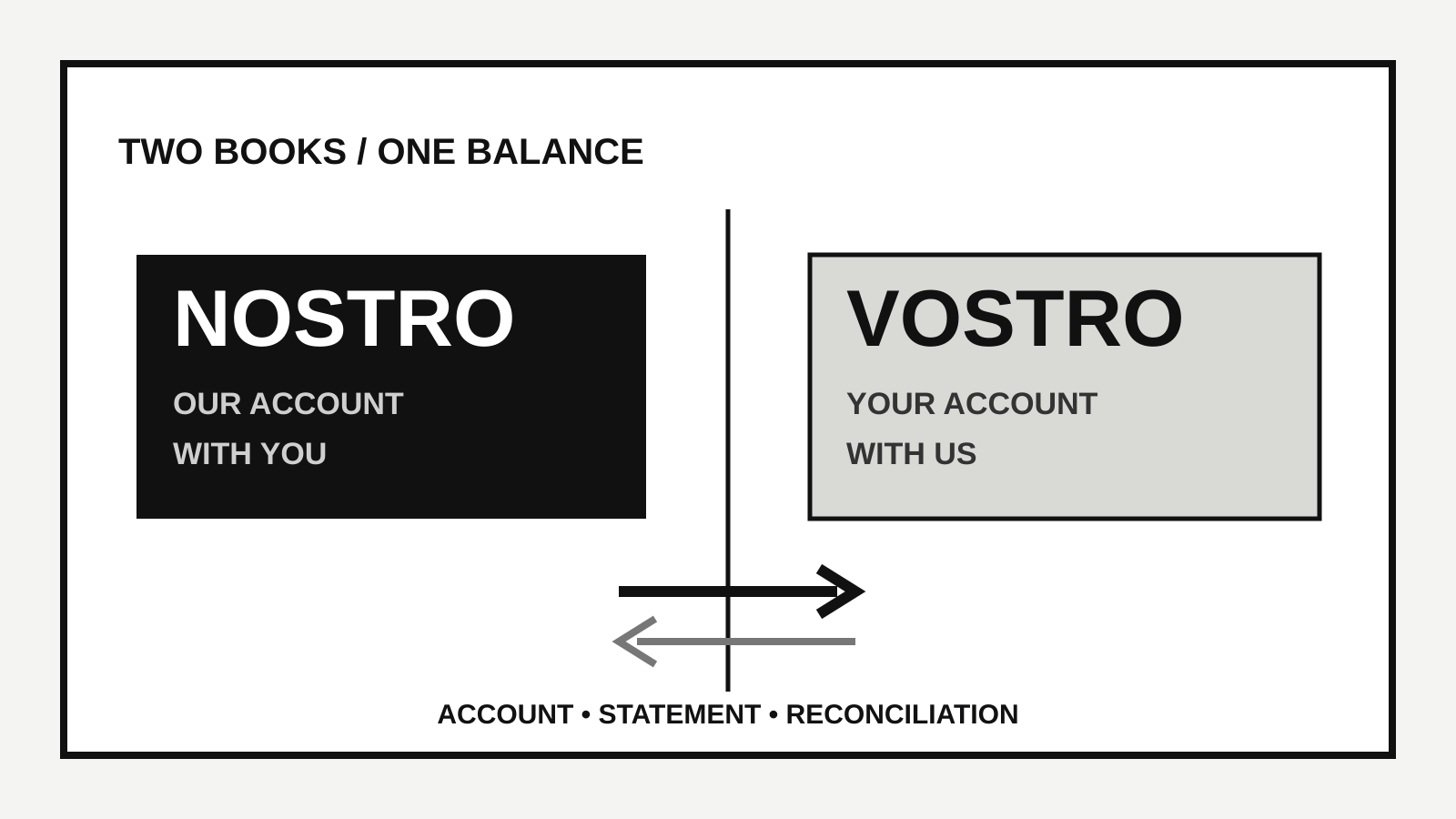
Nostro and vostro describe the same bank balance from opposite sides of a correspondent-banking relationship. Bank A calls the account it holds with Bank B our account with you: its nostro. Bank B calls that same balance your account with us: its vostro.
The labels matter because each bank keeps its own books, payment instructions change the balance, and operations teams must reconcile their internal records with the statement produced by the bank that actually holds the account.
Source review: BIS CPMI correspondent-banking material and the U.S. Congressional Research Service overview, checked 31 October 2026.
The same account, two ledgers
Assume North Bank needs U.S. dollar payment services but does not hold a settlement account in the United States. It maintains a dollar account at Harbor Bank.
| Viewpoint | What the account is called | What it represents |
|---|---|---|
| North Bank | Nostro | North Bank’s money held at Harbor Bank |
| Harbor Bank | Vostro | Money Harbor Bank holds for North Bank |
There are not two pools of cash. There is one account relationship and two accounting perspectives. North Bank records a claim on Harbor Bank. Harbor Bank records an obligation to North Bank.
The BIS CPMI report on correspondent banking describes correspondent arrangements as a foundation for cross-border payments and identifies the account relationship, customer due diligence, message quality and information sharing as operational concerns. The terminology belongs to that account layer; it is not a payment rail by itself.
How a payment uses the balance
Suppose a customer of North Bank sends $25,000 to a supplier whose bank can be reached through Harbor Bank.
- North Bank accepts the customer’s instruction and applies its customer-account controls.
- North Bank sends the payment instruction through its correspondent arrangement.
- Harbor Bank debits North Bank’s balance and routes or credits the receiving side according to the applicable payment system and account relationships.
- North Bank records the outgoing movement in its internal nostro ledger.
- Harbor Bank reports the debit on the account statement it maintains for North Bank.
The U.S. Congressional Research Service’s correspondent-banking overview uses a similar three-bank example: where the sending and receiving banks do not hold accounts with each other, they use a correspondent that holds accounts for both.
The message and the money are related but separate. SWIFT can carry instructions and status information, yet CRS notes that SWIFT is not a bank, does not hold accounts and does not itself settle funds. The correspondent account is where the relevant balance changes.
Why reconciliation is necessary
North Bank can record an outgoing payment before it receives Harbor Bank’s final statement entry. Harbor Bank may also apply fees, reject an instruction or post a correction. Those timing and classification differences create breaks between the internal ledger and the external account statement.
A useful reconciliation process matches:
- opening balance;
- confirmed credits and debits;
- payments still in transit;
- correspondent fees;
- returned or rejected payments;
- value dates and currencies;
- adjustments and manual entries; and
- closing balance.
The objective is not to force every message status into a settled entry. It is to identify which movements are confirmed on the account, which remain outstanding and which require investigation.
Our UETR payment-tracking guide explains how a bank traces a Swift payment. Tracking answers where an instruction is in the chain; nostro reconciliation answers whether the expected account movement appears in the books.
Nostro liquidity is currency-specific
A bank can have enough assets overall and still lack the right currency at the right correspondent before a payment deadline. Nostro management therefore involves forecasts by currency, location and time.
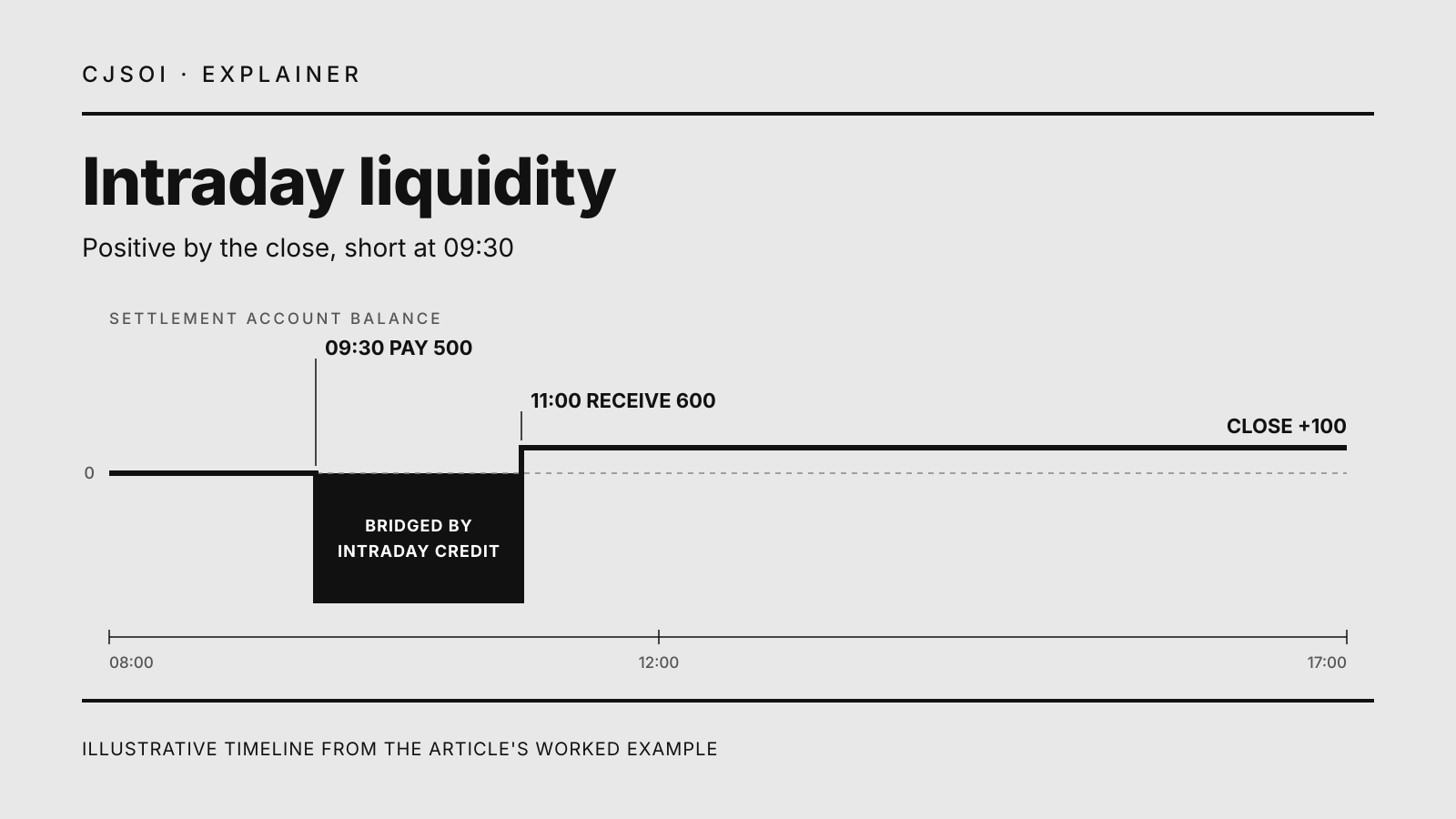
If North Bank expects a dollar credit at 14:00 but must send a dollar payment at 11:00, the end-of-day balance forecast does not solve the intraday gap. It may need to pre-fund the account, borrow, exchange another currency or delay an outgoing payment within its rules.
That is why a nostro balance sits inside a wider liquidity process. Our intraday-liquidity explainer covers payment queues, time-specific obligations and collateral. The correspondent account is one place where those timing pressures become visible.
Fees and deductions change the expected amount
Correspondents can charge account, processing and investigation fees under their agreements. An intermediary elsewhere in the chain can also deduct a charge from a transfer, depending on the payment terms and route.
Operations teams should not assume that an unexplained difference is an exchange-rate loss. They need the payment amount, instructed charges, correspondent statement, FX record and any return message. A clean match uses evidence from the actual route.
The customer-facing amount and the bank-to-bank settlement amount may differ for legitimate reasons. The bank still needs a rule for allocating the difference and explaining it to the customer.
Where credit and operational risk enter
North Bank’s nostro is a claim on Harbor Bank. If Harbor Bank cannot meet its obligations, freezes access or suffers an operational failure, North Bank may not be able to use the balance when expected.
The account relationship therefore creates more than processing convenience. Banks assess:
- the correspondent’s financial condition;
- legal and regulatory conditions in the account’s jurisdiction;
- operational resilience and access controls;
- sanctions and anti-money-laundering obligations;
- cut-off times, holidays and contingency routes; and
- concentration in a small number of providers.
CRS describes correspondent banking as essential to wire transfers, clearing, trade finance, treasury management and settlement, while also highlighting due-diligence costs and the risk that banks terminate relationships broadly. The trade-off is access versus a relationship that must be monitored and controlled.
Nostro is not the customer’s deposit account
A customer may see a debit in an app while the sending bank is still arranging settlement through correspondents. The customer account records what the bank owes its customer. A nostro records what another bank owes the sending bank.
Those balances can move at different times. A payment can be accepted, screened, queued, sent, settled between banks and finally credited to the beneficiary as separate events. Calling all of them “complete” hides the operational state.
Our broader correspondent-banking guide maps the relationship and payment chain. This article focuses on the mirrored account records and the controls needed to keep them aligned.
A compact operating example
North Bank starts the day with a $2 million nostro balance at Harbor Bank. It expects $600,000 of incoming credits and $1.9 million of outgoing payments.
Its internal forecast predicts a $700,000 closing balance. During the day, however:
- a $250,000 incoming payment is delayed;
- Harbor Bank debits $2,000 in fees; and
- a $100,000 outgoing payment is rejected and returned.
The eventual closing balance is $548,000, not the first forecast of $700,000. The difference can be explained only by matching the delayed credit, fee and return to the statement. This example is illustrative; it does not represent a particular bank or fee schedule.