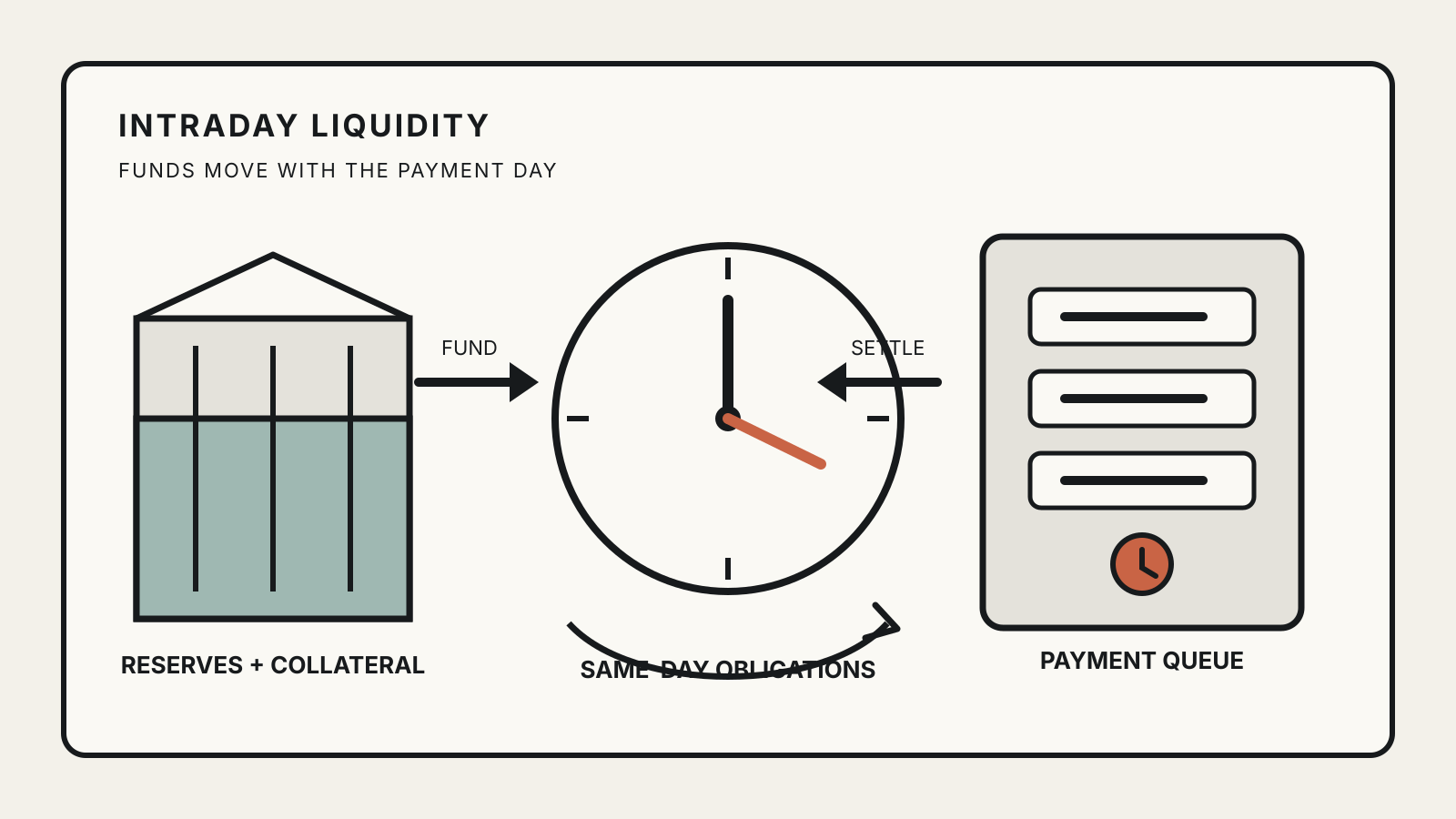
A bank can finish the day with enough money and still run short at 10:00 in the morning. Intraday liquidity is the funding a bank can access during the business day to make payments and settle obligations on time.
The problem is timing. Outgoing payments may be due before incoming payments arrive. A bank therefore needs reserves, collateral and credit capacity that can bridge the gap without turning every temporary mismatch into an overnight loan.
Sources checked October 30, 2026. This explainer describes payment-system operations, not a bank’s current liquidity position.
What intraday liquidity means
The Basel Committee defines intraday liquidity as funds accessible during the business day, usually so a financial institution can make payments in real time. The funds are used and replenished as the day progresses.
That makes intraday liquidity different from the stock of cash a bank reports at day-end. It is also different from longer-term funding. A bank may borrow within the day, receive a customer payment and repay the borrowing before the system closes.
The Basel intraday liquidity monitoring framework focuses on the resources available at particular times and the obligations that must be met before particular deadlines.
Where the funds come from
A bank’s available resources can include:
- balances already held in its central-bank settlement account;
- incoming payments received from other banks;
- unused intraday credit from a central bank;
- collateral that can be pledged for intraday credit;
- intraday credit from a correspondent or custodian bank;
- market transactions arranged to deliver cash at a useful time.
These sources are not interchangeable. Collateral has to be eligible, in the right legal entity and operationally ready to pledge. A credit line can have a limit or be withdrawn under stress. An expected incoming payment may arrive late.
The Federal Reserve’s comparison of central-bank liquidity facilities says U.S. depository institutions can use intraday credit during operating hours. Collateralized credit is provided without a fee, while uncollateralized intraday credit carries a fee. Other central banks structure access, collateral and pricing differently.
Why net cash at the end of the day is not enough
Imagine a bank must send 500 at 09:30 and expects to receive 600 at 11:00. Its net position for the day is positive by 100, but it still needs 500 before 09:30.
This is why gross payment flows matter. The Basel guidance notes that daily gross outflows can be much larger than a bank’s net overnight balance. A delay in one large inflow can create a shortfall even when the full day’s inflows eventually exceed outflows.
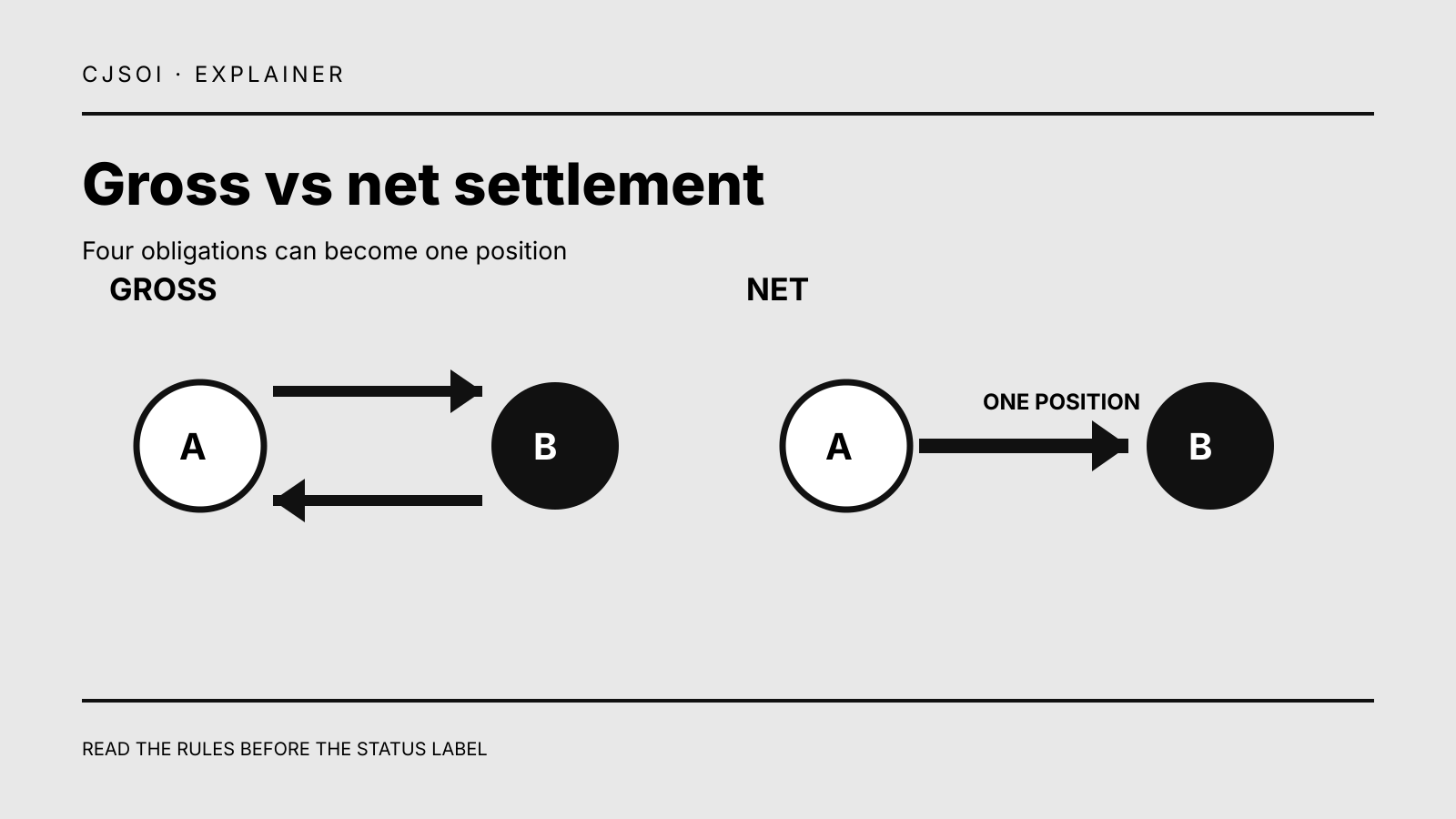
The mechanics also depend on the payment system. A real-time gross settlement system processes payments individually when funds or credit are available. A net settlement system offsets obligations before settlement. See the separate guide to gross versus net settlement for that distinction.
What counts as a time-specific obligation
Some payments have to settle by a particular time. Examples can include:
- obligations to another payment or securities settlement system;
- margin calls;
- delivery or return of money-market transactions;
- customer payments with a contractual deadline;
- payments needed to complete foreign-exchange settlement;
- other payments critical to the bank’s operations or reputation.
The Basel Committee says banks should identify and prioritize time-specific and other critical obligations, while settling less critical payments as soon as possible. Delaying everything to conserve cash can shift liquidity pressure to other participants and reduce confidence in the system.
The payment queue is part of liquidity management
A bank does not simply choose one balance at the start of the day and wait. It forecasts expected inflows and outflows, monitors the live position and adjusts as payments arrive.
That can mean pledging more collateral, drawing intraday credit, moving funds between systems where allowed, or changing the timing of non-critical payments. Payment systems may also use queues and liquidity-saving mechanisms that match or offset compatible payments.
The trade-off is delay versus funding. Sending every payment immediately can require more settlement liquidity. Waiting for offsetting inflows can reduce the amount needed but may create operational risk and missed deadlines.
What banks monitor
The Basel framework lists practical measures rather than one universal ratio. They include:
- the largest net negative position during the day;
- liquidity available at the start of the business day;
- the value and timing of total payments;
- time-specific obligations;
- intraday credit extended to customers;
- payment throughput at selected times.
The lowest starting resources and the highest daily use can be more revealing than an average. A bank also needs to know which counterparties, currencies, systems and customers create its largest time-sensitive flows.
The broader Basel liquidity guidelines call for frequent monitoring of balances, remaining credit capacity and available collateral. Monitoring lets a bank acquire more funds or restrict non-critical outflows before a shortfall blocks a critical payment.
How stress changes the calculation
Intraday liquidity can tighten when a counterparty delays payments, a correspondent limits credit, collateral loses value or a payment system has an operational problem.
A bank may then face two pressures at once: expected inflows fail to arrive, while customers draw more of their own intraday credit lines. If borrowed intraday funds cannot be repaid before the end of the day, the bank may need overnight funding.
Stress testing therefore has to include timing, not just total cash. The Basel guidance asks banks to consider institution-specific and market-wide events, including severe operational or settlement disruptions. It also stresses the practical time needed to move collateral and liquidity between legal entities, currencies and systems.
Why this matters beyond one bank
A delayed payment can hold up the recipient’s own outgoing payments. A large participant that misses a settlement deadline can therefore spread liquidity pressure through the network.
Active intraday liquidity management helps payment and settlement systems continue to function while preserving finality. It does not remove credit, operational or solvency risk. It makes a very specific risk visible: having funds overall but not having them in the right place at the right time.