A blockchain application may show a transaction as “confirmed” while the payment team still cannot treat the obligation as legally or operationally settled. The two systems are answering different questions.
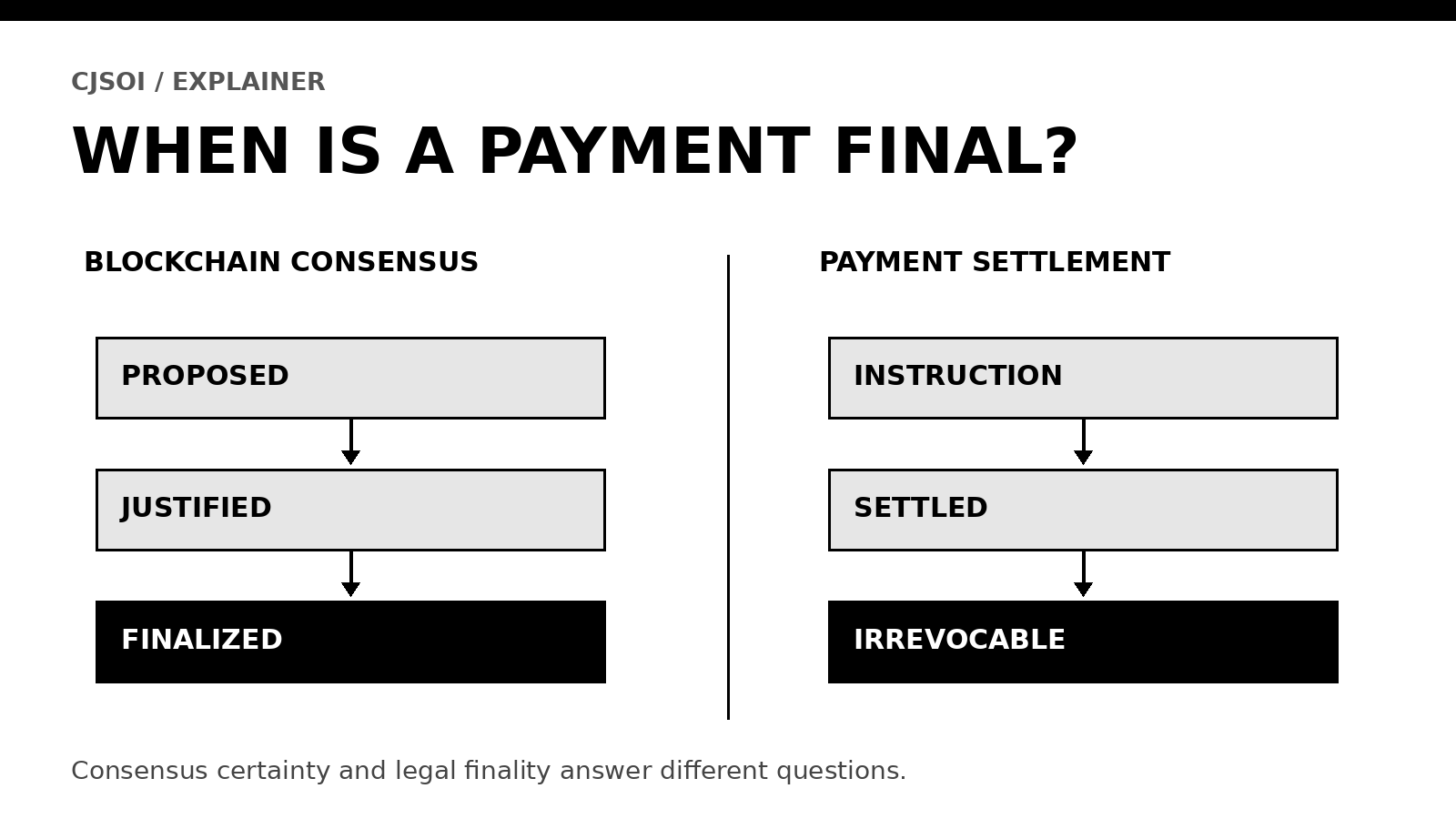
Blockchain finality asks how difficult it is for a network to replace a block or transaction. Payment settlement finality asks when the transfer is complete and irrevocable under the rules governing the payment system. A sound design has to identify both points and the gap between them.
What blockchain finality means
On a proof-of-stake blockchain, finality is a property of the consensus process. Ethereum’s Gasper documentation describes checkpoints at epoch boundaries. A checkpoint becomes justified when validators representing at least two-thirds of staked ether vote for it. When another justified checkpoint builds on it, the earlier checkpoint becomes finalized.
This is stronger than an application simply seeing a transaction in a recent block. Reversing a finalized Ethereum block would require a critical consensus failure and the destruction of at least one-third of the staked ether, according to the protocol documentation. That gives participants crypto-economic confidence about the canonical chain.
Other networks use different mechanisms. Some have deterministic finality, some use probabilistic confidence after a number of blocks, and some rely on a smaller validator set. The application must document the actual network rule rather than copying a generic “six confirmations” threshold.
What settlement finality means
Financial-market infrastructure uses a different test. The CPMI-IOSCO Principles for Financial Market Infrastructures state in Principle 8 that an infrastructure should provide clear and certain final settlement, at minimum by the end of the value date and preferably intraday or in real time.
Its rules need to define the point at which settlement is final and the point after which an unsettled instruction may no longer be revoked. Those points depend on the system’s legal framework, operating rules, assets and participants. They are not created merely because a user interface displays a green check.
Settlement finality matters because participants need to know when the transferred asset can be reused, when credit and liquidity exposures end, and whether an insolvency or dispute could unwind the transfer.
Confirmation, finality and discharge are separate events
Consider a token payment used to settle an invoice:
- The wallet broadcasts a transaction.
- The network includes it in a block.
- The merchant application displays a confirmation.
- The relevant checkpoint becomes finalized.
- The merchant’s payment rules recognise the transfer as satisfying the invoice.
- Cash, securities or another off-chain asset may still have to settle elsewhere.
Step 4 is about the ledger. Step 5 is about the commercial and legal arrangement. Step 6 can introduce another settlement system entirely.
That distinction is especially important when a token represents a claim on an issuer, a bank deposit, a fund unit or an off-chain asset. Blockchain finality can establish that the token moved on-chain. It does not by itself prove that the issuer will redeem it, that a linked bank transfer has settled or that a court would treat the underlying obligation as discharged.
Why applications should not label everything “final”
A single status label hides the state that operators need. A better payment interface separates:
- submitted: the instruction has been signed or broadcast;
- included: the network has placed it in a block;
- network finalized: the protocol’s finality condition has been met;
- accepted for payment: business checks and payment rules have passed;
- settled: the relevant asset transfer is final under the governing system;
- reconciled: internal records match the external ledger and counterparties.
The exact names may differ, but the states should remain distinct. The team should also record which event starts fulfilment, releases goods, updates credit limits or closes an invoice.
For related operational design, see CJSOI’s explainer on delivery versus payment and its comparison of gross and net settlement.
Build the control around the weakest leg
A transaction that spans multiple systems is only as final as the leg that remains reversible. A token transfer can finalize before the fiat payout. A securities token can move before the cash leg. A bridge can accept an event on one chain while a challenge period or validator process remains open elsewhere.
Map each leg with five fields:
| Field | Question |
|---|---|
| Technical event | What does the network actually record? |
| Finality rule | When can that record no longer be replaced under normal operation? |
| Legal rule | Which agreement or system rule makes the transfer irrevocable? |
| Asset claim | What right does the receiver obtain? |
| Operational action | What may the business safely do at this point? |
This map exposes cases where a technical confirmation is being used to authorise an action that really depends on legal settlement or redemption.
Handle exceptions explicitly
The system also needs a procedure for network outages, validator incidents, chain reorganisations, sanctions holds, mistaken addresses and disputed transfers. Finality does not eliminate operational errors. An irreversible ledger transfer can make correction harder because the remedy may require a new transaction or an off-chain claim.
Do not promise users that a transaction is “impossible to reverse.” Describe the protocol condition precisely, name any remaining business or legal conditions, and show who can pause fulfilment when an exception appears.
A practical review checklist
Before a product treats an on-chain payment as complete, document:
- the network and its finality mechanism;
- the confirmation or checkpoint used by the application;
- the governing payment and participant rules;
- the asset or claim received;
- any bridge, custodian, issuer or bank leg;
- the point at which fulfilment is authorised;
- the evidence retained for reconciliation and disputes.
Sources checked: Ethereum Gasper documentation and the CPMI-IOSCO PFMI overview, accessed 31 October 2026. This explainer describes system design and does not provide legal or investment advice.