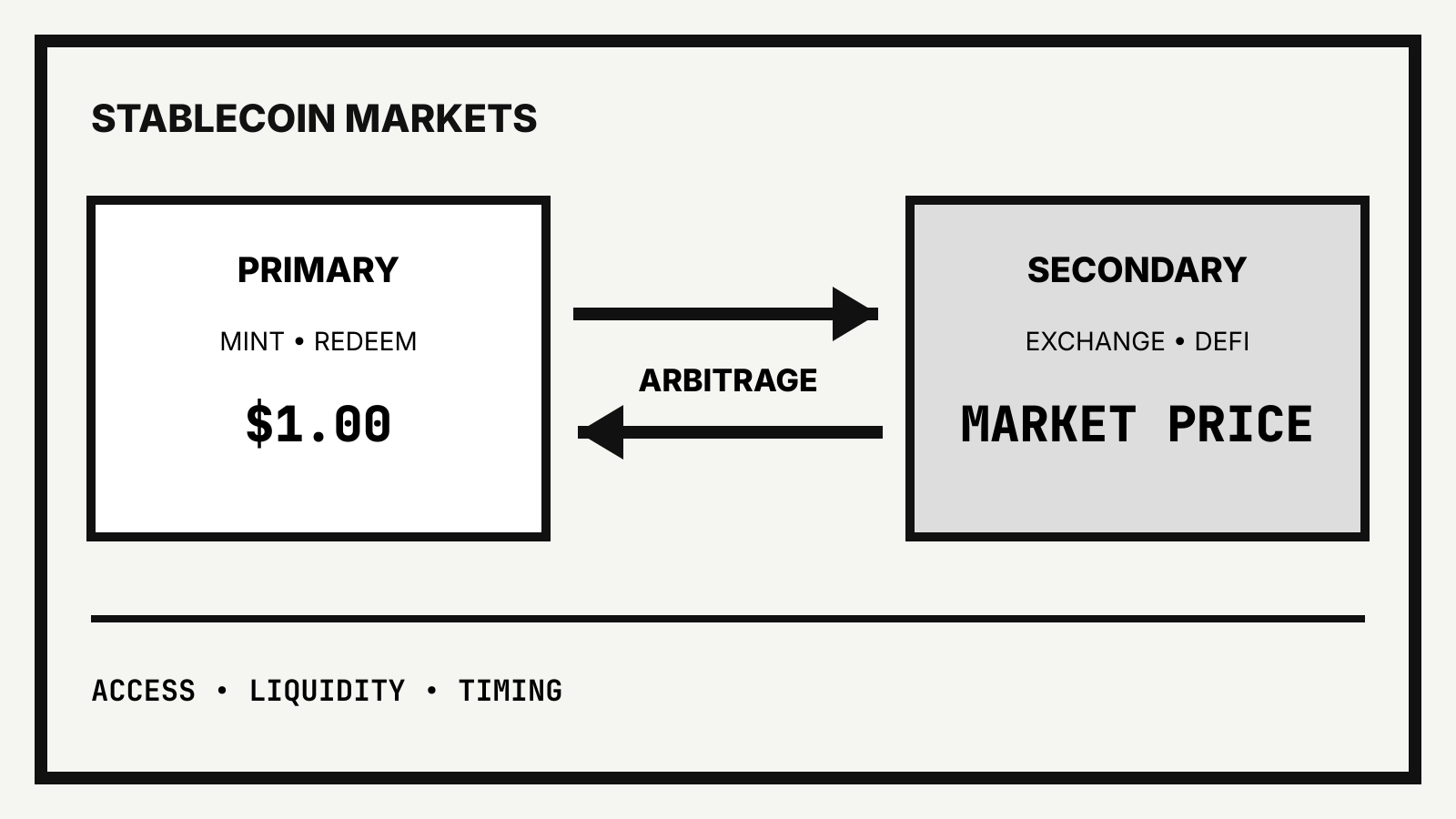
A stablecoin can trade at $1 without every buyer dealing directly with its issuer. The price is connected by two markets: a primary market, where eligible customers mint or redeem with the issuer, and a secondary market, where everyone else trades on exchanges or through onchain liquidity pools.
That distinction explains both the usual one-dollar price and the moments when it breaks. A secondary-market quote can move away from par even while the issuer continues to redeem at par. Whether arbitrage closes the gap depends on access, fees, transfer speed, banking hours and confidence in the reserve.
Sources and product terms checked on November 1, 2026. Market structure can differ by issuer, venue and jurisdiction.
Primary and secondary markets at a glance
| Market | Typical counterparties | What changes hands | Main price anchor |
|---|---|---|---|
| Primary | Issuer and approved customers | Fiat money and newly issued or redeemed tokens | Issuer’s mint or redemption terms |
| Secondary | Traders, customers, exchanges and liquidity pools | Existing tokens, fiat, other stablecoins or cryptoassets | Orders, liquidity and market expectations |
The Federal Reserve’s February 23, 2024 note on primary and secondary stablecoin markets uses this two-market structure to explain how redemption and arbitrage usually keep major fiat-backed stablecoins near their reference value.
What happens in the primary market
In a simplified dollar stablecoin flow, an approved customer sends dollars to the issuer and receives newly minted tokens. For redemption, the customer returns tokens, the issuer removes them from circulation and sends dollars under its published terms.
The important phrase is approved customer. Direct access may require an institutional account, identity checks, a supported country, minimum transaction amounts and a compatible bank account. Settlement may also depend on banking rails and cut-off times.
This is why “redeemable for one dollar” does not necessarily mean that every wallet can send one token to the issuer and receive one dollar immediately. Before relying on a redemption path, read the issuer’s eligibility, fees, minimums and timing. Our guide to stablecoin redemption explains that exit check in more detail.
What happens in the secondary market
Most users acquire stablecoins from a venue rather than from the issuer. They buy existing tokens on a centralized exchange, an automated market maker or an over-the-counter desk.
Secondary prices come from available orders and liquidity. On a centralized venue, the quote reflects the order book. In an automated market maker, the quote follows the pool’s pricing function and token balances. The venue also adds its own withdrawal rules, fees and operational risk.
A price of $0.997 or $1.003 is therefore possible without a change to the issuer’s stated redemption price. Small differences can reflect trading costs, inventory needs and settlement frictions. For onchain venues, read our explanation of stablecoin liquidity pools.
How arbitrage links the two markets
Suppose a redeemable stablecoin trades at $0.98 on an exchange. An eligible arbitrageur may buy the token, redeem it with the issuer for $1 and keep the difference after fees and costs. The buying pressure can lift the exchange price.
If the token trades at $1.02, an eligible customer may mint at $1 and sell on the secondary market. New supply and selling pressure can push the price down.
The trade is not free money. An arbitrageur must consider:
- direct issuer access and minimum transaction size;
- bank, exchange and blockchain fees;
- transfer and redemption time;
- limits on deposits or withdrawals;
- the chance that a venue pauses service;
- reserve, legal and operational risk while the trade is open.
Arbitrage becomes weaker when these costs rise or when traders doubt that redemption will complete. A visible price gap may persist because the nominal spread is smaller than the risk-adjusted cost of closing it.
Why a depeg can persist
A depeg is a market price away from the reference value. It can be brief and venue-specific, or it can reflect a broader loss of confidence.
The Federal Reserve note discusses the March 2023 stress around USDC after Circle disclosed reserve exposure to Silicon Valley Bank. Secondary-market selling moved the token below par while access to banking and redemption mattered to the expected value of the exit. The episode shows why a reserve can be high quality overall yet still face timing and concentration questions.
A persistent gap can come from several sources:
- Redemption access is narrow. Many sellers cannot redeem directly.
- Settlement is delayed. Banking hours or operational reviews slow the round trip.
- Liquidity is fragmented. Prices differ across chains and venues.
- Reserve value is uncertain. Traders apply a discount to expected recovery.
- A venue is impaired. Deposits, withdrawals or market making may be limited.
Our stablecoin depeg guide focuses on what a holder can check during such an event.
Cross-border flows add another layer
A dollar stablecoin can also be the dollar leg of a foreign-exchange transaction. Someone entering from a non-dollar currency must first obtain dollars or a dollar-priced token; someone exiting may need local currency and local banking access.
A 2026 BIS working paper, Stablecoin flows and spillovers to FX markets, reports that more than 70% of fiat-to-stablecoin conversions in its data originated from non-US-dollar currencies. The authors find that intermediary constraints and stablecoin flows can affect parity deviations and foreign-exchange markets, with larger estimated effects in emerging markets. Those are research findings from the paper’s data and model, not a claim that every stablecoin trade moves an exchange rate.
For the transaction mechanics between two currency tokens, see stablecoin FX settlement.
A practical price check
Before treating a one-dollar quote as guaranteed value, check four layers:
| Check | Question |
|---|---|
| Issuer | Who can mint or redeem, at what minimum, fee and timetable? |
| Venue | Can you deposit, trade and withdraw the exact token and network? |
| Liquidity | How much price impact appears for your actual trade size? |
| Reserve and law | What backs the token, where is it held and what claim exists in insolvency? |
Also confirm the contract address and network. Two assets can share a ticker while having different issuers, reserve structures or redemption rights.