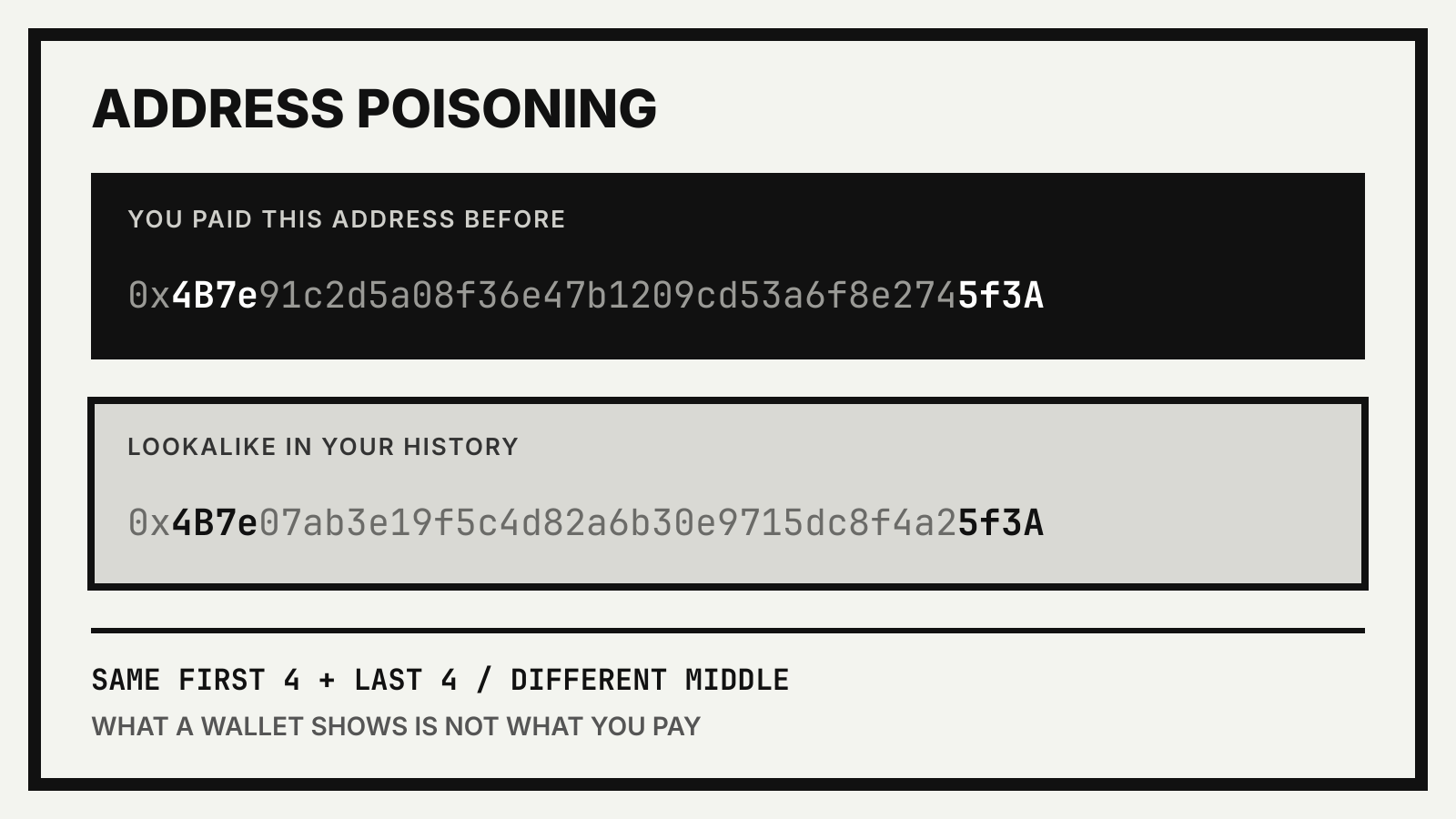
Address poisoning is a scam in which an attacker plants a lookalike of an address you have already paid, then waits for you to copy it from your own transaction history. The first and last characters match, the middle does not, and a stablecoin transfer cannot be reversed once it is sent. A Carnegie Mellon study counted about 270 million attempts on Ethereum and BNB Smart Chain, and at least $83.8 million in confirmed losses.
How the trick works
Wallet addresses on Ethereum and BNB Smart Chain (BSC) are 40-digit hexadecimal strings that nobody memorizes, so people pick a recipient from their recent history or copy the last address they used. The attacker watches for a stablecoin transfer, generates an address whose beginning and end match the recipient’s, and gets that address into the victim’s history.
The Carnegie Mellon paper, “Blockchain Address Poisoning”, describes three ways to plant it:
- Tiny transfer. The attacker sends the victim a small amount of the same token from the lookalike address.
- Zero-value transfer. Many token contracts let a caller record a transfer of zero tokens from any sender to any receiver through
transferFrom. The history then shows the victim apparently paying the lookalike. - Counterfeit token transfer. The attacker deploys a token with a near-identical name and uses it to show a transfer of the same amount the victim sent to the real recipient.
The paper notes that the three can be combined, and that attackers mostly act within about 20 minutes of the victim’s original transfer.
How common it is
The researchers measured July 2022 to June 2024 on Ethereum and BSC, looking at transfers of a few major stablecoins. Their counts, in the paper’s Tables 1 and 2:
| Ethereum | BSC | |
|---|---|---|
| Poisoning transfers | 17.4 million | 252.7 million |
| Victim addresses targeted | 1.3 million | 16.1 million |
| Successful payments to attackers | 1,738 | 4,895 |
| Victims who paid | 1,502 | 4,004 |
| Losses | $79.3 million | $4.5 million |
| Median loss | $2,160 | $85 |
The totals are 6,633 incidents and at least $83.8 million. The authors call this a lower bound: a well-known case in which a victim sent 1,155 WBTC, worth about $68 million, to a lookalike address was not counted because the study followed stablecoins only. On Ethereum the paper puts the success rate at 0.01%. CMU’s CyLab summary, published 7 January 2026, says it runs at about one success per 10,000 attempts and adds a single $50 million loss on 19 December 2025.
The BSC pattern also shows that cheap transfers invite volume. The paper reads the far larger count on BSC as a sign that attacks are more common on chains with lower fees. See network selection for how fees differ by network.
What a lookalike costs to forge
Attackers do not need the whole address, only enough matching characters to pass a glance. Each extra hexadecimal digit multiplies the work by 16. The paper models the expected number of tries as about 16 to the power of the matched digits, divided by the number of target addresses.
The table below is our own calculation from the paper’s figures. It uses the 516,437,000 addresses per second the authors measured with the Profanity2 vanity-address tool on one Nvidia RTX 8000 graphics card, and it ignores the cost of checking each address against a target list.
| Matched digits (first + last) | Expected tries, one target | One GPU, one target | One GPU, one million targets |
|---|---|---|---|
| 3 + 3 | 16.8 million | 0.03 seconds | under 1 millisecond |
| 4 + 4 | 4.3 billion | 8 seconds | under 1 millisecond |
| 5 + 5 | 1.1 trillion | 35 minutes | 2 milliseconds |
| 6 + 6 | 281 trillion | 6.3 days | 0.5 seconds |
| 7 + 7 | 72 quadrillion | 4.4 years | 140 seconds |
The authors found most attack groups matching up to 14 digits, which they estimate cost about $43 in compute. One group matched 20 digits. They estimate that took about 27,000 GPU-days, at most $1.7 million of rented compute against roughly $4 million of profit.
Who gets targeted
Attackers pick active, wealthy users. In the paper, victims of the top seven groups held far more stablecoins than a random sample of USDT users, and the number of attacks a user received rose with how often they transferred (Spearman correlation 0.7). In 79% of successful Ethereum attacks, several lookalikes were aimed at the same victim, so the attackers compete for the same mistake.
Similarity helped less than expected. The paper found no strong linear link between how many digits matched and success. Attackers appear to profit more from many slightly weaker lookalikes than from a few perfect ones. It also notes that wallets and block explorers have shown only the first and last few characters of an address, which is exactly the part a forger copies.
What actually reduces the risk
The paper lists protocol, contract, wallet and user fixes. Only some are in anyone’s hands today.
- Contracts: disallowing zero-value
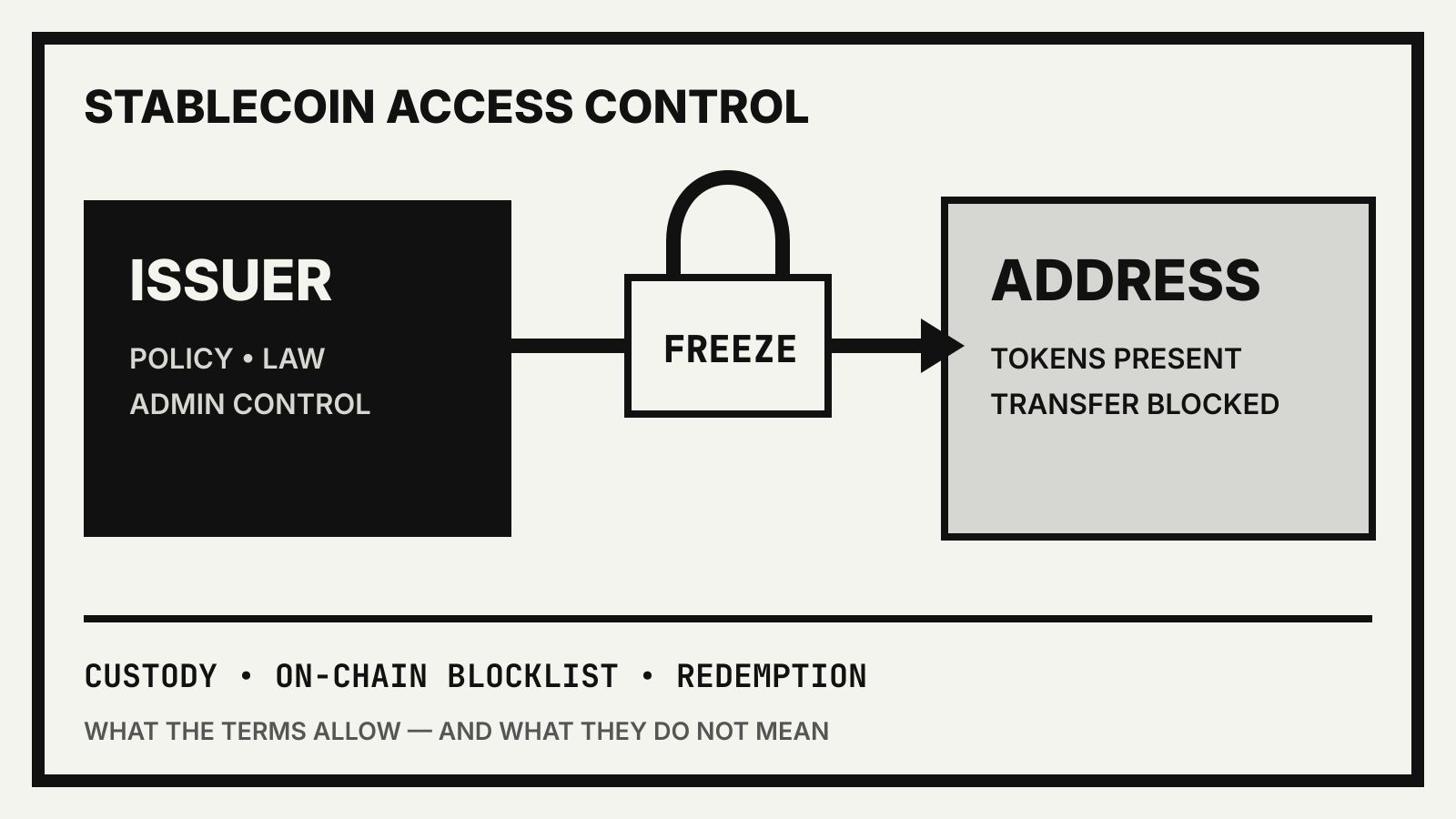
transferFromwould break the fake-history trick, but the authors report that the developer community decided not to change those contracts because existing code relies on them. - Issuers: in the largest payment the authors observed, Tether blocked the attacker’s address within an hour, which stopped the funds moving on. That is a rescue after the fact and depends on the issuer’s blocklist; see can USDT be frozen and how stablecoin issuers freeze funds.
- Wallets and explorers: show more of the address, hide suspected poisoning transfers, or ask for confirmation before paying a near-match.
- You: keep an allow-list of trusted addresses, treat unexpected small or zero-value transfers as a warning, and compare the full address, not just the ends. Our reading of the mechanism is that your own history is the weak point, so take the address from the recipient’s current invoice or a saved contact rather than from a past transaction.
An error here is different from sending to the wrong network, where the right owner may still hold the keys. A poisoned payment goes to a stranger.
Limits of this evidence
The study covers Ethereum and BSC. It does not measure TRON, Solana or other chains, and the authors list Solana and other low-fee networks as future work. It also says that attackers reuse lookalikes across chains that share the same address format, which affects any EVM network. The figures are dated: they stop at June 2024 apart from the CMU note on December 2025. The paper does not claim these rates hold today.
Last checked 24 November 2026 against the paper (version 3, 2 July 2025) and the CyLab release. The addresses in the cover image are invented examples.