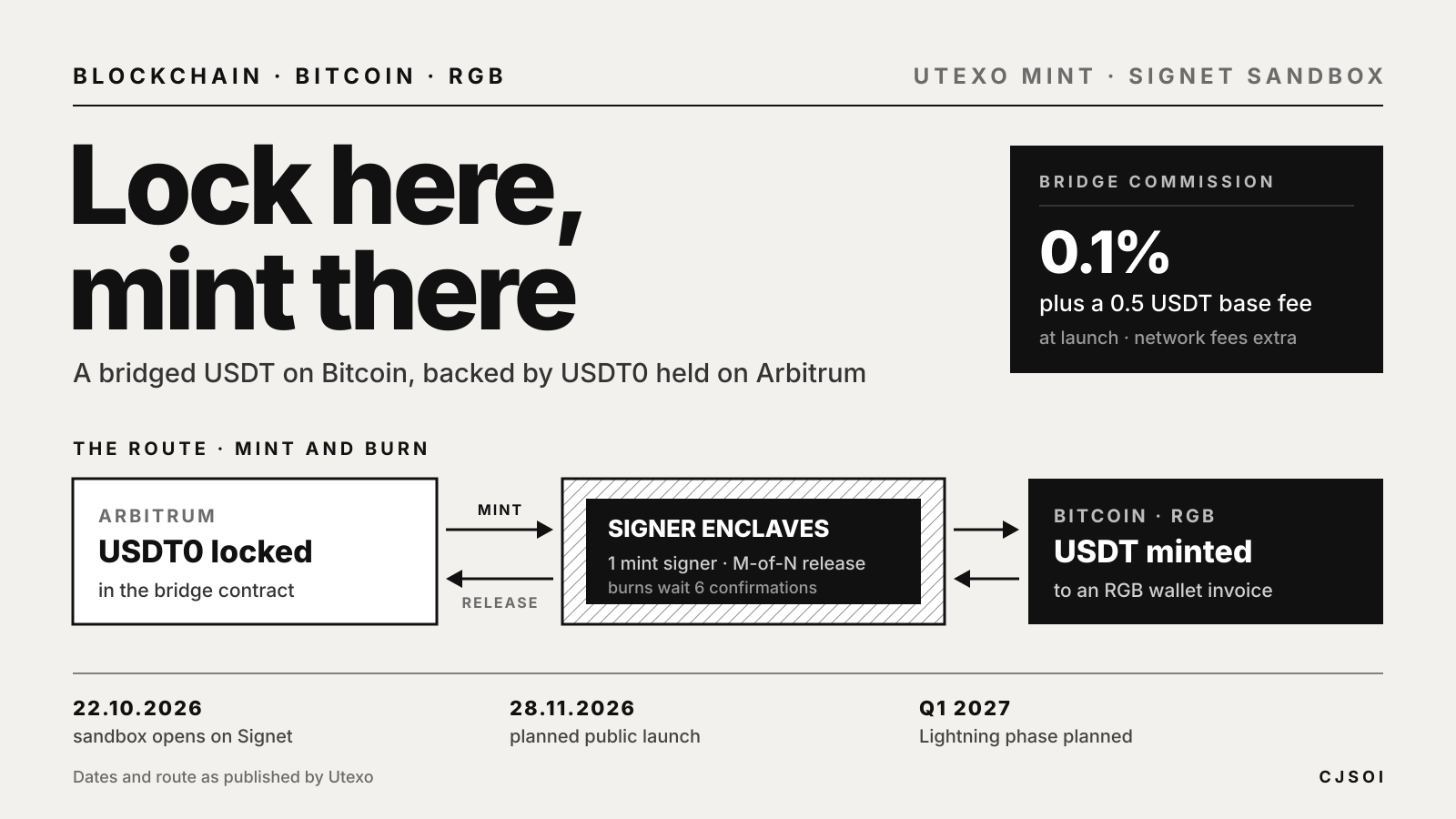
USDT on Bitcoin now has a planned launch date. Utexo announced on October 22, 2026 that it has opened Utexo Mint, a platform where professional operators can test minting and redeeming its version of USD₮ on Bitcoin, and that the public launch is scheduled for November 28. Testing runs on Bitcoin Signet, a test network, not on Bitcoin mainnet.
Utexo describes the token as its “bridged version of USD₮.” It is issued through RGB, a protocol for issuing and transferring assets on Bitcoin, and backed by USDT0 locked on Arbitrum. Onboarding is open to exchanges, wallets, market makers, OTC desks and trading firms; individual users are not the audience of this phase.
What opened on October 22
According to Utexo’s announcement, operators in the sandbox can test three things: minting, confidential transfers and redemption. Utexo says it will also offer tools to manage liquidity across supported networks and to convert between fiat and its bridged USD₮.
The rollout has two phases after the sandbox:
| Phase | Date given by Utexo | What it covers |
|---|---|---|
| Sandbox | From October 22, 2026 | Operators test on Bitcoin Signet |
| Public launch | November 28, 2026 | Availability on Bitcoin through partner wallets and exchanges |
| Lightning | Planned for Q1 2027 | Extension to the Lightning Network for payments |
The November and 2027 dates are plans, not completed events. The announcement does not name the launch partners.
How the mint works
Utexo’s Mint documentation describes a lock-and-mint design with Arbitrum as the single settlement hub. USDT sent from Ethereum, Polygon PoS, Plasma or Tron is first routed to Arbitrum as USDT0 through the USDT0 / LayerZero protocol. The USDT0 is locked in a bridge contract, and the same amount, less fees, is minted as USDT on Bitcoin to the recipient’s RGB wallet.
Two parts of the design matter for anyone holding the token:
- Minting. A single mint signer, running in an AWS Nitro Enclave, holds the RGB mint rights. It signs a mint only after the USDT0 deposit on Arbitrum is final. Utexo says every wallet that later receives the token re-checks that each mint in its history is backed by such a deposit.
- Redemption. To get USDT0 back, the holder burns the Bitcoin-side token. The release waits for six Bitcoin confirmations and needs an M-of-N quorum of independent signer enclaves before the bridge pays out on Arbitrum, or onward to another supported network.
This is the distinction our explainer on native and bridged stablecoins draws: the Bitcoin-side token is a claim on USDT0 locked in Utexo’s bridge, so its value depends on that contract and its signers as well as on Tether. Our comparison of USDT, USA₮ and USDT0 explains what USDT0 itself is.
Fees and limits
Utexo’s getting-started guide gives the bridge commission at launch as 0.1% of the amount plus a base fee of 0.5 USDT, with network costs charged separately: gas on the EVM side, USDT0 / LayerZero fees on routed transfers and a Bitcoin fee paid by the RGB wallet. The documentation says commissions can apply on both the lock and the unlock.
As our own calculation from those published rates, minting 1,000 USDT would carry a bridge commission of 1.50 USDT (1.00 plus 0.50) before network fees.
The guide also says:
- the staging setup uses Arbitrum mainnet with real USDT0 on one side and Bitcoin Signet on the other, and Bitcoin mainnet “is not available yet”;
- accounts that have not completed KYC or KYB can mint only up to a cumulative 100 USDT;
- the receiving wallet must support the RGB asset schema that USDT on Bitcoin uses;
- a burn cannot be undone, and a burn that names a plain EVM address can be paid out only on Arbitrum.
Background: Tether’s RGB plan
Tether announced on August 28, 2025 that it planned to launch USD₮ on RGB, saying users would be able to hold USD₮ alongside bitcoin in the same wallet. Utexo’s October 22 announcement does not include a statement from Tether, and it presents the Bitcoin token as Utexo’s bridged version rather than as a new Tether-issued chain. Tether’s issuer terms and reserves are summarized in our USDT entry.
Until wallets and exchanges publish their own support, treat USDT on Bitcoin as a separate network choice. Our network selection guide covers why the same ticker on two chains is not interchangeable, and Can USDT Be Frozen? covers the controls that already exist on other networks.