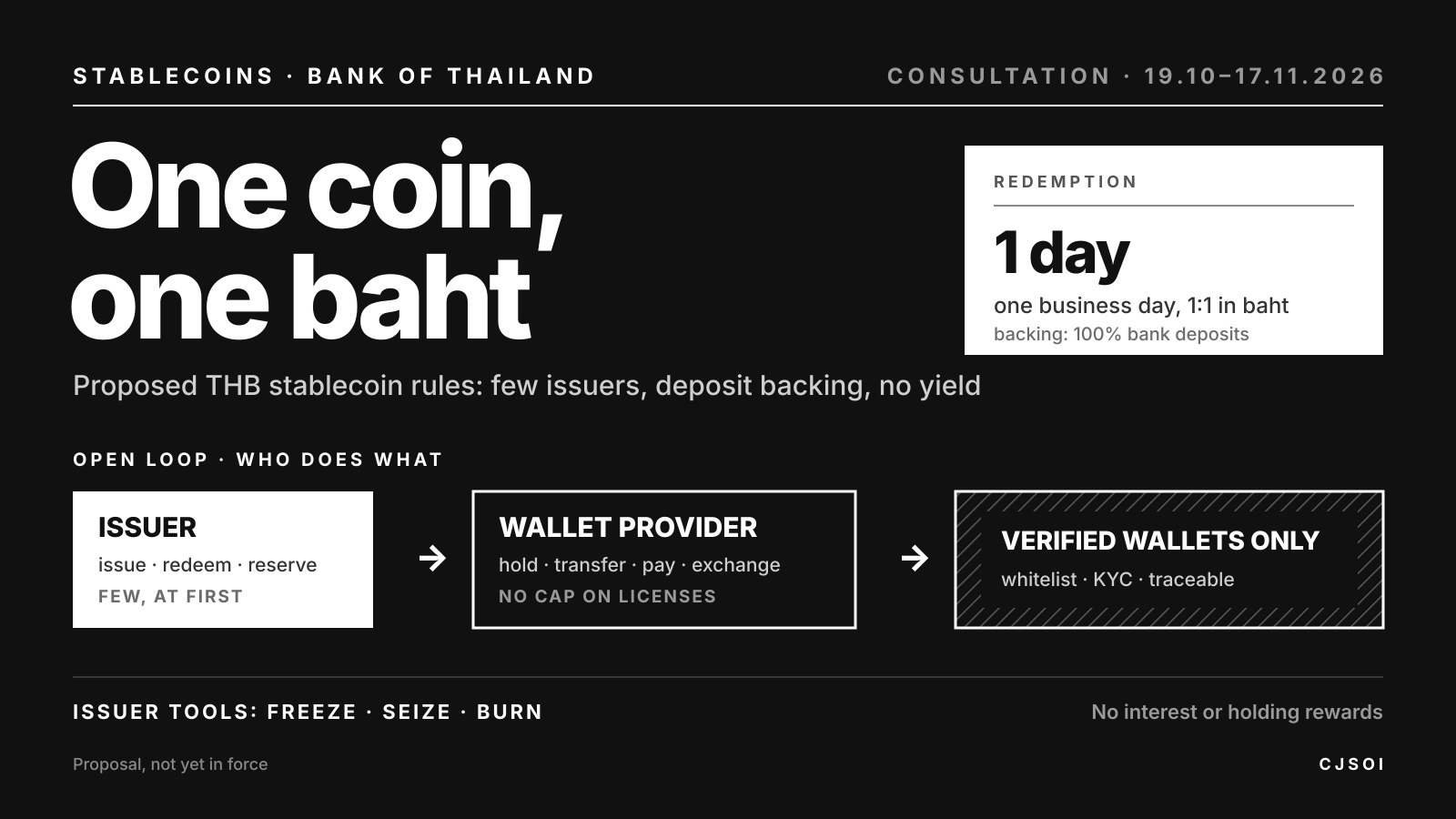
The Bank of Thailand (BOT) has published the rules it proposes for a THB stablecoin, a token pegged one-to-one to the Thai baht, and opened them to public comment from October 19 to November 17, 2026. The consultation paper, dated October 2026 and published in Thai by the BOT’s Payment Systems Policy and Financial Technology Department, would allow only a few issuers at first, require full backing in bank deposits and bar any yield to holders.
These are proposals. The BOT says it will use the comments before it issues rules.
Two kinds of licensed firm
The BOT describes an open-loop design that separates two roles:
| Role | What it does |
|---|---|
| Issuer | Issues and redeems the coin and manages the backing assets |
| Wallet provider | Holds, transfers, accepts and exchanges coins for the public |
In the first phase the BOT would limit the number of issuers. It argues that too many coins would split liquidity, confuse users and merchants, and weaken the baht token’s role as a stable unit of account. Wallet providers that meet the criteria could apply in licensing rounds, with no cap on how many are licensed. Both would be supervised as payment service businesses under the Payment Systems Act.
The BOT says a THB stablecoin should add to existing payment systems such as PromptPay, not replace them, and that applicants must show a measurable benefit, such as lower cost, faster settlement or uses that need programmability, round-the-clock availability or atomic settlement.
Reserves, redemption and no interest
For issuers, the paper proposes:
- Backing. At first, 100% of backing assets held as bank deposits, spread across several banks rather than concentrated in one. The BOT says this would let holders get their money back in full even if the issuer fails. It may later propose legal changes to allow high-quality liquid assets such as short-term government bonds.
- Redemption. Holders can redeem at one coin to one baht within one business day.
- No yield. No interest, return or incentive linked to how long or how much a holder keeps, directly or indirectly. The BOT says the coin is a means of payment, not a savings or investment product.
- Disclosure. Backing assets kept separate from the issuer’s other assets, daily public disclosure of the reserve and the coins in circulation, and an external audit at least once a year.
The paper cites the failure of Silicon Valley Bank, which held part of USDC’s reserves, and the Poly Network smart-contract exploit as the kind of crisis issuers must be able to withstand.
Whitelisted wallets and a freeze button
The anti-money-laundering proposals reach into the token itself. An issuer would have to restrict its coin to wallets that have passed identity checks (whitelisting) and be able to freeze, seize or burn coins remotely when they are misused. The paper names illegal transactions and bridging or wrapping the coin to move it outside the regulated perimeter as examples.
Wallet providers would run the same customer checks as e-money businesses, keep customer coins separate and unused, act as the point of contact for complaints, and block transfers to unverified wallets. They could not serve or connect to foreign digital asset exchanges outside the supervision of Thailand’s Securities and Exchange Commission, which the BOT says is meant to prevent the coin being used to get around foreign exchange controls.
The BOT’s earlier position, from a March 2021 policy statement, was that baht-backed stablecoins used for payments may be classed as e-money and that firms must consult the BOT before operating one.
For how issuers can freeze tokens today, see Can USDT Be Frozen?; for what bridging changes, Native vs Bridged Stablecoins. Another Asian licensing regime is covered in our Hong Kong stablecoin license guide, and stablecoins in currencies other than the dollar and euro are listed on the stablecoin list.
Questions
Is there a THB stablecoin I can use now?
The paper sets out proposed rules. It does not name approved issuers, and the rules are not yet in force.
Will a THB stablecoin pay interest?
Under the proposal, no. Issuers would be barred from paying interest or holding-based rewards.
How fast must an issuer redeem?
Within one business day, at one coin per baht, under the proposal.
Sources
- Bank of Thailand, public hearing on the principles for regulating THB stablecoin businesses, October 19 to November 17, 2026 (Thai)
- Bank of Thailand, consultation paper “Principles for regulating businesses related to THB stablecoin,” October 2026 (PDF, Thai)
- Bank of Thailand, “Stablecoins Regulation Policy,” press release No. 16/2021, March 19, 2021
More from the Stablecoins desk.