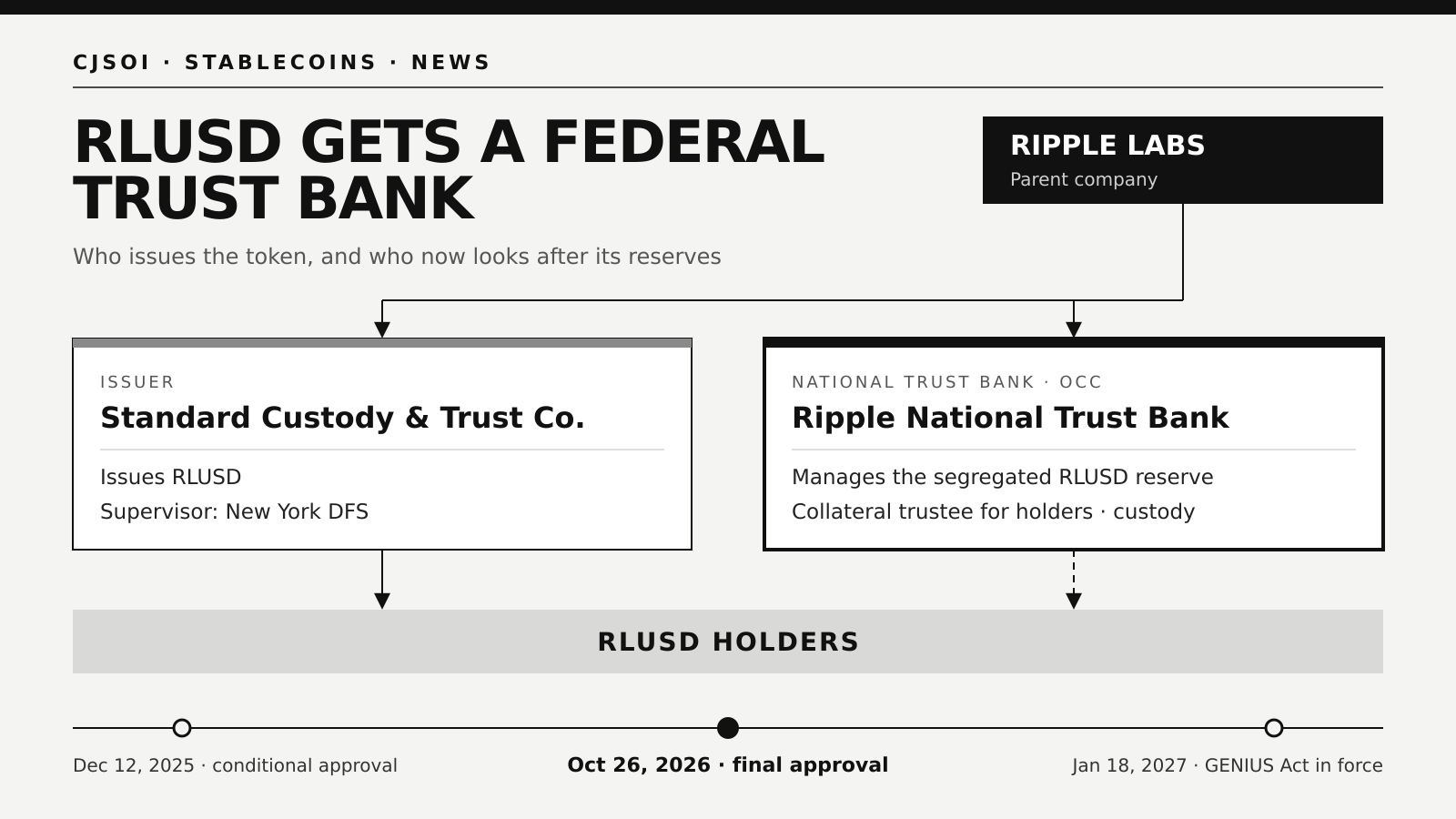
Ripple National Trust Bank has received final approval from the Office of the Comptroller of the Currency (OCC), Ripple said on October 26, 2026. The national trust bank will manage the segregated reserves behind Ripple USD (RLUSD) and act as collateral trustee of those reserves for RLUSD holders, according to Ripple’s announcement.
RLUSD itself does not move to the new bank. Ripple says the stablecoin will still be issued by Standard Custody & Trust Company (SCTC), its limited purpose trust company regulated by the New York State Department of Financial Services (NYDFS). What changes is that a federally supervised bank now sits between the issuer and the reserve assets.
Who does what for RLUSD
| Role | Entity | Supervisor |
|---|---|---|
| Issues RLUSD | Standard Custody & Trust Company | NYDFS |
| Manages the segregated reserve | Ripple National Trust Bank | OCC |
| Collateral trustee for RLUSD holders | Ripple National Trust Bank | OCC |
| Primary reserve custodian | BNY | Not stated in the announcement |
The OCC’s conditional approval letter of December 12, 2025 describes the same split. The bank plans to manage the RLUSD reserve “on a directed basis” for SCTC and to perform collateral trustee services “for the benefit of RLUSD holders on a fiduciary basis.” It also plans to offer cryptocurrency custody, on a fiduciary basis, to affiliates and unaffiliated institutional customers. The letter gives the bank’s location as New York, New York, and its proposed charter number as 25364.
Ripple has not said when Ripple National Trust Bank will open for business. Its statement refers to the period “as RNTB begins operations.”
What a national trust bank can and cannot do
A national trust bank is a narrower charter than a commercial bank. In the December letter, the OCC said the bank “will not be an insured depository institution” and that it “does not currently plan to issue stablecoins.” The conditions attached to that approval limit the bank to the operations of a trust company and require it to stay outside the Bank Holding Company Act’s definition of a bank.
The conditional approval also set financial floors for the first three years of operation:
- at least $11.7 million in tier 1 capital, with the greater of half of it or $5.85 million held in eligible liquid assets;
- a separate buffer of 180 days of operating expenses in eligible liquid assets;
- OCC no-objection before any significant change to the business plan.
Those terms come from the conditional approval. We did not find a final decision document from the OCC when this report was published, so any changes made at the final stage are not reflected here.
One condition looks ahead. The OCC wrote that the bank must, “if and to the extent necessary,” conform, cease or divest its collateral trustee structure to comply with the GENIUS Act and its implementing rules. The OCC’s own GENIUS Act final rule, issued on October 21, 2026, takes effect on January 18, 2027.
RLUSD in figures
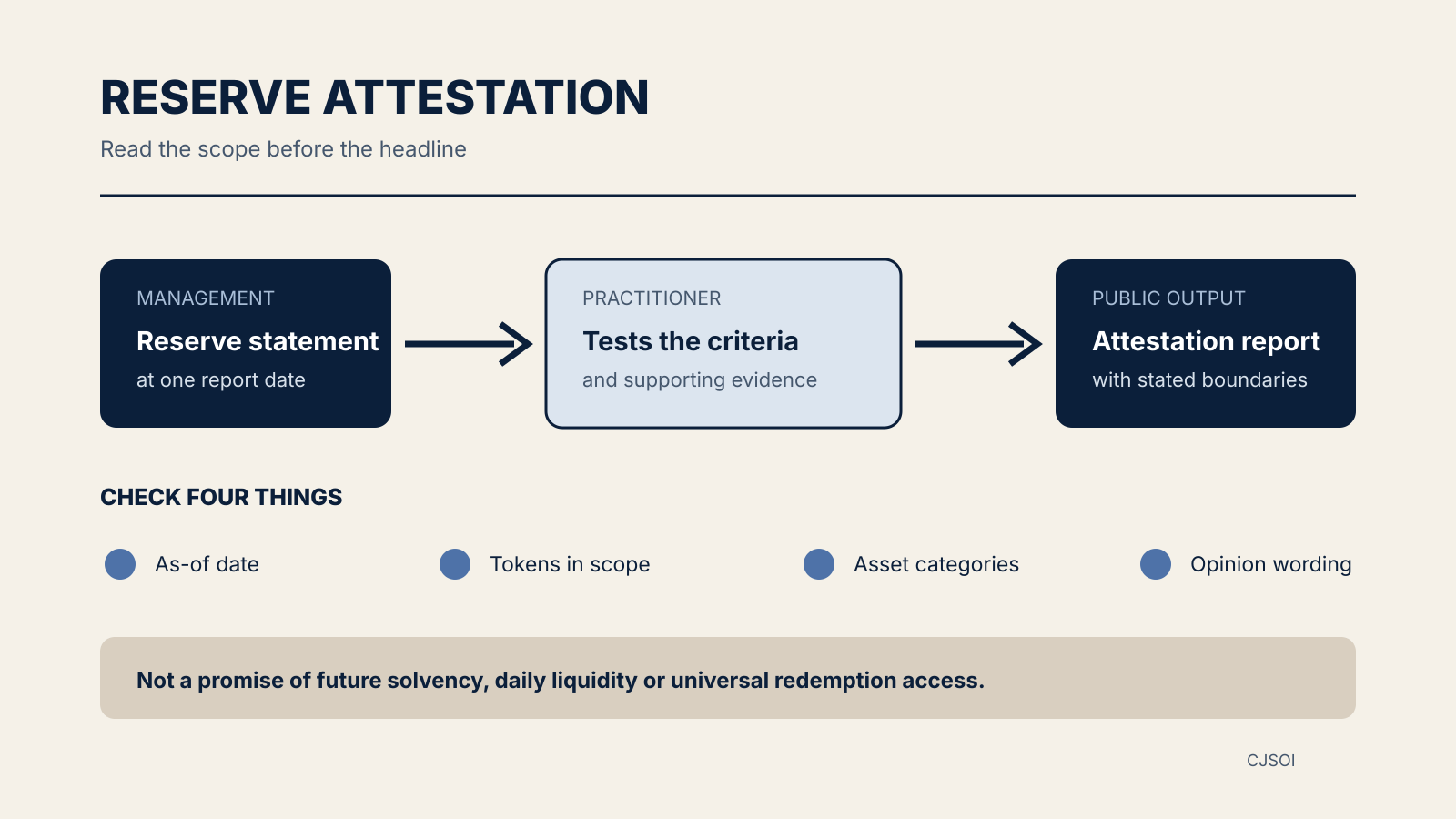
Ripple says RLUSD launched in December 2024 and has a market capitalization of $2.5 billion. It says the reserves consist of U.S. dollar deposits, U.S. government securities and other cash equivalents, and that it publishes monthly attestations by an independent third party covering circulating supply and reserve assets. These are Ripple’s own figures; the issuer, reserve and redemption details we track are on the RLUSD entry of our stablecoin list.
The final approval closes a process that began with the OCC’s batch of conditional trust bank approvals in December 2025, which we covered in OCC Conditionally Approves Five Trust Bank Applications. For how a trustee and a custodian differ from the issuer, see How Banks Hold Digital Assets for Clients and What Happens When You Redeem a Stablecoin?.