New Zealand stablecoin regulation may get a payments-first shortcut. On November 9, 2026, the Financial Markets Authority (FMA) proposed that New Zealand dollar stablecoins fully backed by money in a New Zealand bank would stop counting as financial products. Feedback closes at 5pm on Friday, December 18, 2026.
The FMA announced the consultation in media release MR No. 2026-51 and set out the detail in its consultation paper. It says no decisions have been made.
What the FMA proposes
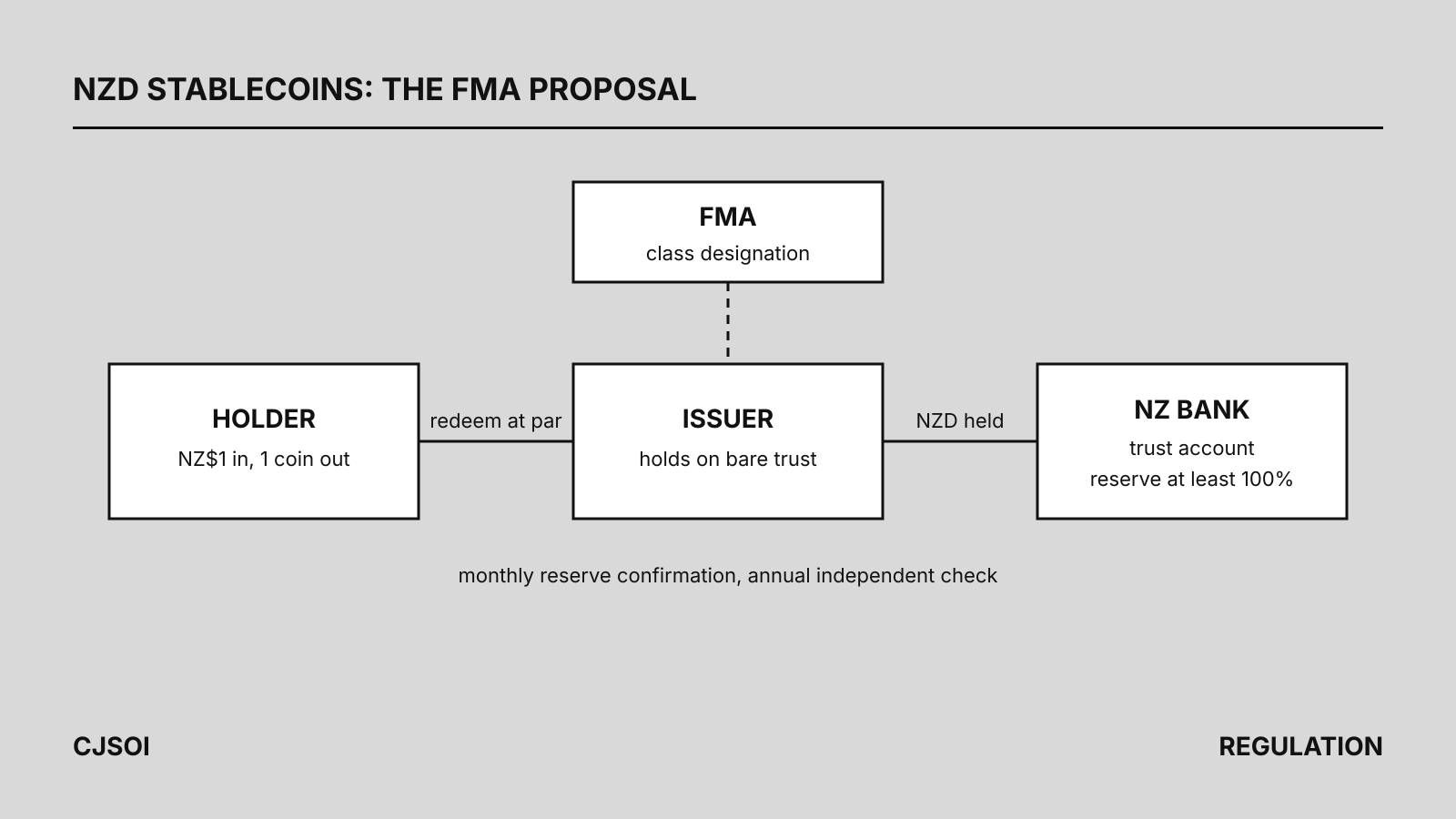
The tool is a class designation under section 562 of the Financial Markets Conduct Act 2013 (subsection 1, paragraph c). The FMA’s reasoning: a stablecoin of this kind is probably a “debt security” under the current definition, yet people use it to move money, not to invest. Calling it a financial product adds few obligations, because bank debt securities are not “regulated offers”, and the paper says it can make exchanges and banks reluctant to deal with the coin.
To qualify, a coin would need four features:
- It is issued for NZ$1 per coin and fully backed from the point of issue.
- The issuer holds that NZ$1 on bare trust for the holder, in a trust account at a New Zealand registered bank.
- The holder can hand the coin back and get the NZ$1, subject only to commercially reasonable limits on eligibility, minimum amounts, timing and fees.
- The coin pays no income or interest to holders. The issuer may keep trust-account interest to cover costs.
Ongoing duties and the penalty for missing one
| Duty | Proposed rule |
|---|---|
| Reserve level | NZD in the trust account at least equal to the face value of coins in circulation, at all times |
| Reserve confirmation | Published on a public website at least monthly |
| Independent check | Verification of reserves at least annually, results published; who verifies and to what standard is an open question |
| Disclosure | A website statement that the coins rely on the designation |
If an issuer breaks one of these duties, the designation does not apply for that period and the coins “would be treated as financial products.” The designation would be open to any issuer that meets the terms, with no application to the FMA, and would cover only coins issued or transferred after it takes effect.
What stays out
The paper does not propose to cover algorithmic coins, reserves in government securities, money market funds or other investments, yield-bearing coins, commodity-backed coins, or coins pegged to the US dollar or any other currency. The designation would not change anti-money-laundering duties or fair dealing rules, and it is “not an endorsement or approval by the FMA of any issuer or stablecoin.”
One precedent already exists
In March 2026 the FMA made the ECDD Holdings Limited Stablecoin Designation Notice 2026 for the NZDD coin. It was made on March 10, took effect on March 11 and does not expire. The new class designation “closely follows” its features and duties. The difference is reach: the March notice names one issuer, the proposal would apply to any issuer that meets the terms.
Worked example (our calculation)
Take a hypothetical issuer with 20,000,000 NZD coins in circulation. The trust account must hold at least NZ$20,000,000 at every moment. If a check shows NZ$19,900,000, the NZ$100,000 gap means the designation stops applying until the issuer fixes it, and during that time the coins are financial products. The proposal asks for backing at face value and no more; Nigeria’s rules add a 2% reserve buffer.
For how regulators divide this work, see who regulates a stablecoin and what happens when you redeem a stablecoin. Reserve and issuer details for listed coins are on the stablecoin list.
Questions
When does the New Zealand stablecoin consultation close?
At 5pm on Friday, December 18, 2026. The FMA then considers submissions and decides whether to make the designation.
Would a USD stablecoin such as USDC be covered?
No. The proposal covers only NZD-referenced coins with NZD reserves at a New Zealand registered bank.
Can an NZD stablecoin pay interest to holders?
Not under the proposal. A coin that gives holders income or interest would fall outside the designation.
Sources
- FMA, “FMA consults on clearer regulatory pathway for NZD referenced and backed payment stablecoins,” MR No. 2026-51, November 9, 2026
- FMA, consultation page: proposed class designation for NZ dollar-referenced and -backed stablecoins, November 9, 2026
- FMA, consultation paper: proposed class designation for NZD stablecoins
- FMA, ECDD Holdings Limited Stablecoin Designation Notice 2026
More from the Regulation desk.