Canada has published its draft stablecoin regulations. The proposed Stablecoin Regulations appeared in the Canada Gazette, Part I, on October 24, 2026, with the Department of Finance as sponsor. They fill in the rules that the Stablecoin Act left to regulation, and they are needed before the Act can come into force. Comments are open for 60 days from publication, which takes the window to December 23, 2026.
The Act itself received Royal Assent in March 2026 and makes the Bank of Canada the registrar and supervisor of non-bank issuers of fiat-backed stablecoins. Our explainer on Canada’s Stablecoin Act covers the statute. This report covers what the draft regulations add.
Redemption: three business days, 1% fee cap
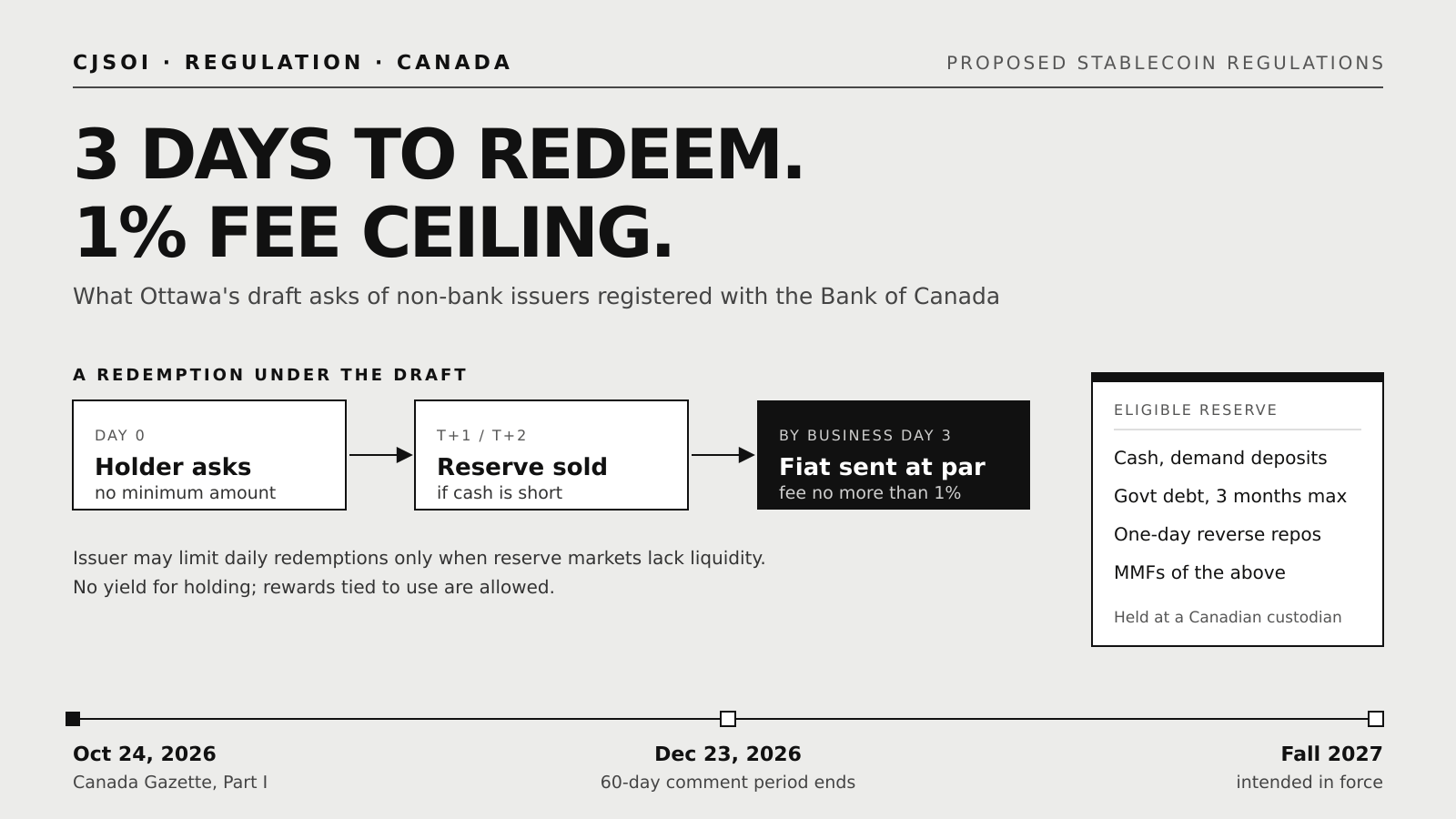
The Canada stablecoin regulations would require an issuer to redeem on request, at par in the reference currency, within three business days and with no minimum amount. Finance explains the three days in the regulatory impact statement: Canadian securities settle T+1 and foreign securities T+2, and one more business day is added for processing.
Redemption fees would be capped at 1% of the amount redeemed. Finance says current direct-redemption fees are around 0.1%, and that a cap at that level could shut out smaller issuers. Issuers would have to disclose purchase and redemption fees and give holders at least seven days’ notice on their website before a fee increase.
The draft text lets an issuer limit the daily amount of redemptions only when it cannot meet all requests because of a liquidity shortfall in the markets where its reserve assets trade. The redemption policy must say when that can happen.
What the reserve may hold
At the end of each day the reserve must be worth at least the value of the stablecoins outstanding. The draft allows four kinds of asset:
- demand deposits, including cash;
- government debt securities with three months or less to maturity;
- reverse repurchase agreements with a one-business-day term, on that same short government debt;
- money market funds made up entirely of those assets.
There are no limits on the mix among them; Finance says fintech companies asked for that flexibility. Reserve assets may not be pledged, though one-day repos on short government debt are allowed to meet redemptions. The reserve must sit with a qualified custodian incorporated in Canada; financial institutions not incorporated in Canada are excluded. An issuer with several stablecoins at one custodian needs a separate account for each.
Yield: holding no, using yes
The Act already bars issuers from paying interest. The draft goes further: an issuer could not set up arrangements with third parties, including income-sharing, that pay holders for holding more of a stablecoin or holding it longer. Rewards tied only to using a stablecoin, such as for a payment, would be allowed. Issuers also could not use terms, logos or images that suggest a yield, legal tender status, deposit insurance or a government guarantee.
Payment firms and wallets
The package amends the Retail Payment Activities Regulations so that payment service providers handling prescribed stablecoins fall under Bank of Canada supervision. Prescribed stablecoins would be those from issuers on the Bank’s list, plus stablecoins from financial institutions under substantially similar laws. Finance estimates about 30 additional firms, such as trading platforms with custodial wallets, software wallets and crypto payment processors, would be brought in.
Fees, penalties and timing
Supervision costs would be recovered from issuers in three tiers by outstanding value, in Canadian dollars: a $750,000 base fee at $1 billion or more, $350,000 from $500 million, and $25,000 below that. The top two tiers would also share the remaining costs. Penalties could reach $1 million for a serious violation and $10 million for a very serious one, such as failing to hold the reserve or redeem at par.
Finance’s baseline assumes about five issuers would be covered, naming QCAD from Stablecorp, CADC from Loon Technology and Circle’s USDC, plus possible new entrants. The intention is for the regulations and the Act to come into force in fall 2027. An issuer already issuing the day before the Act comes into force could continue if it applies to the Bank of Canada within 30 days. The Bank plans to consult on supervisory guidelines once the final regulations are published in Part II of the Gazette.
For how the rules compare with other regimes, see who regulates a stablecoin, the GENIUS Act and stablecoin redemption. Issuer details for USDC and other tokens are on the stablecoin list.
Questions
When can comments on Canada’s stablecoin regulations be filed?
For 60 days after the October 24, 2026 Gazette notice, so until December 23, 2026, preferably through the Canada Gazette online commenting feature.
Do the regulations apply to banks?
No. The Stablecoin Act does not apply to financial institutions such as banks and credit unions that issue stablecoins. Banks can act as qualified custodians for issuers’ reserves.
Can a Canadian issuer offer rewards?
Only rewards tied to using the stablecoin. Payments for holding it, including through partners funded by the issuer, would be prohibited.
Sources
- Canada Gazette, Part I, Vol. 160, No. 43, “Stablecoin Regulations,” October 24, 2026
- Bank of Canada, Stablecoins
- Department of Finance Canada, Canada’s Stablecoin Framework
More from the Regulation desk.