The World Bank Group said on November 17, 2026 that it will explore regulated stablecoin infrastructure for the payments and settlements it makes for its clients, working with Citi and Circle. According to the World Bank Group’s announcement, the aim is to see whether these tools can make those payments cheaper, faster and more transparent.
This is a commitment to explore, not a launch. The release names no amounts, no start date and no list of countries.
What the World Bank Group will test
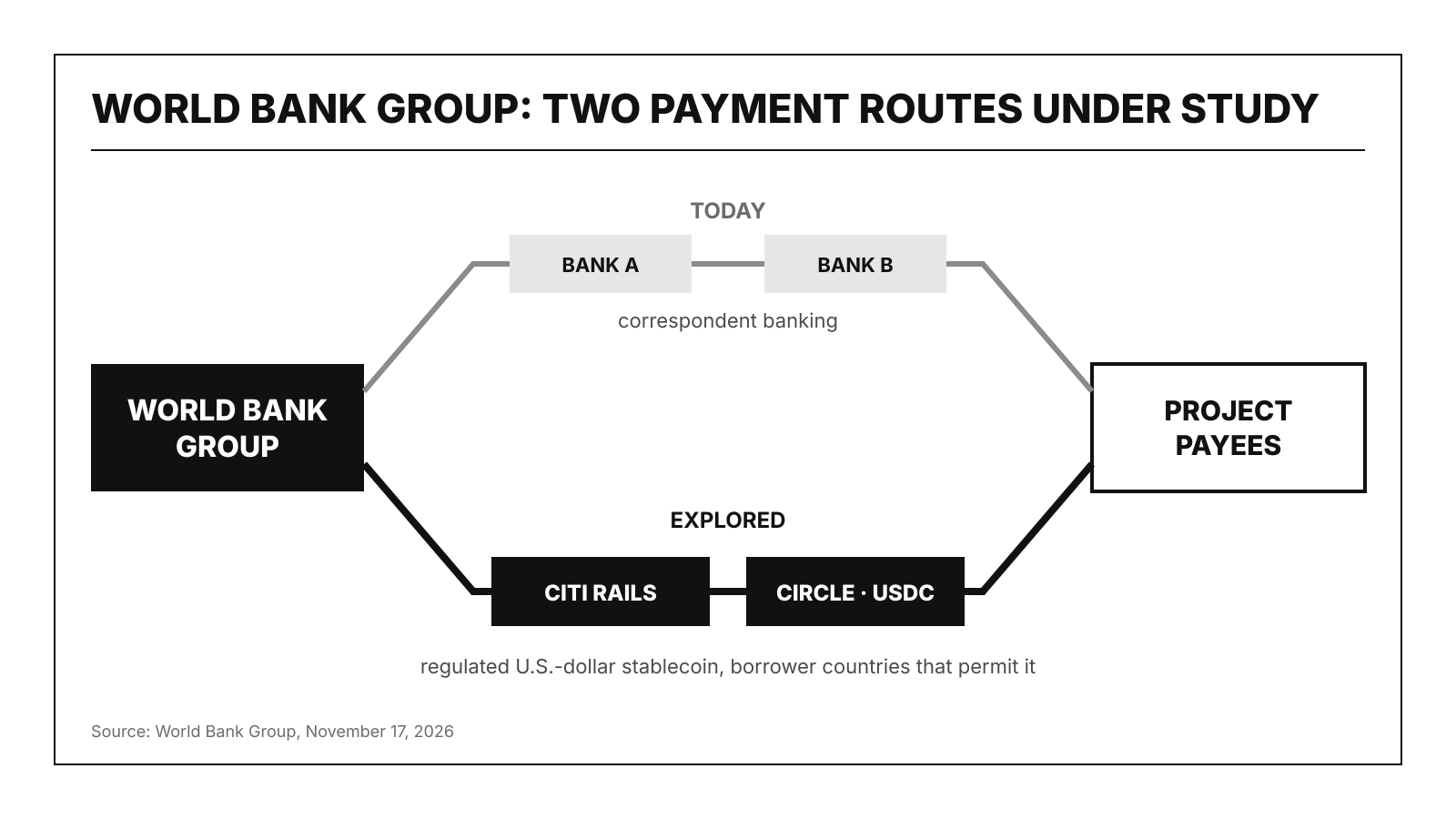
The work looks at how U.S. dollar-denominated regulated stablecoins and blockchain-based payment rails could operate alongside, or improve, the Group’s existing fund disbursement arrangements. Those arrangements rely on correspondent banking, the chain of bank-to-bank accounts that most cross-border payments pass through today (see how correspondent banking works).
The two partners have separate roles in the release:
| Partner | Role named by the World Bank Group |
|---|---|
| Citi | Connections to established banking rails |
| Circle | Stablecoin payments infrastructure to mint and settle funds in USDC |
Citi’s head of services, Shahmir Khaliq, says in the release that Citi’s network spans more than 180 jurisdictions and that the work aims at 24/7 capabilities while complying with local regulations. Circle’s chief executive, Jeremy Allaire, says Circle supports the Group’s work on responsible stablecoin use by global institutions. Our USDC entry covers the coin’s issuer, reserves and redemption terms.
The first phase and its limits
The first phase will focus on an “intermediated, interoperable” stablecoin-based payment model. It will engage borrower countries “where digital asset use is supported and permitted,” so countries that restrict stablecoins fall outside it. Over time the Group plans to bring in other banks.
The release does not say whether payees would receive USDC or local currency, who would convert between the two, or what fees would apply. Those details decide whether a payment is cheaper in practice, and none of them are public yet.
Where FundsChain fits
The initiative builds on FundsChain, the World Bank Group’s blockchain platform for tracing project money. When the Group introduced FundsChain in September 2025, it described a ledger on Hyperledger Besu that lets borrowers, auditors and development partners follow disbursements and how funds are used. The November 17 release says more than 350 projects in 96 countries are now onboarded.
FundsChain records where money goes. The new work concerns how the money itself moves, which is a separate question.
World Bank Group President Ajay Banga says in the release that the aim is to “make the financial plumbing of development work better for the people who need it most,” with faster and cheaper payments to clinics, farmers and governments.
Questions
Is the World Bank issuing a stablecoin?
No. The release describes exploring payments in existing regulated U.S.-dollar stablecoins, with Circle minting and settling USDC.
Will World Bank projects be paid in USDC?
Not decided. The first phase covers borrower countries where digital asset use is permitted, and the release does not say how recipients would be paid.
What is FundsChain?
A World Bank Group blockchain ledger that tracks project disbursements and how funds are spent. It traces payments; the release does not describe it as moving money.
Sources
- World Bank Group, “World Bank Group Explores Regulated Stablecoins to Modernize Payments, Redirect Resources to Development Impact,” November 17, 2026
- World Bank Group, FundsChain launch announcement, September 26, 2025
More from the Stablecoins desk.