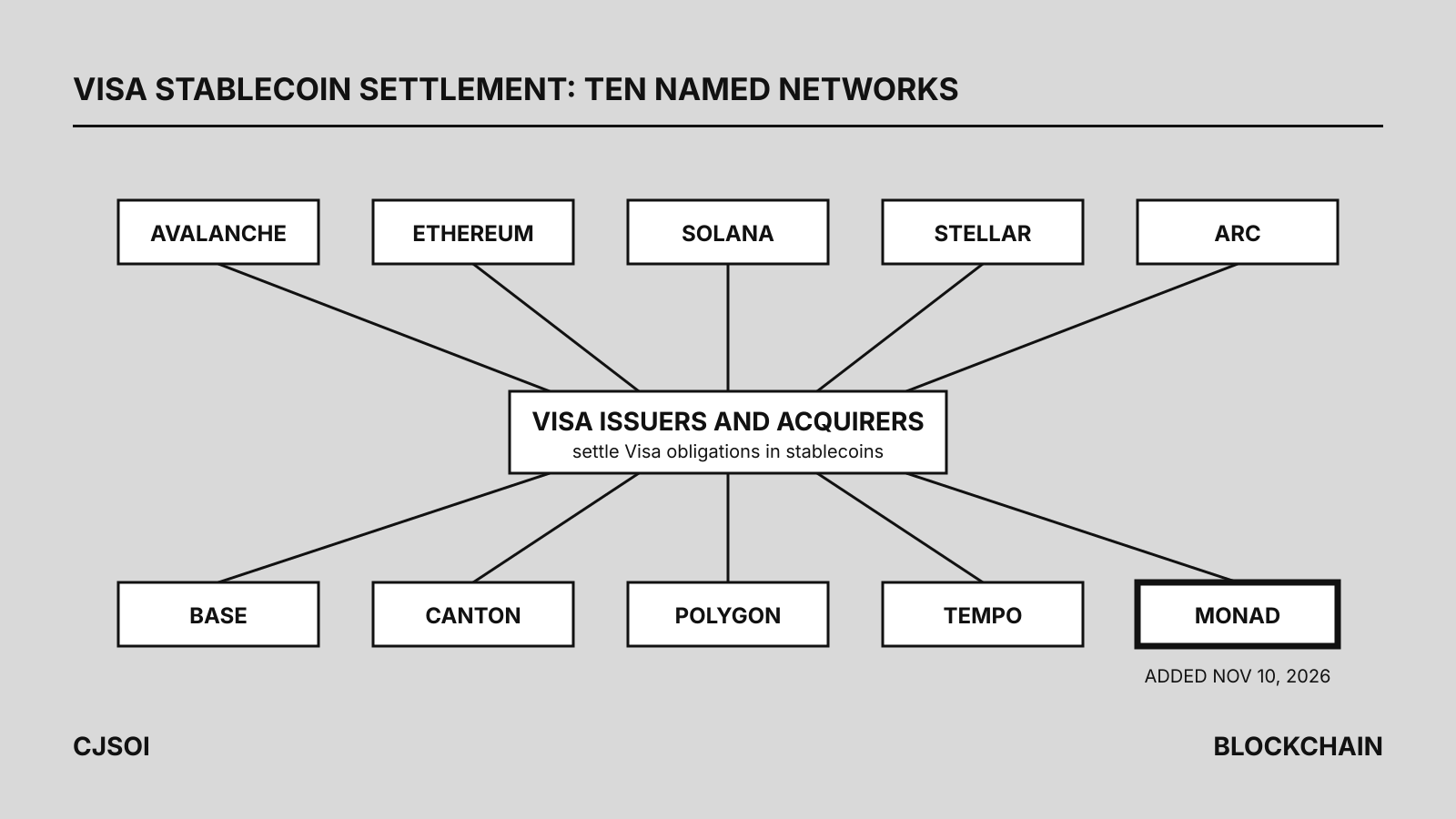
Monad is now one of the blockchains Visa uses for stablecoin settlement. The Monad Foundation said on November 10, 2026 that Visa has added Monad as a stablecoin settlement network, giving participating Visa issuers and acquirers another way to settle their Visa obligations onchain.
Monad is a layer-1 blockchain that runs Ethereum-compatible smart contracts. The release adds no settlement volume, launch partners or start date for the first Monad settlement.
What the announcement says
Card settlement has traditionally followed a five-business-day schedule over banking rails, the release says. On a blockchain, the Monad Foundation argues, issuers can move funds on weekends and holidays and convert between stablecoins and fiat with less friction, while acquirers get settlement moments after submission. Because Monad runs Ethereum’s virtual machine, the release says, custody, wallet and compliance tools built for Ethereum can typically extend to it.
Dan Roesbery, Visa’s vice president for global onchain partnerships and go-to-market, said in the release that Visa’s goal is “to give our partners the flexibility to settle on the blockchain networks that best meet their needs.” Keone Hon, co-founder and general manager of the Monad Foundation, linked the addition to privacy features still in development.
Visa stablecoin settlement blockchains: the list now
Visa’s April 29, 2026 release named nine networks. Monad makes ten by our count of Visa’s and Monad’s announcements; Visa does not publish a running list, so a network added without an announcement would not appear here. The last column is our check of Circle’s USDC contract address page on November 20, 2026.
| Network | When it was named | Native USDC listed by Circle |
|---|---|---|
| Avalanche | Before April 29, 2026 | Yes (C-Chain) |
| Ethereum | Before April 29, 2026 | Yes |
| Solana | Before April 29, 2026 | Yes |
| Stellar | Before April 29, 2026 | Yes |
| Arc | April 29, 2026 | Yes |
| Base | April 29, 2026 | Yes |
| Canton | April 29, 2026 | No |
| Polygon | April 29, 2026 | Yes (Polygon PoS) |
| Tempo | April 29, 2026 | No |
| Monad | November 10, 2026 | Yes |
The Monad release does not say which stablecoin Visa’s partners will use there. USDC is the only token Visa’s April release named for the program, and Circle lists a native USDC contract on Monad mainnet, so the route exists on the issuer’s side. Whether any Visa partner settles in it is not stated.
What is not live yet
The release says participants will benefit from Monad’s privacy functionality “in coming months.” Category Labs, which develops Monad, described Monad Private Settlement on October 6, 2026 and wrote that it “is a published design and is not yet live.” In that design, each private domain is a standard smart contract on Monad: transactions inside it are encrypted, access is denied by default, and auditors and regulators can be granted scoped access. The institution chooses the domain’s validators. No launch date is given.
The speed figures also differ by source. The press release cites 400-millisecond blocks and 800-millisecond finality; Monad’s developer documentation lists 300-millisecond blocks and 600-millisecond finality. Both describe settlement in under a second. Our explainer on blockchain finality and settlement finality covers why a final block is not the same as a legally final payment.
Program size
The release says Visa reported a $25 billion annualized stablecoin settlement run rate as of September 2026, up roughly 10 times on a year earlier, and more than 225 stablecoin-linked card programs. Visa’s own September 8, 2026 release put the run rate above $20 billion and the card programs above 160. Neither figure is split by blockchain, so Monad’s share cannot be measured.
Two days after the Monad addition, Visa’s program also gained a new settlement asset: Western Union’s USDPT, issued by Anchorage Digital Bank on Solana. Our earlier report covers the April expansion to nine blockchains.