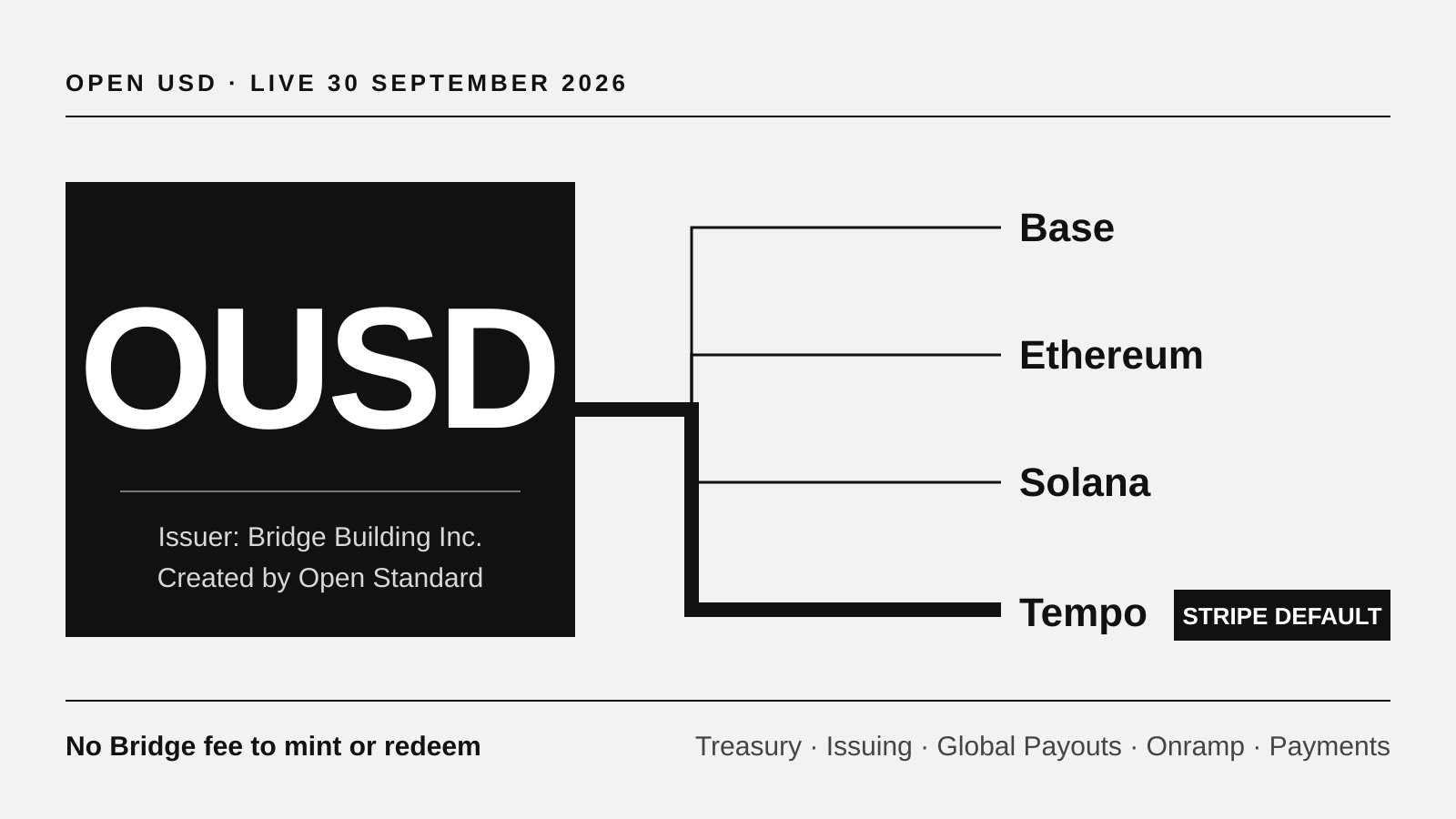
Open USD (OUSD), the stablecoin created by the Open Standard group, went live on September 30, 2026 on Base, Ethereum, Solana and Tempo, according to Bridge, which issues it. The same day, Stripe said OUSD on Tempo is now the default stablecoin configuration across its products.
The OUSD stablecoin is issued by Bridge Building Inc. Bridge describes Open Standard as an independent company founded by Coinbase, Mastercard, Shopify, Stripe and Visa, joined by more than 200 partners.
Who issues OUSD
Bridge’s announcement names Bridge Building Inc. as the current issuer. It also mentions the conditional approval from the U.S. Office of the Comptroller of the Currency (OCC) to establish Bridge National Trust Bank, and adds a limit: that trust bank is a separate legal entity in organization, is not yet operational and does not currently issue OUSD. Bridge says the conditional approval is not final charter approval or authorization for the trust bank to issue OUSD under the GENIUS Act. Our report on earlier OCC trust bank decisions explains what a conditional approval leaves open.
Bridge says it has issued more than $1 billion across dozens of stablecoins, a total that includes OUSD.
Fees and rewards
Bridge says it will not charge fees for minting or redeeming OUSD and will not impose liquidity restrictions that delay those transactions. Stripe describes “low transaction fees that stay predictable even as volumes increase, and no minting or burning fees.” Neither post publishes a fee schedule.
Any Open Standard network partner gets direct access to OUSD through Bridge. Businesses that join Open Standard can earn rewards on OUSD balances held at Bridge, and Stripe says partners can earn rewards based on OUSD activity, including OUSD balances on Stripe. Stripe says businesses can join at no cost. For where stablecoin income usually comes from, see how stablecoin issuers make money.
What Stripe changed
Stripe lists OUSD support in five products:
- Treasury: receive, hold, send and spend funds;
- Issuing: run a card program;
- Global Payouts: pay recipients globally;
- Crypto Onramp: offer fiat-to-OUSD conversion to customers;
- Payments: accept OUSD.
OUSD can also be used with Bridge’s orchestration APIs to convert between OUSD, fiat and other stablecoins, and with Privy to support it in digital wallets. Stripe says finance platform Ramp will soon use Stripe to power stablecoin accounts holding OUSD.
The default does not force a switch. Stripe says users can still choose the stablecoin and blockchain that suit them, that it supports several alternative stablecoins, and that it won’t require users to convert existing stablecoin balances to OUSD. Tempo, the network Stripe chose for the default, reached mainnet in March; see our Tempo report.
Reserves
Bridge’s OUSD reserve page, checked on October 12, 2026, showed reserve assets at 100.25% of OUSD outstanding, split 12.0% cash and 88.0% Treasuries. The page says the Treasury share includes money market funds made up of T-bill ladders with less than three months’ duration, and lists the coin as issued from the U.S. The page is the issuer’s own figure; neither launch post describes an independent attestation.
OUSD is not yet in our stablecoin list, which compares issuers, reserves and redemption terms for 29 other tokens.
Questions
Who issues OUSD?
Bridge Building Inc. Bridge National Trust Bank does not currently issue it.
Which networks is OUSD on?
Base, Ethereum, Solana and Tempo.
Does Stripe require businesses to use OUSD?
No. OUSD on Tempo is the default configuration, but Stripe says users can choose other supported stablecoins and need not convert existing balances.
Does Bridge charge to mint or redeem OUSD?
Bridge says it will not charge minting or redemption fees.
Sources
- Bridge, “Open USD is live, issued by Bridge,” September 30, 2026
- Stripe, “OUSD is now the default stablecoin on Stripe,” September 30, 2026
- Bridge, Open USD (OUSD) reserve page, checked October 12, 2026
More from the Payments desk.