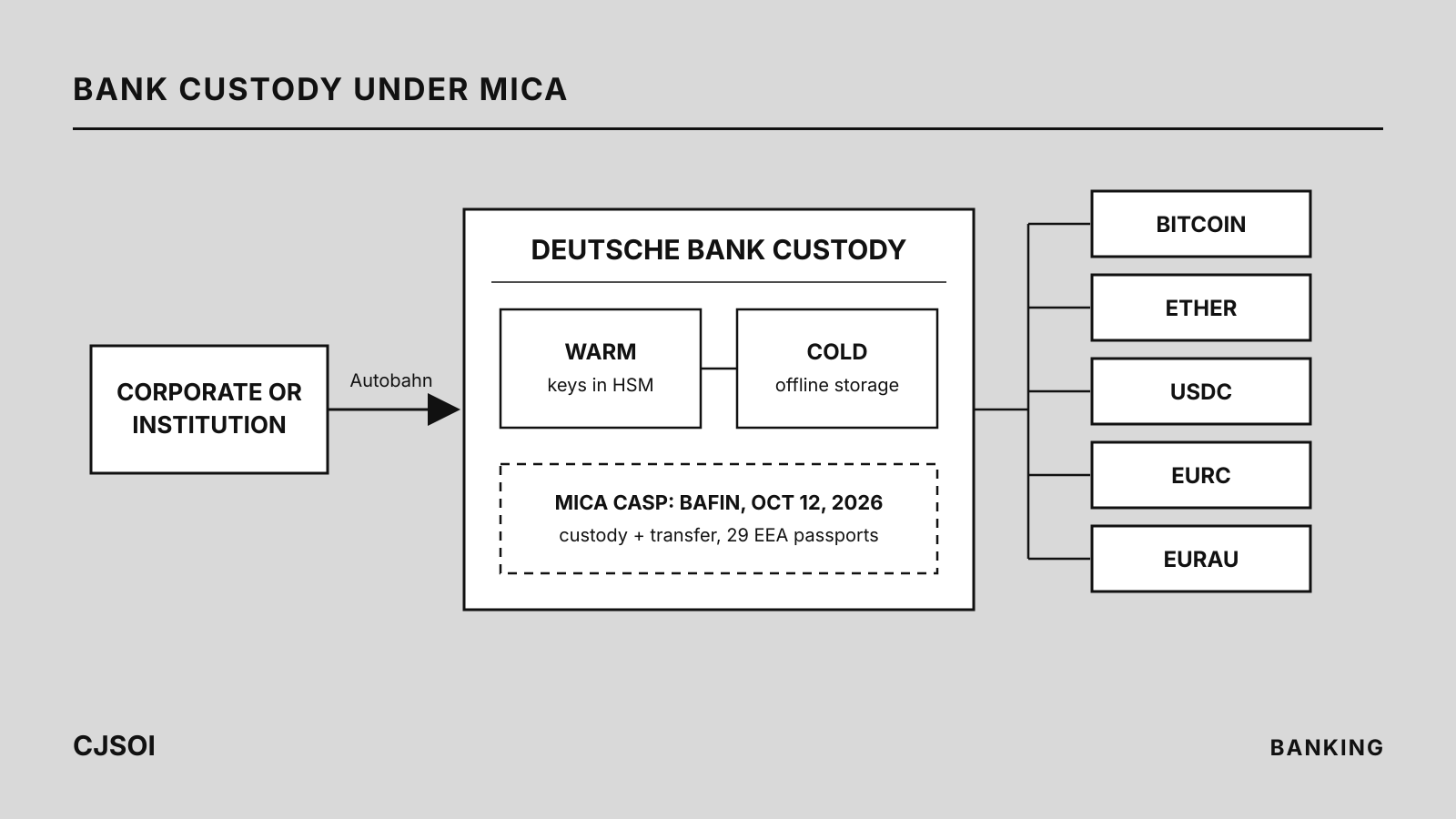
Deutsche Bank’s digital asset custody service is live. In a launch notice published on its corporate-banking site in November 2026, the bank said it had “officially launched” the service after receiving approval from Germany’s Federal Financial Supervisory Authority (BaFin). Corporate and institutional clients in Europe can now have the bank hold Bitcoin, Ether and three stablecoins, USDC, EURC and EURAU, and move them to third parties.
The service is not open to retail customers. When the bank first announced it on September 16, 2026, its media release said it was “not intended for retail clients.”
From announcement to launch
| Date | Step | Source |
|---|---|---|
| September 16, 2026 | Deutsche Bank announces the service, with go-live “this year” subject to the regulatory timeline | Deutsche Bank media release |
| October 12, 2026 | Authorization date in ESMA’s interim MiCA register: BaFin-authorized for custody and administration of crypto-assets and for transfer services | ESMA register entry |
| November 2026 | Launch notice: service live after BaFin approval | Deutsche Bank Corporate Bank |
The register entry also shows Deutsche Bank has notified ESMA that it intends to offer these two services in 29 other EEA countries under the MiCA passport. The bank’s service page describes the same set-up from the client side: available in Germany, with cross-border servicing across Europe passported out of Deutsche Bank AG in Frankfurt.
What clients can hold
| Asset | Type | Issuer and EU status |
|---|---|---|
| Bitcoin | Crypto-asset | No issuer |
| Ether | Crypto-asset | No issuer |
| USDC | Dollar e-money token | Circle; named the EU’s first significant e-money token by the EBA in October |
| EURC | Euro e-money token | Circle Internet Financial Europe SAS, an e-money institution licensed by France’s ACPR |
| EURAU | Euro e-money token | AllUnity GmbH, an e-money institution licensed by BaFin on July 1, 2025 |
Three of the five assets are stablecoins, and two of those are euro tokens. The bank says tokenized financial instruments will be added later and that any other asset depends on client demand and its product-approval, risk and regulatory processes. It gives no date for either.
The launch notice names the eligible clients as those of the Corporate Bank and Investment Bank: corporates, asset managers, hedge funds, custodians, brokers and sovereign institutions. The service page says clients reach it through Autobahn, the bank’s multi-channel gateway, or its Corporate Bank Portal.
How the keys are held
Deutsche Bank manages the wallets and private keys on the client’s behalf. According to the bank, keys are generated and protected in hardware security modules, key material sits in separate warm and offline cold storage, duties are split between staff, and more than one person must approve important actions. Clients can also set their own transfer-approval process, according to the service page. At launch the services are custody, transfers to third parties and internal moves between warm and cold storage.
What MiCA adds, and what it does not
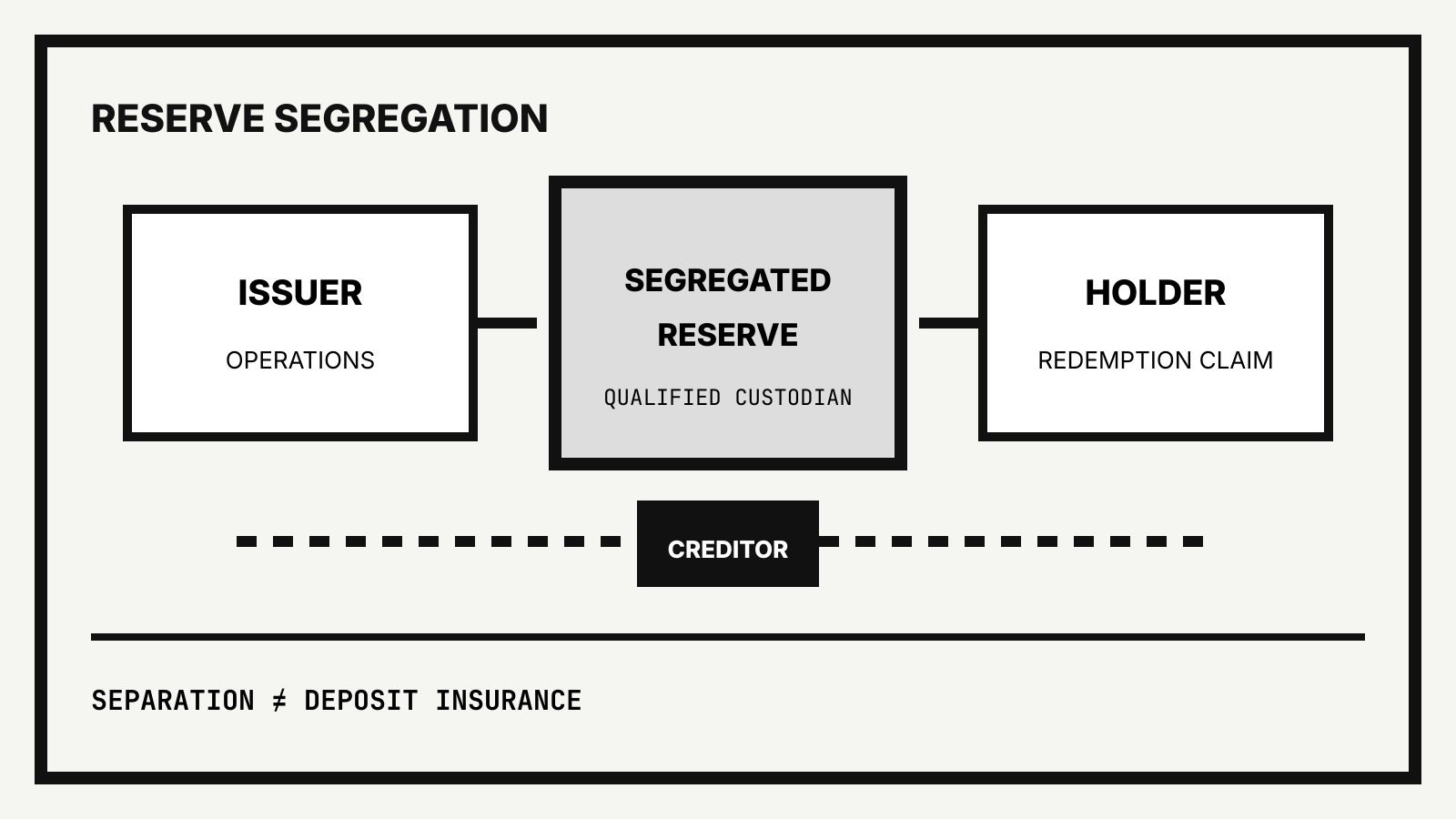
Because the bank is authorized as a MiCA custodian, Article 75 of the regulation applies. Client crypto-assets must be held separately from the bank’s own on the ledger and be legally segregated from its estate, so its creditors have no recourse to them in an insolvency. The custodian is liable for the loss of a client’s crypto-assets or access to them when the incident is attributable to it, capped at the market value of the lost asset at the time of the loss.
The bank’s notice is explicit about the limit: crypto-assets “are not covered by a deposit-guarantee scheme comparable to the protection applicable to eligible bank deposits.” A USDC or EURC balance held at Deutsche Bank is therefore not a deposit. Redemption at par remains a claim on the token’s issuer, not on the custodian. Our explainer on how banks hold digital assets sets out that split, and the MiCA license register lists the other firms authorized to provide custody in the EU.