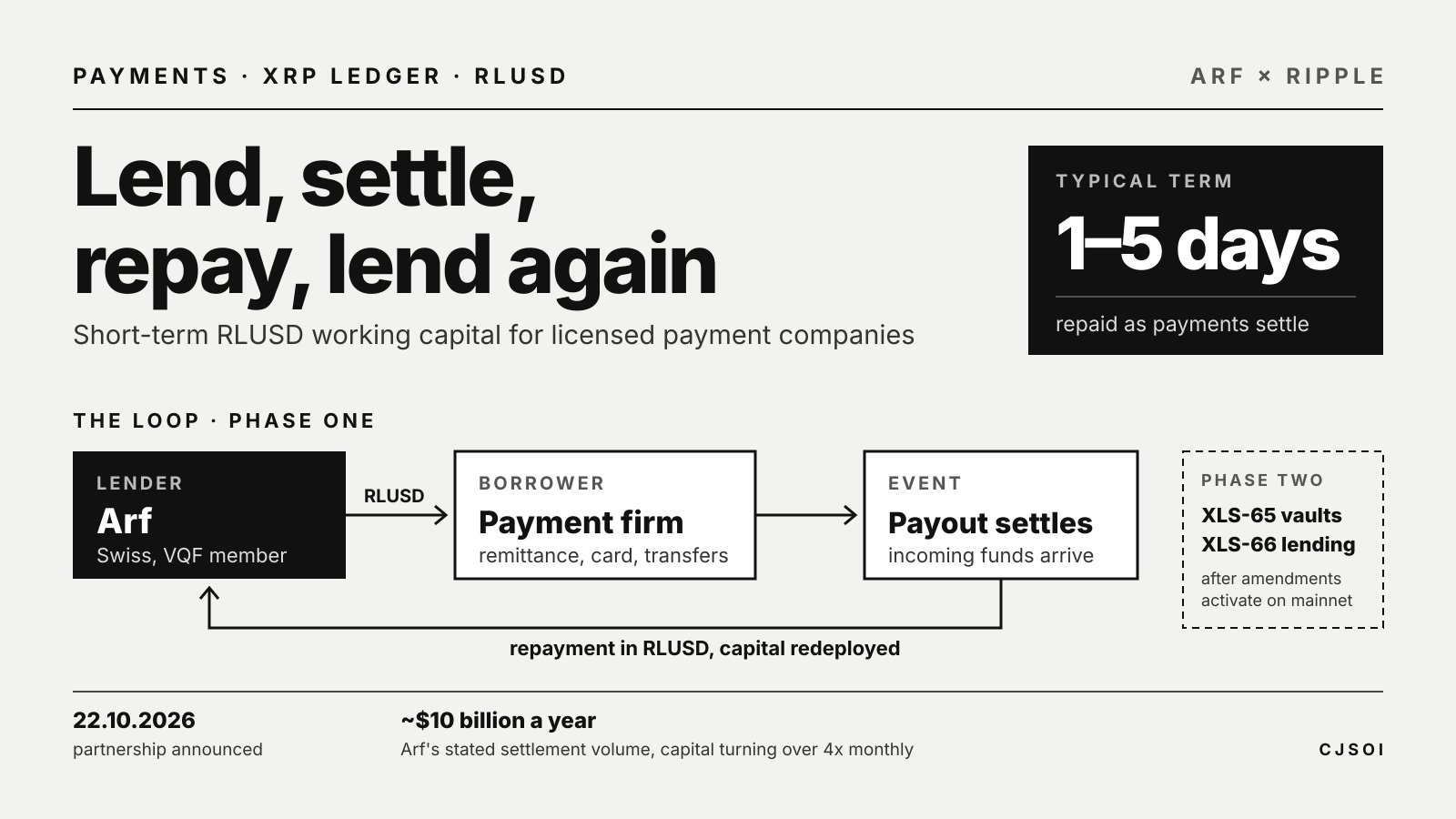
Arf, a Swiss-regulated provider of short-term working capital to payment companies, will lend Ripple’s dollar stablecoin RLUSD to licensed cross-border payment firms on the XRP Ledger (XRPL). The two companies announced the partnership on October 22, 2026, in Arf’s announcement.
The service targets payment, card and remittance companies that need money in place before their own incoming funds arrive. Arf says its settlement liquidity is typically repaid within one to five days as those cross-border payments settle, so the same capital can be lent again.
What changes in the first phase
In the first phase, Arf will provide RLUSD settlement liquidity directly on the XRPL. RLUSD is the asset used across the credit flow, from disbursement of the loan to its repayment, while XRP pays the ledger’s transaction fees and covers the reserve requirements that XRPL accounts and certain ledger objects carry.
Arf describes the problem it is solving in plain terms: a payment company has to pre-fund payouts in many markets while it waits for funds to settle, and bank credit lines “can take months to establish and typically require significant collateral,” according to the announcement.
Payment companies do not have to operate on a blockchain themselves, Arf says. It manages treasuries between fiat and stablecoins through its own bank accounts in major financial hubs, with the ledger running in the background.
Who Arf is and what it reports
| Item | What Arf states |
|---|---|
| Regulation | Swiss-regulated financial institution, member of VQF |
| Headquarters | Zug, Switzerland |
| Operating since | November 2022 |
| Settlement volume | About $10 billion a year |
| Capital turnover | About four times a month |
These figures describe Arf’s existing global business, not activity on the XRPL. The announcement does not say how much RLUSD Arf has committed to the new service, which payment companies will borrow first or when the first XRPL loan will be made. We have left those points out until the companies publish them.
The idea resembles the Visa Direct stablecoin prefunding that moved to production on October 15: in both cases a stablecoin shortens the wait for money that a payout business must hold in advance. In correspondent banking that money usually sits in nostro accounts at banks abroad.
The second phase depends on XRPL amendments
Arf plans to move more of the program onto the ledger’s proposed native lending tools once they are live. Two amendments are involved: XLS-65, which adds Single Asset Vaults that pool capital onchain, and XLS-66, a Lending Protocol that extends that capital as structured loans. Under that model, underwriting and credit decisions would stay with Arf offchain.
The announcement states that these capabilities “are subject to XRPL’s amendment process before they can become available on mainnet.” Arf says it has already built against the proposed protocol and will act as a design partner as the specifications progress.
“Through this partnership with Ripple, we’re bringing stablecoin working capital to the XRP Ledger to help payment companies bridge that gap and support more payment volume,” said Ali Erhat Nalbant, Arf’s co-founder and CEO. Jasmine Cooper, head of product for RippleX at Ripple, said in the same release that “RLUSD provides a regulated dollar stablecoin.”
Where RLUSD stands
The deal adds a credit use for RLUSD alongside custody and collateral plans announced earlier this month, when Standard Chartered began RLUSD custody through its DIFC branch. Issuer, reserve and redemption details for RLUSD and other dollar tokens are kept in our stablecoin list.