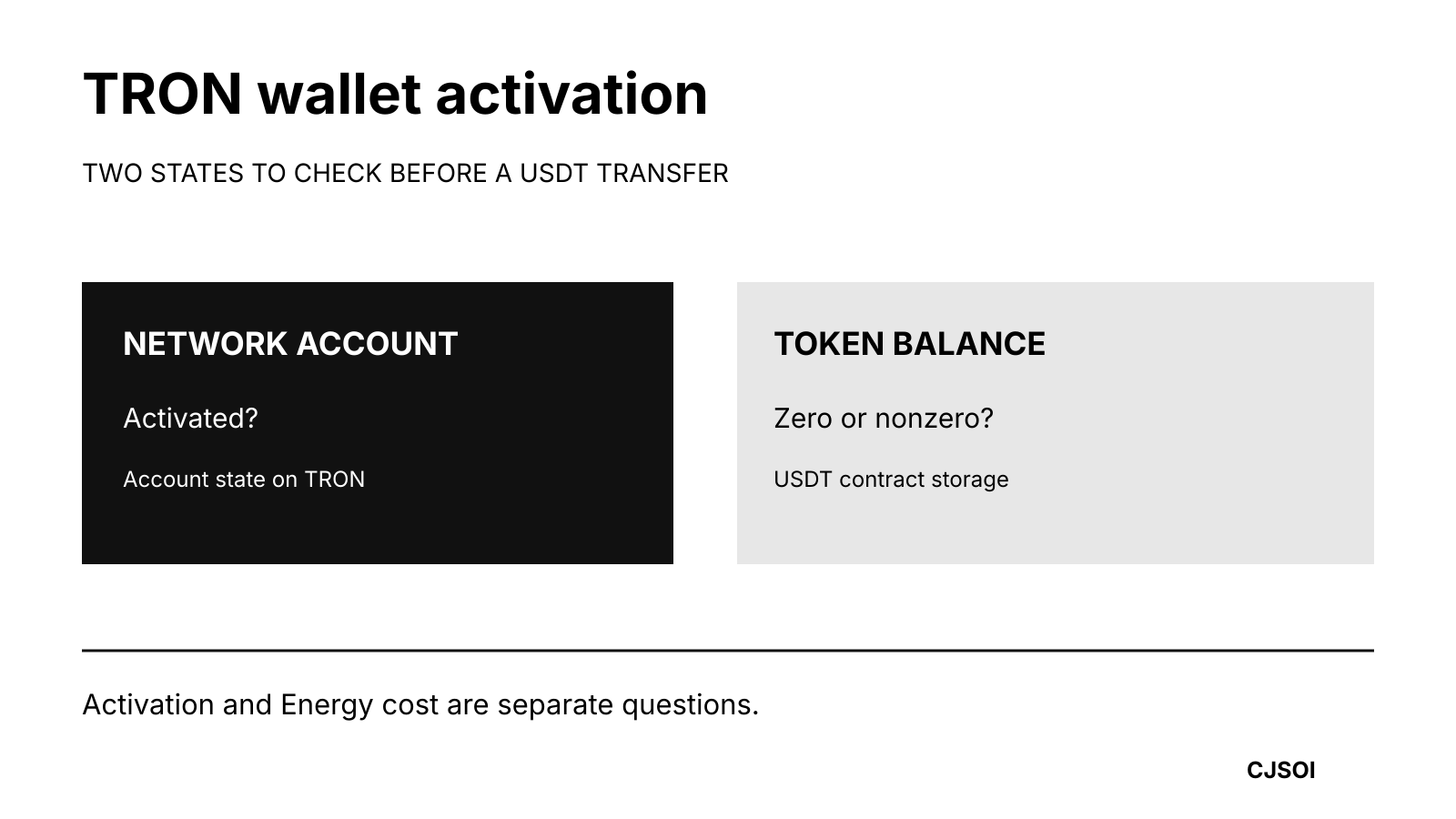
TRON wallet activation makes a locally generated address recognizable as an account on the network. It is separate from the USDT balance recorded by a token contract. That distinction explains why activating an address and estimating a USDT transfer are two checks, even when both concern a recipient who is new to TRON.
Generating an address is not activation
TRON’s accounts documentation distinguishes creating a key pair locally from activating the account on-chain. It describes standard activation through a transfer of TRX or a TRC-10 token from an existing account, or through the account-creation API.
A wallet can therefore show an address before an account query or explorer recognizes an activated account. Keep that state separate from possession of the key. An explorer lookup does not determine whether you have backed up access to the wallet correctly.
For a normal self-custody setup, first verify that the displayed receiving address belongs to the intended wallet and network. Do not use a sample address from documentation as your destination. If the recipient is an exchange or another service, follow that service’s current deposit instructions rather than attempting to configure its address as your own wallet.
The documentation also describes a separate contract-activation path involving a contract transferring TRX or TRC-10. Do not apply that description to every token transfer simply because tokens are handled by contracts.
Who pays for standard account creation?
The account documentation describes a sender-paid account-creation charge of 1 TRX and an additional 0.1 TRX when the activating sender lacks sufficient Bandwidth. These are documented chain-parameter values, not a permanent quote from a wallet or exchange.
TRON’s resource-payment documentation directs developers to current chain parameters for charges. A service can also have its own withdrawal pricing. An exchange’s displayed fee is a service quote; it should not be presented as the network’s account-creation charge.
For a planned activation, inspect the sending wallet’s operation and fee display before approving it. After broadcast, retain the transaction identifier and inspect the result. Do not send repeated transfers merely because the receiving screen has not refreshed.
The point of the activation step is an on-chain account state. It does not automatically supply the recipient with all resources needed for later smart-contract transactions.
Why a zero-USDT recipient can cost more Energy
TRON’s smart-contract troubleshooting documentation explains that recipient storage state can change the Energy cost of a TRC-20 transfer. Updating a balance slot from zero to nonzero can cost more than updating an already nonzero slot.
The page gives approximate USDT examples of 64,000 Energy for a recipient with a positive balance and 130,000 for a recipient with a zero balance. It expressly says the amounts fluctuate with the contract’s dynamic Energy factor. They are examples of different execution paths, not a fixed fee schedule.
That is a different condition from whether the address is activated. An account can exist on TRON while its USDT balance is zero. Conversely, a reference to token holdings should not replace the account-state check. The account documentation notes that TRC-20 balances are queried through the token contract or an index service rather than stored directly in the account object.
For a transfer estimate, ask which condition the wallet or service used: the actual recipient’s current token balance, or an assumed recipient type. An estimate for another address need not apply to this one.
Activation does not eliminate the next transfer’s fees
The TRON resource model separates Bandwidth, which covers transaction size, from Energy, which covers smart-contract execution. Where available resources do not cover an operation, TRX can be burned under the network’s charging rules.
Activating an account does not make all subsequent USDT transfers free. Likewise, sending TRX to a recipient does not by itself change that recipient’s zero USDT balance into a positive one.
This distinction matters when assessing a claim that a small activation transfer will halve every later USDT fee. Ask what mechanism the claim refers to and compare it with the actual state and current estimate. A network account, token storage and the sender’s available resources are separate inputs.
Our Energy and Bandwidth guide explains how those resources fit together. The TRON Energy data page holds the site’s maintained resource and service comparisons; use it for current context rather than treating a historical example as today’s quote.
A practical recipient check
Before moving funds, identify who controls the destination. For your own wallet, compare the address through the wallet and an explorer, and establish the account state. For a service deposit, use the service’s official network selection, deposit address and any stated conditions.
Next, inspect the transfer estimate using that destination. Keep the token amount separate from the network resource charge and any service charge. If the estimate differs from a previous transfer, compare recipient token state and contract conditions before assuming something is wrong.
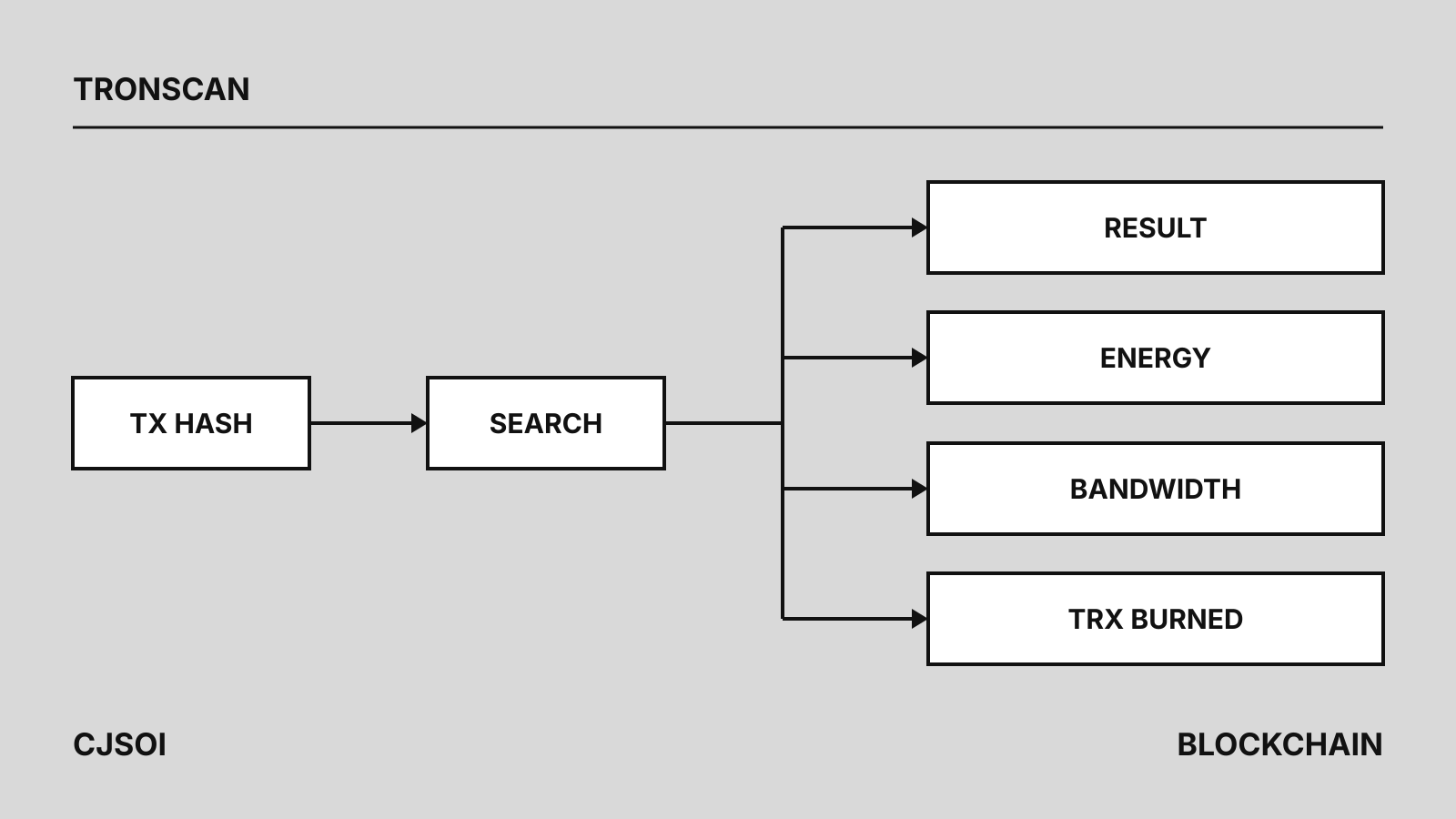
After submitting, check the transaction outcome before taking another action. A delayed display in a wallet is not proof that the network rejected the transfer. Our TRONSCAN guide explains how to read the transaction record.
There is no need to disclose a private key or recovery phrase to someone offering activation help. The account documentation describes activation as an operation involving a receiving address. Keep wallet-access secrets out of messages, support forms and websites.