The European Securities and Markets Authority (ESMA) said on October 8, 2026 that crypto-asset service providers (CASPs) authorized under MiCA should stop providing services in non-MiCA stablecoins to clients in the European Union. The press release accompanies an opinion addressed to national regulators (reference ESMA75-113276571-1742).
The opinion covers asset-referenced tokens (ARTs) and e-money tokens (EMTs), the two MiCA categories that stablecoins fall into. It does not name any token.
Which stablecoins count as non-MiCA
ESMA defines non-MiCA-compliant ARTs or EMTs as tokens for which the conditions for a lawful offer to the public or admission to trading in the EU under Title III or Title IV of MiCA, including any exemptions or transitional arrangements, are not met. Those titles carry the issuer-level rules: redemption rights, reserve or safeguarding requirements, governance, disclosure and supervision. For how those rules apply to dollar and euro tokens, see our explainer on MiCA and stablecoins.
What changes for service providers
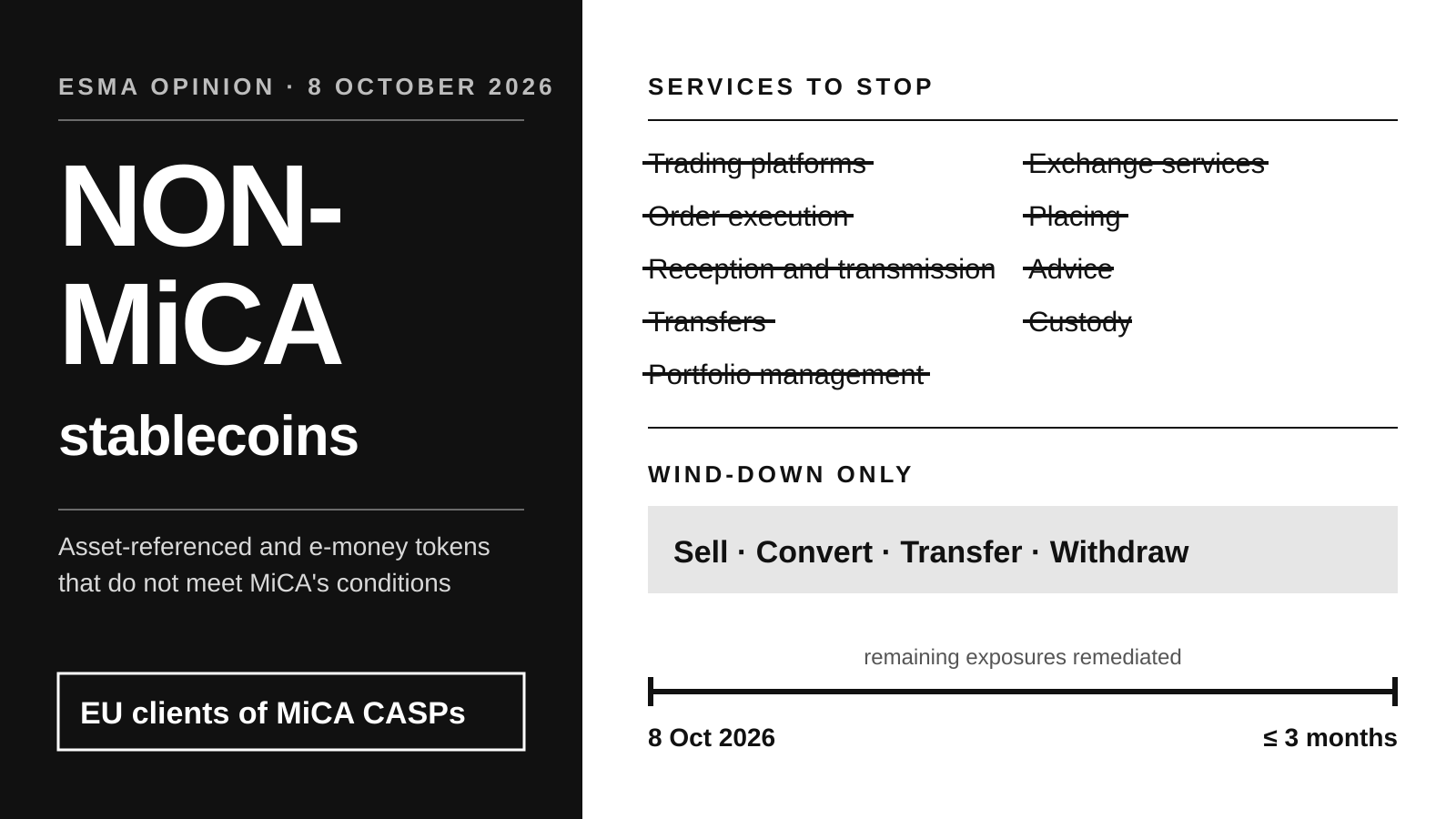
ESMA says the expectation applies to every crypto-asset service under MiCA, whether provided on its own or in combination:
- operating a trading platform, exchange services and order execution;
- placing, and reception and transmission of orders;
- advice and portfolio management;
- transfer services, and custody and administration.
CASPs “should not maintain, introduce or facilitate access” to these tokens for EU clients, and should put technical, contractual and organizational controls in place, including controls that stop clients from acquiring or increasing positions.
ESMA also rules out the disclosure route. In its view, warnings, disclosures or client acknowledgements would not address the risk, because they cannot replace the safeguards MiCA requires of issuers. It ties the expectation to Article 66(1) of MiCA, the duty to act honestly, fairly and professionally in clients’ best interests.
The opinion says it does not change the earlier position in European Commission Q&A 2404 and ESMA’s public statement on when a service amounts to an offer to the public or admission to trading. Its conclusion applies whether or not a given service meets that test.
What happens to existing holdings
The opinion allows a wind-down. National regulators may let firms that do not yet comply provide strictly limited residual services to avoid harm to clients: liquidation, conversion, withdrawal, transfer or safekeeping of existing holdings. Those services may not support new purchases, promotion, trading or continued market availability, and should be time-limited, communicated clearly to clients and closely supervised.
Where regulators find remaining legacy exposures, ESMA says they should require remediation as soon as possible and no later than three months after the opinion’s publication. During that period, continued services should be limited to sell-only, conversion, transfer or withdrawal functions.
For a holder in the EU, that means a MiCA-licensed platform holding such a token may offer a way to sell, convert or move it out, but not to buy more.
Who enforces it
The opinion is addressed to national competent authorities. ESMA asks them to check whether any authorized CASP in their jurisdiction provides services in non-MiCA stablecoins, and says it will monitor, with those authorities, how the opinion is applied. Firms authorized under MiCA, and the services each may provide, are listed in our MiCA license register; firms flagged for operating without a license are on the MiCA warnings list. Our stablecoin list shows each token’s issuer and regulatory status.
Questions
Does the opinion ban holding a non-MiCA stablecoin?
It is addressed to regulators and concerns services by authorized CASPs. It does not set rules for holders themselves.
Does custody count?
Yes. ESMA lists custody and administration and transfer services among the services covered.
How long do firms have?
Regulators should require remaining exposures to be remediated as soon as possible and no later than three months after publication.
Does ESMA name USDT or any other token?
No. The opinion and press release name no token or issuer.
Sources
- ESMA, “ESMA sets out supervisory expectations on services related to unauthorised stablecoins,” October 8, 2026
- ESMA, Opinion on the provision of crypto asset services in relation to non-MiCA-compliant asset-referenced tokens and e-money tokens, ESMA75-113276571-1742, October 8, 2026 (PDF)
More from the Regulation desk.